

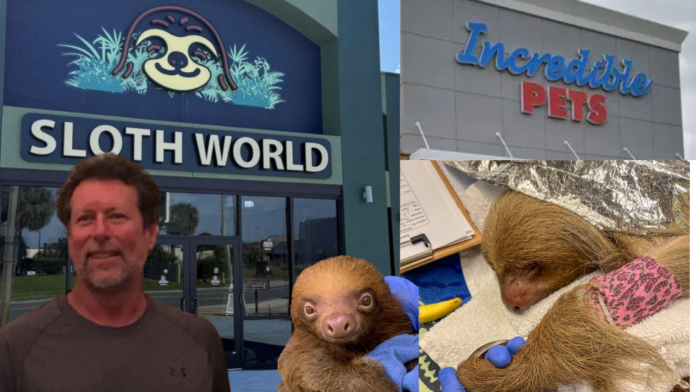
MELBOURNE, Fla. — The man Brevard County has celebrated for four decades as the savior of its sea turtles is now named in a Florida Attorney General criminal investigation and a People for the Ethical Treatment of Animals (PETA) cruelty complaint over the deaths of dozens of wild sloths in an unheated Orlando warehouse located in the parking lot of a karaoke bar.

Peter A. Bandré, founder of the Sea Turtle Preservation Society and longtime president of Incredible Pets Inc. on North Wickham Road, served as Vice President of Sloth World Inc., the now-bankrupt International Drive attraction tied to the deaths of as many as 52 sloths. Florida Attorney General James Uthmeier announced May 1 that his office is assisting the Ninth Judicial Circuit with an “ongoing criminal investigation” into the operation, and PETA filed an April 30 complaint with the Florida Department of Law Enforcement seeking aggravated animal cruelty charges against Bandré and Sloth World owner Benjamin Agresta.
The story has been covered by national outlets including Inside Climate News, the BBC, the Associated Press, and Newsweek. None has reported the Brevard County dimension: that the man at the operational center of the Sloth World scandal is the same person whose name graces the founding history of one of the Space Coast’s most beloved conservation nonprofits, an organization preparing to celebrate its 40th anniversary on May 6, three days from the date of this report.
A Space Coast Rocket review of Florida Department of State corporate records, combined with a comparison of archived and live versions of websites that previously featured Bandré, reveals what appears to be a sequence of removals of his name from the public record: first from corporate filings six weeks before the story broke, then from the Sloth World website itself one week after, and from biographical material about him on the Sea Turtle Preservation Society website at some point in this same window.
What the Florida Fish and Wildlife Conservation Commission Found
According to a Florida Fish and Wildlife Conservation Commission (FWC) incident report obtained by Inside Climate News through an open-records request, the sequence of events began on December 18, 2024, when 21 sloths captured from the wild in Guyana were delivered to a storage unit at 7547 International Drive in Orlando. According to reporting by Orlando Shine, that storage unit is located in the parking lot of Oh Shucks Pub and Karaoke Bar. The unit had no electricity, no running water, and was not climate-controlled.

Bandré, who was the licensee of record for the import facility operating as Sanctuary World Imports, told FWC investigators the building was not ready for the animals but said it was too late to cancel the shipment. Space heaters were powered through an extension cord run from a neighboring building. The fuse tripped overnight, leaving the sloths without heat as outside temperatures fell into the 40s. By December 22, all 21 were dead.
A second shipment arrived from Peru in February 2025. Two of the 10 sloths were dead on arrival. The remaining eight were described in the FWC report as emaciated and in very poor health. None survived. According to Mongabay and other reporting, total deaths reached as high as 52 of approximately 69 sloths imported.
The FWC closed its civil investigation without issuing a citation, written warning, or violation, concluding the deaths did not meet the threshold for state wildlife enforcement action. That decision drew sharp public criticism from state Rep. Anna Eskamani, U.S. Rep. Maxwell Frost, and PETA, all of whom argued the conduct met the threshold for criminal animal cruelty under Florida law even if it did not violate FWC regulations.
The PETA Complaint: Bandré “Wrote the Leading Textbook on Sloth Care”
PETA’s April 30 complaint to the Florida Department of Law Enforcement seeks criminal charges against Bandré and Agresta under Florida Statute 828.12(2), which makes it a third-degree felony to own or have custody of any animal and fail to act in a way that results in cruel death.
The complaint pulls no punches in describing Bandré’s expertise as an aggravating factor rather than a mitigating one. PETA argues that Bandré markets himself as a “sloth expert” and the author of the leading textbook on sloth care, and that he “more than most” should have known an unelectrified storage unit was an unfit enclosure for rainforest-dwelling animals.
“Bandre and Agresta had every reason to know that keeping sloths in the storage unit was likely to cause the animals harm,” the complaint states. “Nonetheless, Bandre and Agresta moved ahead with their plan to keep 21 sloths in a completely unsuitable and patently dangerous environment.”
The book the complaint references, Nurturing the Unique Treasures of Nature: A Practical Guide to Caring for Two-Toed Sloths in Captivity, is sold on Amazon under the author name Pete Bandre.
The Paper Trail: A Quiet Erasure
National outlets reporting on Sloth World have consistently described Bandré as a “former” Vice President of the company or as someone who “has since left.” That framing comes from statements Sloth World owner Benjamin Agresta made to FWC inspectors during a follow-up visit in early 2026. The Florida Department of State corporate record tells a more specific story.
Sloth World Inc. (Document P24000072906) was incorporated December 2, 2024, sixteen days before the first 21 sloths arrived in Guyana and died at the warehouse. The company filed its 2026 Annual Report on January 15, 2026, six weeks into the new year, listing two officers under penalty of perjury: Benjamin R. Agresta as President and Pete Bandre as Vice President. At that point, all 31 documented sloth deaths had already occurred. The FWC’s August 2025 incident report documenting Bandré’s admissions about the warehouse conditions had already been written. Conservation groups had publicly criticized Sloth World’s wild-caught sourcing on January 21, 2026, less than a week after the filing.
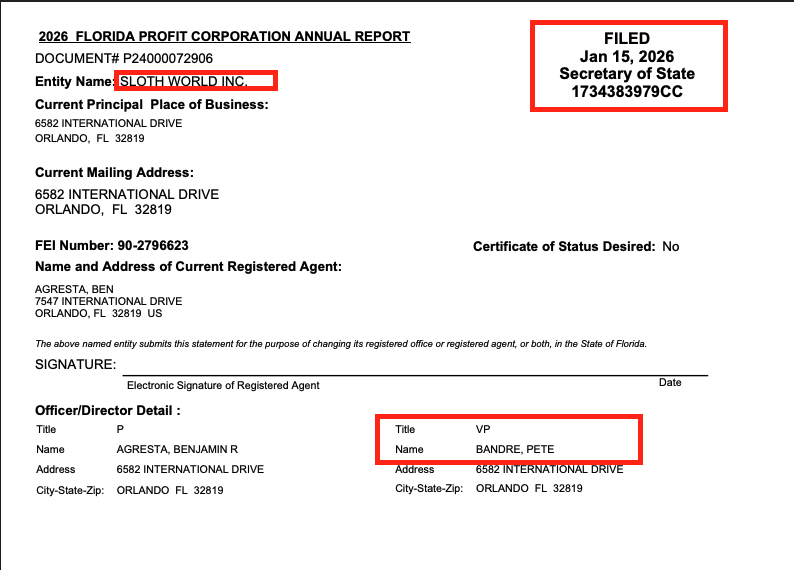
On March 6, 2026, Sloth World Inc. filed an Amended Annual Report with the Florida Secretary of State. The amended filing removed Bandré’s name entirely from the corporate record. Where the January report had listed two officers, the March amendment listed only Agresta as President. The Vice President position was deleted, not replaced.
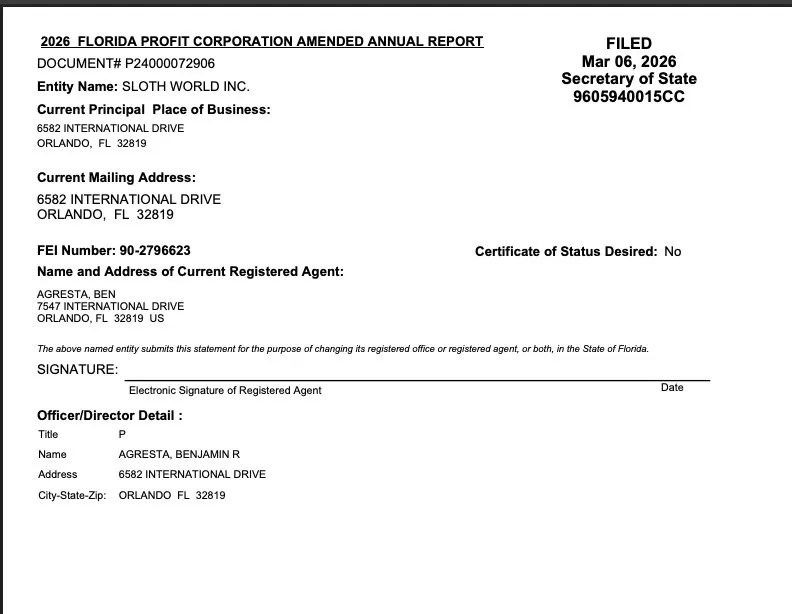
That amendment was filed 41 days before Inside Climate News published the investigation that made the sloth deaths national news on April 16, 2026. It was filed in the same window that Agresta first told FWC inspectors during a follow-up visit that Bandré was “no longer affiliated” with the business. The general public did not yet know about the deaths. The FWC’s August 2025 incident report had not yet been released through the open records request that would eventually surface it. But Bandré’s name had already been erased from the corporate filing.
The Online Trail Vanishes Too
The corporate paperwork was not the only place Bandré’s name began disappearing in the weeks before the story broke.
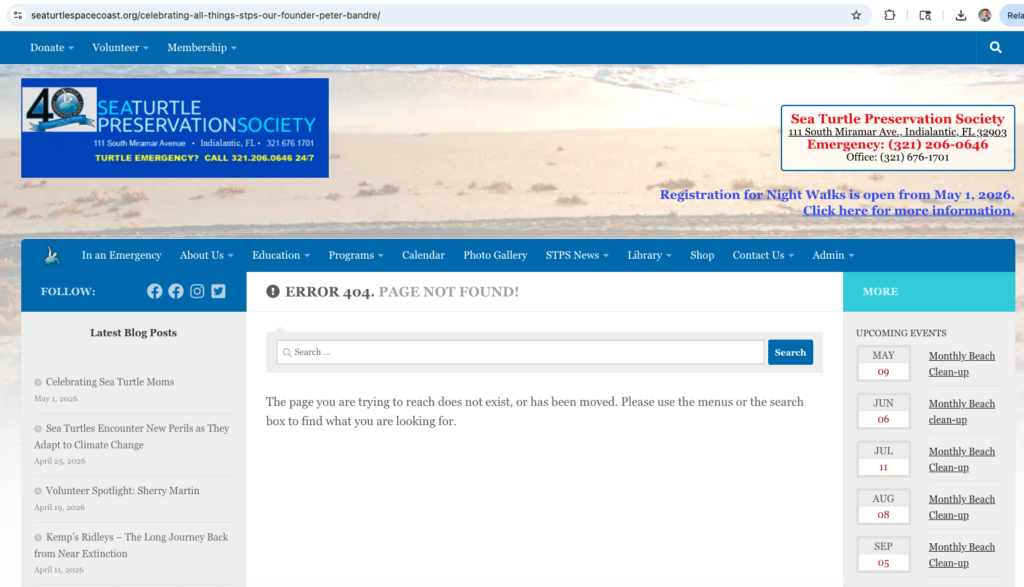
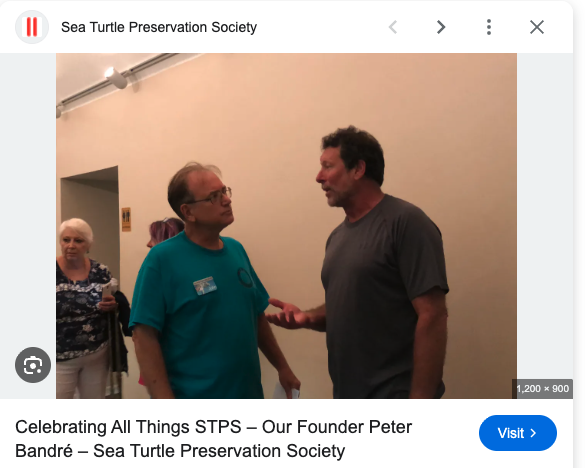
The Sea Turtle Preservation Society page titled “Celebrating All Things STPS — Our Founder Peter Bandré,” a 2020 biographical tribute by longtime STPS member Donna Braunlich, was indexed by Google as recently as February 2026 and contained two photographs of Bandré at STPS events from November 2018. As of this report, the page returns a 404 error. The article it contained has been removed from the live STPS site. Google’s search index still references the page, but the content is gone.
The Space Coast Rocket conducted reverse image searches for photographs of Bandré using multiple search engines. Image search results that appear to display Bandré now return broken or 404 links when followed back to their original sources. His personal social media presence appears to have been substantially reduced. Standard search-engine searches that should turn up dozens of photographs from a four-decade public conservation career instead return only a handful of broken thumbnails.
Sloth World’s own website went further. According to Attractions Magazine, on April 23, 2026, one week after the Inside Climate News investigation became national news, slothworld.com was wiped of all previous content and replaced with a placeholder page reading “PARDON OUR DUST! WE’RE WORKING ON SOMETHING AMAZING — CHECK BACK SOON!” The company’s linked LinkedIn, Facebook, and Instagram accounts were emptied of public content. The team page that had previously identified Bandré as Vice President and Head of Animal Care, and as “one of the most respected sloth experts in the world,” is no longer publicly accessible. Search-engine caches from January 2026 still display the prior content, but the live website does not.
The Brevard connection remains in plain view in the public record. STPS still names Bandré as its founder. Incredible Pets Inc. is still listed under his name on Better Business Bureau and Florida corporate records. But the photographs, the biographical tribute, the corporate Vice President title, and the Sloth World team page bio have all quietly vanished from the places where reporters and members of the public would most easily find them.
The Brevard Connection
Bandré’s identity in Brevard County is as fixed as the Indialantic Boardwalk where it began. According to the Sea Turtle Preservation Society’s own official history, in 1982 a then 24-year-old Bandré, a contractor newly arrived from the Philadelphia area, stopped for coffee at the beach in Indialantic and discovered 50 to 60 dead sea turtle hatchlings in the parking lot. The hatchlings had crawled toward streetlights instead of the ocean.
That morning launched a four-decade conservation career. Bandré obtained the first state stranding-and-rescue permit in the area, and on May 6, 1986, the Sea Turtle Preservation Society was incorporated as a Florida 501(c)(3). He served as the organization’s founder and president for nine years, according to his own LinkedIn profile, before leaving in 1994 to launch Incredible Pets Inc. on Wickham Road.
STPS still honors him on its website and in 2021 named a satellite-tagged male green sea turtle “Peter” in his honor for the organization’s 35th anniversary. As recently as March 2026, Spectrum News 13 ran a feature on STPS’s 40th anniversary that opens with the story of Bandré’s discovery on the Indialantic beach. The organization’s 40th anniversary tribute page, published March 22, 2026, identified him as “first and foremost” among the volunteers being honored.
National Wildlife Magazine profiled him in 1991. The Washington Post quoted him in 1988 in a story about a high-profile clash with Gannett Company president Allen Neuharth over Cocoa Beach lighting ordinances. Bandré received an outstanding achievement award from the National Marine Fisheries Service for his sea turtle work.
Following the Money: Conservation Reputation, For-Profit Pipeline
The Sea Turtle Preservation Society has paid Bandré nothing in over three decades. According to IRS Form 990 filings reviewed on ProPublica’s Nonprofit Explorer, the organization has reported zero executive compensation every year on record going back to at least 2002. Bandré is not listed on any STPS 990 as a director, officer, or compensated employee.
What STPS gave him was credibility. And Bandré built a series of for-profit ventures on top of that credibility, all centered on the buying, breeding, importing, and selling of exotic animals.
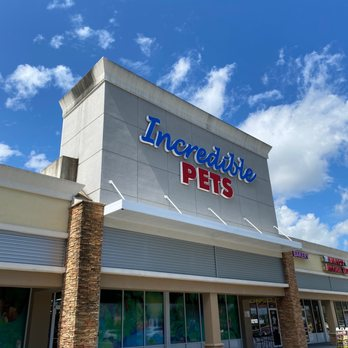
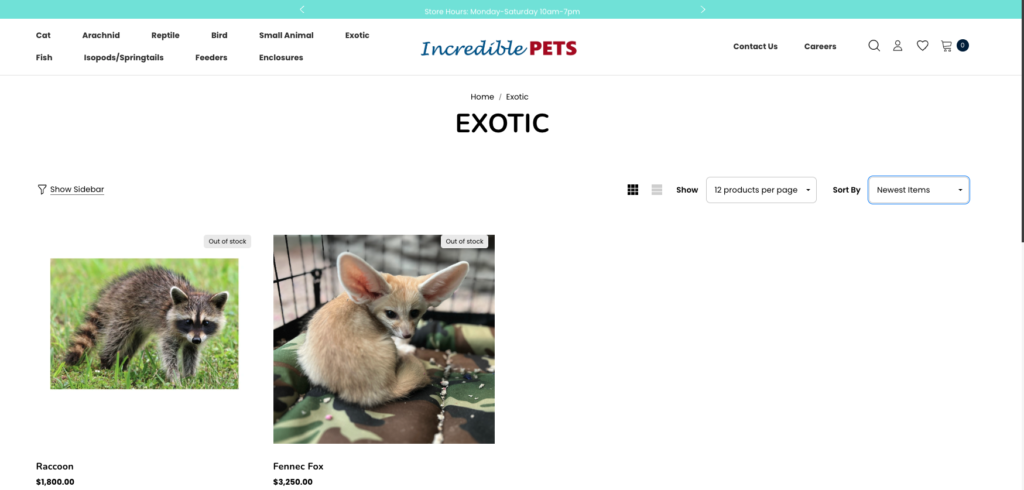
Incredible Pets Inc., the Melbourne pet store he co-founded in 1992 and operated until reportedly selling the business in 2021, became one of the country’s larger documented sloth importers. According to government records reviewed by Inside Climate News, the company brought at least 80 sloths into the United States between 2011 and 2021. A 2017 Incredible Pets Facebook post quoted by Inside Climate News read: “It’s going to [be a] baby sloth Christmas.” When a commenter wrote “I need a baby sloth for Christmas,” the company responded: “Do you want one? We can get you one.”
According to the Orlando Shine investigation, Bandré was making weekly trips to Miami in 2024 and 2025 to pick up new sloths for the Sloth World pipeline, “arriving with three or four animals at a time at an estimated cost of $300-400 per animal.”
The Sloth Conservation Foundation and The Sloth Institute have flagged that Bandré is the administrator of a Facebook group focused on private sloth ownership and captive husbandry. He also published Nurturing the Unique Treasures of Nature, the sloth care book PETA’s complaint cites as evidence of his expertise.
What Happens Next
The 13 sloths who survived Sloth World were surrendered to the Central Florida Zoo and Botanical Gardens. At least two of those 13 have since died, including Bandit, the sloth the zoo described as having arrived in the most critical condition and an adult female named Habanero. Sloth World has filed for bankruptcy. Orange County issued a stop-work order on the warehouse for building code violations. The U.S. Department of Agriculture has confirmed that neither Sloth World nor Sanctuary World Imports held the federal license required to exhibit animals to the public.
The Central Florida Zoo’s running public log of the survivors’ care reads as a chronicle of how hard the zoo’s veterinary team has fought to undo what the warehouse on International Drive set in motion. On April 25, all 13 sloths had survived their first 24 hours, with several requiring more focused attention for dehydration and low body weight. By April 27, Bandit was identified by name in guarded condition, too weak to climb, kept in a padded enclosure so he would not fall far if he tried. On April 28, day four of quarantine, he had made it through another night with his status hour by hour. On April 29, he was euthanized. On April 30, the zoo announced an unconventional treatment effort: a shipment of fecal samples from healthy sloths at the Los Angeles Zoo, used to perform fecal microbiota transplants on the surviving animals to restore the gut bacteria the warehouse conditions had stripped from them. On May 1, Habanero was reported in critical condition. On May 3, the zoo announced he had been humanely euthanized after his condition declined despite earlier signs of stabilization. Eleven sloths remain in the zoo’s care. Two are in guarded condition. According to the zoo, every sloth that arrived was underweight, every sloth is being treated for gastrointestinal issues, and many will require lifelong human care to have any chance of surviving the conditions they were taken from the wild to endure.
Rep. Eskamani has indicated she is working on legislation to strengthen FWC oversight of captive wildlife, including a requirement that all animal deaths under applicable permits be reported publicly and a pause on permit renewal until investigations into deaths are completed.
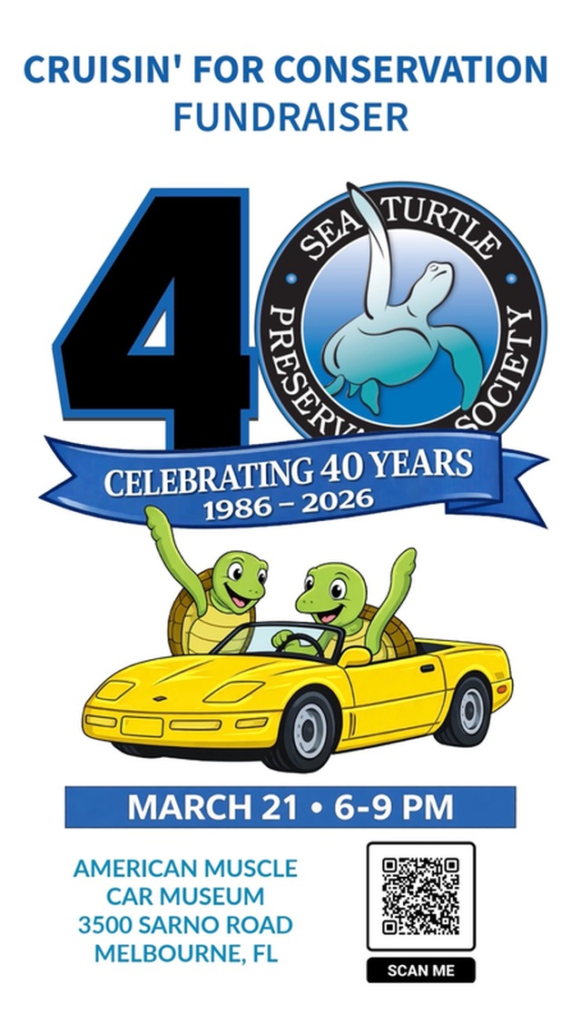
Three days from the publication of this report, on May 6, 2026, the Sea Turtle Preservation Society will mark 40 years since its incorporation.
Correction (May 4, 2026): An earlier version of this article incorrectly described Bandit’s age. The Central Florida Zoo has clarified that Bandit was not a three-month-old sloth. The article has been updated to reflect the zoo’s own description of Bandit as the sloth that arrived at the zoo in the most critical condition. The Space Coast Rocket regrets the error.
The Space Coast Rocket has filed public records requests with the Florida Fish and Wildlife Conservation Commission, the Office of the Florida Attorney General, the Ninth Judicial Circuit State Attorney’s Office, the Florida Department of State Division of Corporations, and the U.S. Department of Agriculture’s Animal and Plant Health Inspection Service. This is a developing investigation. Tips welcome at the contact information below.
Criminal Defense
Bankruptcy · Evictions
WICKS LAW P.A.
Call or text for
free consult
321-733-2700
Eric Wicks, Esq.
1250 West Eau Gallie Blvd. G
Melbourne, FL 32935
Abogado Wicks habla español