

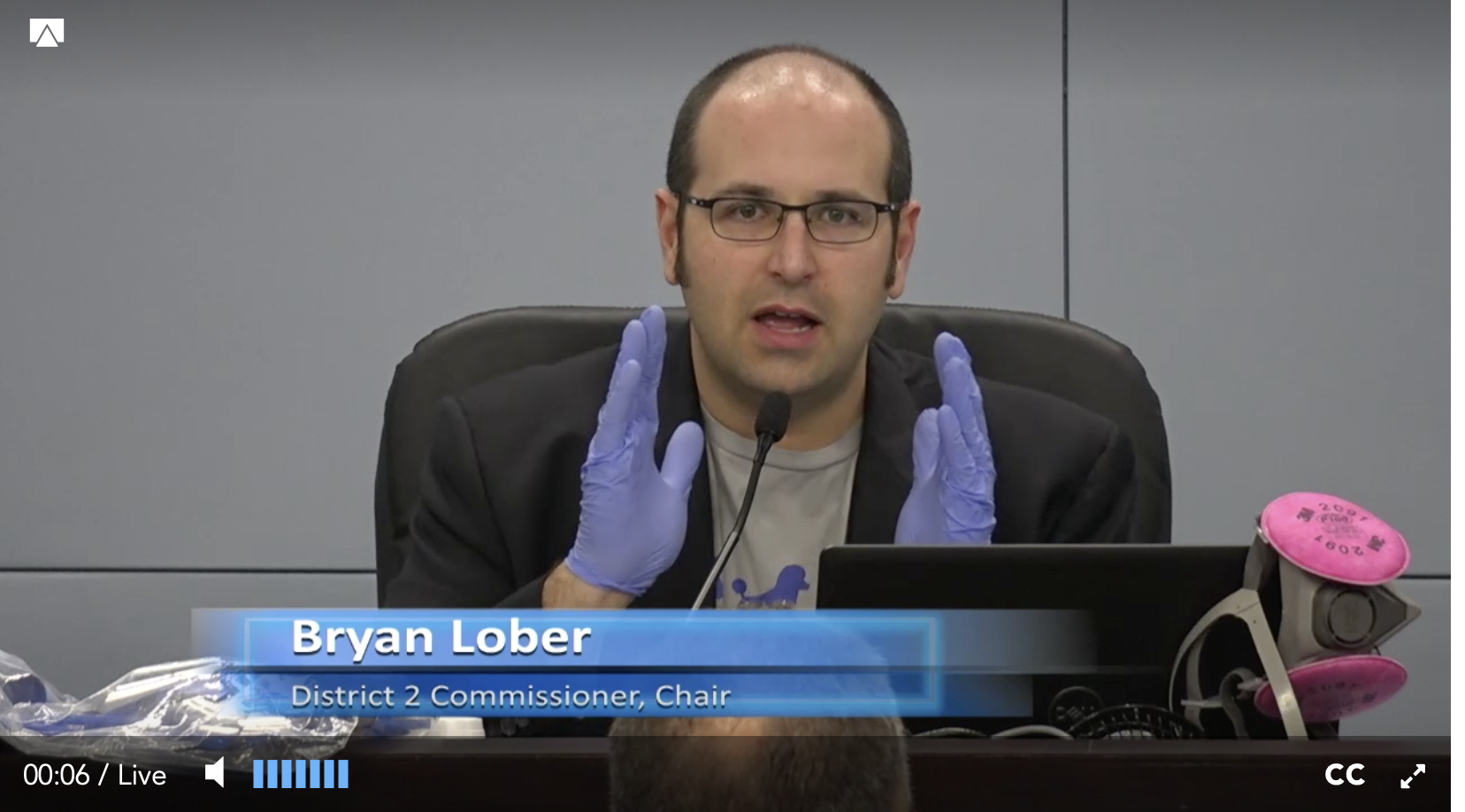
An administrative law judge has recommended that the Florida Commission on Ethics dismiss its case against former Brevard County Commissioner Bryan Lober. The case centered on the County’s tax-exempt certificate being used on campaign purchases from a woodworking supplier. It is the latest turn in a saga that began with a 2022 audit, led to his resignation from the County Commission, and drew a statement from State Attorney Phil Archer that Lober would have been prosecuted if time had not run out.

Judge James H. Peterson III of the Division of Administrative Hearings signed the 16-page recommended order on September 15, 2026. He found the Commission’s advocates did not prove by clear and convincing evidence that Lober used the certificate or acted with corrupt intent.
The recommendation is not the final word. The Ethics Commission will make the final decision.
How It Started: The Audit and the Resignation
The case traces back to February 2022. An anonymous email to commissioners, county officials and the news media questioned spending by Lober’s District 2 office with its county purchasing card, which totaled nearly $40,000 over two years. The County Commission then asked Clerk of Court and Comptroller Rachel Sadoff to audit purchasing card use across all five commission offices.
Weeks into the audit, Lober announced his resignation, effective April 1, 2022, claiming it was due to a death in his family.

In November 2022, the Clerk’s office contacted the Florida Department of Law Enforcement. The audit had turned up information that Lober may have bought personal items with county funds, kept county property after leaving office, and used the County’s tax-exempt certificate to avoid sales tax.
State Attorney: He Would Have Been Charged
FDLE sent its findings to the 18th Judicial Circuit State Attorney’s Office in May 2024. In July 2024, prosecutors announced no criminal charges would be filed.
Chief Assistant State Attorney Stacey Salmons concluded the evidence was insufficient for grand theft and scheme to defraud. A key reason was that county purchasing card rules at the time applied to staff but not to commissioners.
On the tax exemption allegation, the office said there was evidence Lober committed the offense, but the statute of limitations had already expired on April 1, 2024. Archer said that if not for the expired deadline, Lober “would have faced criminal prosecution for the felony crime of Fraudulent Claim of Tax Exemption.”
Ethics Commission Finds Probable Cause
FDLE referred the matter to the Ethics Commission. In April 2025, the Commission found probable cause that Lober misused his position and abused his office for a disproportionate benefit. The allegations involved his county purchasing card and the County’s tax-exempt certificate on purchases tied to his reelection campaign. The Space Coast Rocket reported on the probable cause order and related investigative records.
The Commission sent the case to the Division of Administrative Hearings in April 2026. By the June 29, 2026 hearing, the case had been narrowed to three purchases from Rockler.com. The orders were placed March 20, July 25 and July 27, 2021, under the account rockler@bryanlober.com. They were paid with Lober’s campaign card and listed on his campaign finance reports as sign-building tools and supplies, and no sales tax was collected.
The Email Signed “Bryan”
The central piece of evidence was a March 20, 2021 email to Rockler from loberb@gmail.com, the address Lober lists on his Florida Bar profile. It said the writer had spoken with a customer service representative named Marilyn. It said the order was for “my employer (Brevard County Board of County Commissioners),” and it gave the County’s exemption certificate number. It asked Rockler not to process the order unless the exemption could be applied. It was signed “Truly, Bryan.”
Lober testified he did not write it. “It’s my email address that I and my wife use. I did not author that email,” he told the judge.
The judge asked Lober whether he was suggesting his wife wrote the email, and Lober answered, “Yes, sir.” Minutes later, under questioning from the Commission’s advocate, he said he was “not indicating that my wife wrote that specific email.” He said he understood she wrote an email to Rockler around that date but did not know whether it was the one in evidence.
When the advocate pointed to the signature and asked whether his wife’s name was Bryan, Lober replied, “No, that would be rather troubling if it were.”
Lober testified he asked his wife to place the March order “for the D2.” He said he did not recall whether he or she placed the two July orders. “I may well have, I probably did,” he said. He attributed the lack of tax on the July orders to an error by Rockler.
“I can tell you to an absolute certainty, I did not ask her to do that,” Lober said of using the tax exemption.
Rebecca Lober’s Statement and the Fifth Amendment
Lober’s defense rested largely on a notarized statement from his wife, Rebecca Lober, dated September 5, 2025. She is also an attorney. In the statement, she said her husband asked her to order “certain materials.” She wrote that she misheard “for the D2 campaign” as “for D2” and believed the purchase was County business. She said she used his County office address and phone number and emailed the vendor asking that the County’s certificate be applied.
The statement does not name Rockler, give a date, or quote the email. Asked at the hearing whether she referred to Rockler by name, she said she did not recall.
Rebecca Lober testified she was employed by the Brevard County Clerk of Court’s office while her husband was on the commission. Sadoff later testified that Rebecca Lober had served as general counsel for her office.
Questioned by Assistant Attorney General Joseph Burns, Rebecca Lober invoked her Fifth Amendment right against self-incrimination repeatedly. She invoked it when asked:
- How she recognized the email
- Whether she spoke with Marilyn at Rockler
- Whether she made the March 20, 2021 purchase
- Whether she was familiar with the rockler@bryanlober.com account
- Whether she made later Rockler purchases
- Whether she ever told FDLE, the State Attorney’s Office or the Ethics Commission she made the purchases
- Where she obtained the County’s tax-exempt certificate number
Asked whether she had ever used the Rockler account for personal purchases, she answered, “I’m not aware of doing so.” The email says its writer had used the account for personal purchases in the past.
Under questioning from Lober’s attorney, William Spicola, she testified she placed “an order,” believed it was for County business, and sent the County’s certificate. When Burns then showed her the March 20 Rockler order number and asked about the date and company, she again invoked the Fifth. Asked why she waited until September 2025 to give a statement, she said nobody had questioned those issues before.
No Witness With Personal Knowledge
Sadoff testified she was aware of facts and circumstances suggesting the certificate had been misused. On cross-examination she acknowledged she did not see anyone send the email and had never spoken with Lober about the Rockler purchases.
Ethics investigator Robert Malone testified he believed Lober sent the email because it was in his name and nothing pointed to anyone else. He said no one ever brought up Rebecca Lober during the investigations. He also acknowledged he never interviewed anyone from Rockler and did not subpoena Rockler records. He described his investigation as largely a review of FDLE’s work.
Malone testified that Lober’s attorney told him Lober did not want to give a sworn interview. Lober’s side asked for written questions, and the Commission declined. Lober testified he was not willing to sit down with FDLE, calling the audit investigation “a witch-hunt.”
Lober’s campaign paid $134.77 in back sales tax to the Florida Department of Revenue through a voluntary disclosure dated February 19, 2025. That was after FDLE’s referral to the Ethics Commission.
What the Judge Found
When he admitted the email into evidence over the defense’s objection, Peterson noted there “may be some problem with tying this to Mr. Lober.”
In his recommended order, the judge found no witness with personal knowledge showed that Lober wrote or sent the email, or that he requested the tax exemption on any of the three orders. He found Rebecca Lober’s statement and testimony consistent with her husband’s denial. He also found that her invoking the Fifth Amendment “did not repudiate” her notarized statement.
As for the July orders, he found no email, order note or other record showing anyone requested tax-exempt treatment. He also found the late tax payment did not establish corrupt intent.
Several of the judge’s findings of fact closely track, and in places repeat word for word, the proposed recommended order Spicola filed on August 21. At the end of the hearing, the judge had asked both sides to address whether Rebecca Lober’s use of the Fifth Amendment could support an adverse inference. The recommended order addresses her invocation in its findings of fact but contains no separate legal conclusion on that question.
The Commission’s advocates had asked the judge to find that Lober violated state ethics law and the Florida Constitution. They sought a $5,000 civil penalty and a public censure and reprimand. They argued his denial was not credible and that Rebecca Lober’s testimony should be excluded on the points where she refused to answer.
What Happens Next
Both sides have 15 days from September 15 to file written exceptions with the Ethics Commission, which puts the deadline around September 30. The Commission will then consider the recommended order at a future meeting and issue a final order.
Under Florida’s Administrative Procedure Act, the Commission can reject or modify the judge’s findings of fact only if they are not supported by competent, substantial evidence. It has more latitude to change conclusions of law but must explain its reasoning in writing.
If the Commission adopts the recommendation, the case against Lober will be dismissed. If it finds a violation, penalties available for a former public officer at the time of the conduct include a public censure and reprimand, a civil penalty of up to $10,000, and restitution. Either side may appeal the final order to a Florida district court of appeal.
The Space Coast Rocket will continue to follow the case.
Criminal Defense
Bankruptcy · Evictions
WICKS LAW P.A.
Call or text for
free consult
321-733-2700
Eric Wicks, Esq.
1250 West Eau Gallie Blvd. G
Melbourne, FL 32935
Abogado Wicks habla español