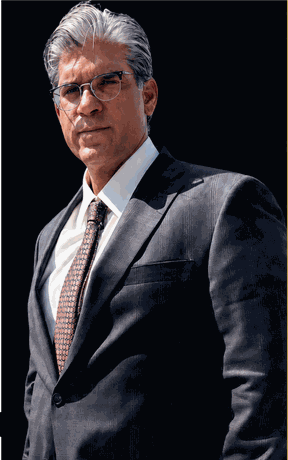

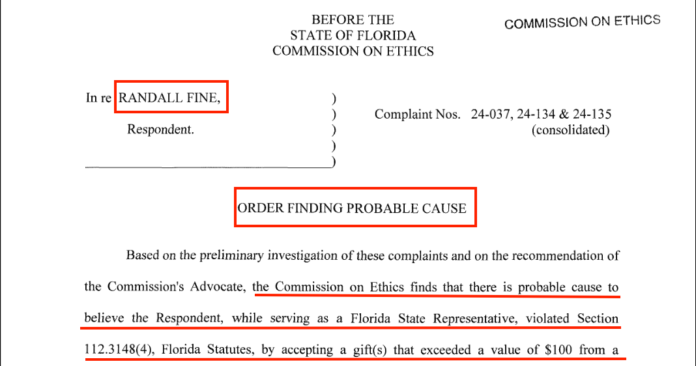
The Commission voted 919 days after the first complaint was filed, ten days after Fine won his primary, and only after his lawyer ran out of reasons his client could not come to Tallahassee. At the same meeting, a law passed while the case sat idle erased half the allegations in the older Jennifer Jenkins complaint.

TALLAHASSEE — The Florida Commission on Ethics has found probable cause to believe U.S. Rep. Randy Fine accepted $20,000 in prohibited gifts, concluding that the political committee he chaired paid a private lawyer to keep him out of two depositions he did not want to sit for, and that Fine never disclosed a dime of it.
The Order Finding Probable Cause was signed by Commission Chair Jon M. Philipson and filed Wednesday, Sept. 2. The Commission voted in closed executive session on Friday, Aug. 28, on a 3-2 vote with one commissioner abstaining, and the file became public this week.
The Commission found probable cause that Fine, while serving as a Florida state representative, violated Section 112.3148(4), Florida Statutes, “by accepting a gift(s) that exceeded a value of $100 from a prohibited donor,” and Section 112.31485(2)(a), “by accepting a gift(s) from a political committee.” It ordered a public hearing on both.
Section 112.31485 carries a civil penalty of three times the amount of a prohibited gift. If the full $20,000 is ultimately found to be prohibited gifts, the statutory formula produces $60,000, and Fine would be personally liable for it.

The hearing came 919 days after Jennifer Jenkins filed the first of the three consolidated complaints, 795 days after the second and third were filed, and ten days after Fine won a four-way Republican primary for another term in Congress. The case stayed confidential through the primary, because Florida law keeps ethics investigations secret until the Commission dismisses a complaint, orders a public hearing, or enters a final public report.
None of that timing was an accident of the docket. The newly released file shows the Commission spent a year asking Fine’s lawyer for a date, being told no a dozen different ways, and finally proposing the August 2026 congressional recess itself. The hearing landed after the primary because that is where the scheduling correspondence put it.
Disclosure: Robert Burns, publisher of The Space Coast Rocket and author of this report, filed Complaint Nos. 24-134 and 24-135. Jennifer Jenkins filed Complaint Nos. 22-079 and 24-037. This article is based on the Commission’s newly public investigative file, its public-session materials, the hearing recording, the continuance correspondence, the related Florida Elections Commission file, and the complainants’ own email records. (all available at the end of this report)
Two checks, two depositions he did not want to attend
At the center of the case are two $10,000 payments from Friends of Randy Fine, the political committee Fine chaired and operated, to the Law Firm of Alan Landman in Melbourne. Both were reported to the Division of Elections as “Legal Services.”
The first was reported Nov. 28, 2023. Jenkins, then a Brevard County School Board member, had sued the School Board and then-Chair Matthew Susin under Florida’s public records law, and had subpoenaed Fine as a third-party witness. He was served at his home on Oct. 27, 2023, through substitute service on his wife.
What happened next is the episode most Floridians have already seen. After a process server tried to reach him at his legislative office in Palm Bay, Fine called the Brevard County Sheriff’s Office and gave a recorded sworn statement, BCSO case 2023-00403545. He told deputies he was being targeted as the “only Jewish Republican of the Florida House,” and that he had hidden behind his office desk from the server out of fear for his life that it might be Hamas coming to kill him. That episode produced the video of Fine hiding under his desk that circulated widely online, and it happened because he was trying to avoid the deposition his committee would pay Landman $10,000 to stop.
In the same recorded statement, Fine gave away the defense his lawyers would spend the next two years building. “By the way nothing having to do with this would be official business,” he told the deputy, “but yea they filed a subpoena and I think I have Alan Landman who is an attorney file a motion to say you know no go here.”
House General Counsel David Axelman filed a notice of legislative continuance for Fine on Nov. 1, 2023, then wrote on Nov. 13 that his appearance was “limited to filing the notice of legislative continuance,” because he did not believe it was a matter of the House. The deposition was reset for Nov. 29. Fine handwrote “return to sender” on copies of the notice mailed to his office and his home.
Landman entered a limited appearance on Nov. 29, 2023 and filed an emergency motion for a protective order. His own motion states he “was retained on 11/28/23 for the limited purpose of filing instant emergency motion and addressing any issues/hearing related hereto.” Nov. 28 is the date the committee reported the first $10,000.
Fine did not show for the Nov. 29 deposition.
The second $10,000 was reported Jan. 8, 2024. By then Landman was doing the same work in a second case. On Nov. 8, 2023, attorney Jessica Travis had filed an amended notice to take Fine’s deposition as a witness on Dec. 20, 2023, in a matter in which Burns was the defendant and Fine was not a party. Landman filed a limited notice of appearance in that case on Dec. 13, 2023, and another emergency motion for a protective order the same day. Landman was not successful in stopping the deposition and Fine was ultimately deposed on March 29, 2024.
Neither case named Fine as a party. In both, he was a subpoenaed third-party witness in his personal capacity. In both, the money that paid to fight the subpoena came out of a political committee funded by donors.
The investigator got the admission Fine would not give him
Commission investigator Ronald D. Moalli’s Report of Investigation was released Dec. 19, 2024. It confirmed the committee made both payments and that a review of Commission records “confirmed that the Respondent did not disclose these payments to the Law Firm of Alan Landman as gifts.”
Moalli got the rest from Landman directly. According to the report, Landman confirmed that the two $10,000 payments “were related to the motions and notifications he filed on behalf of the Respondent in the Jennifer Jenkins and Robert Burns matters,” and added that his only representation of Fine as an attorney was related to those two matters. The advocate for the Florida Attorney General stated during the probable cause hearing that Fine’s own lawyer provided the information to conclude he was representing Fine in his personal capacity.
Fine gave the investigator nothing. The report’s closing paragraph reads: “The Commission on Ethics was notified by attorney Richard Coates that he was representing the Respondent in this matter. Numerous contacts with Mr. Coates were made via telephone and email in an attempt to schedule an interview with the Respondent. However, Mr. Coates never scheduled an interview for Mr. Fine to discuss the allegations in the complaints.”
The emails behind that sentence are in the file. On Aug. 1, 2024, Moalli wrote Coates that when they last spoke, Coates “stated that because you were tied up with helping clients with qualifying, and Representative Fine was in Israel it would be a little bit before we could discuss this matter, and you would contact me,” that Moalli had called on July 24 and left a message, and that he was now trying email. On Aug. 14, Moalli asked for “a few minutes sometime today for a quick phone call.” On Sept. 4, he wrote: “Checking in as I said I would this week. How would you like to proceed?”
Coates’s own answers in that thread are brief. Asked on Aug. 7, 2024 whether the Elections Commission had even found the parallel complaint sufficient for investigation, he replied: “It is under review.”
No interview was ever scheduled. Commission Advocate Melody A. Hadley filed her recommendation on Jan. 6, 2025 and recommended probable cause on both gift counts, writing that “the disbursement of money to Attorney Landman from the political committee for legal services was a gift(s) to Respondent as the matters did not relate to political activities.”
“Respondent did not participate in the investigation,” Hadley told commissioners on Aug. 28.
The defense, and what the Elections Commission actually decided
In an April 8, 2025 written response and again at the hearing, Coates argued that Fine had been subpoenaed “in his official capacity as a member of the Florida House of Representatives,” that he was not a party to either case, and that the committee could lawfully defend its chairman. He argued the videotaped depositions existed to be “clipped and turned into attack ads” during Fine’s 2024 state Senate campaign.
Hadley answered that the record showed Fine appearing simply as Randy Fine, not as a legislator, and that any political use, if at all, came afterward. “I still believe it’s personal,” she said. “We’ve just been told subsequently that it turned political.” Coasts’ stated assertion on the record to the Commission that Fine was subpoenaed in his official capacity was materially and objectively false.
Coates also told the Commission, repeatedly, that two parallel complaints had been dismissed by the Florida Elections Commission, the agency with primary authority over Chapter 106, and that the expenditures had therefore already been blessed.
The Commission’s general counsel corrected him at the hearing. Staff knew of one Elections Commission case, not two, and it had been dismissed at the legal-sufficiency stage because the link between the reported legal expenditures and the court filings was considered speculative at the time. “That wasn’t a merits decision,” he said. It was yet another false statement by Coates to the Commission.
The Elections Commission file, obtained by Moalli and released with the ethics records, bears that out. On Nov. 25, 2024, FEC Agency Clerk Donna Ann Malphurs emailed Moalli the complete file in FEC Case No. 24-130, a single complaint filed by Robert Burns covering both $10,000 payments. It included an Aug. 26, 2024 legal insufficiency letter and a Sept. 18, 2024 letter closing the case after no amended complaint was filed. The Elections Commission’s own complaint review notes that the “Respondent did not respond to the complaint.”
The evidence the Elections Commission said was missing is precisely what Moalli later obtained simply by asking: Landman, on the record, tying the money to the two filings.
Two and a half years of reasons he could not appear
The delay was not caused by an unfinished investigation. Moalli finished on Dec. 19, 2024. Hadley recommended probable cause on Jan. 6, 2025. The Commission did not vote for another 599 days.
The first attempt to move a Fine hearing came before the investigation was even done. On June 24, 2024, Coates asked that Fine’s matter be taken off the Commission’s July 26, 2024 meeting because the American Legislative Exchange Council was meeting in Denver that same day to consider model legislation Fine had sponsored. “Representative Fine wants nothing more than to wrap up this matter,” Coates wrote. “The last thing he wants is to request a delay.” Executive Director Kerrie J. Stillman replied the next day that nothing had been filed, “As such, a continuance request is not necessary.”
What followed, from the released correspondence:
- January 2025. Coates invoked Florida’s legislative continuance statute in the Jenkins case and purported to sweep in any other matter involving Fine. A Jan. 24, 2025 meeting, at which staff had proposed dismissing half the Jenkins allegations under the new law, was canceled.
- March 2025. A March 7 hearing was pushed to April. Complaint coordinator Millie Fulford explained that “the legislative continuance includes any Commission meeting dates scheduled during Session, which includes March.”
- April 2025. The April 25 hearing collapsed on the Commission’s own side. On April 17, Stillman wrote Chair Luis Fusté that three commissioners would be absent, one seat was vacant, and an attending commissioner had recused. “As such, we lack a quorum to consider these matters.”
- June 2025. Now a member of Congress, Fine had a new argument. Coates wrote on May 16 that “the US House of Representatives will be in Session on Friday, June 6, 2025. As such, under the US Constitution, Congressman Fine’s hearings scheduled for June 6, 2025 must be continued.” Fusté granted it May 27. Asked why, Fulford told Burns: “The Respondent is involved in Congressional session.”
- September and October 2025. Stillman went to the congressional calendar herself and offered two Fridays when the House was not meeting, Sept. 12 and Oct. 24. Coates rejected both. “You are correct that, at this time, the United States House of Representatives is not scheduled to be in Session on the two Fridays you referenced,” he wrote on Aug. 22, “however, the Constitutional privilege applied to Members of Congress applies to travel days as well.”
- November 2025. Stillman offered Nov. 12, 13 or 14, another non-session week. Coates replied that Fine was on a bipartisan House Education and Workforce delegation trip to South America and “will be in South America the entire week you referenced.”
- December 2025. Coates rejected Dec. 5 because the week of Dec. 1 was a session week and Dec. 5 “is an official travel day.”
- March 2026. Coates sought another continuance because the House would be in session on a single Friday, March 6. Philipson granted it on Feb. 18, 2026.
Every one of those refusals rested on a claim the Commission’s own rules do not support. Rule 34-5.006, Florida Administrative Code, permits a probable cause hearing to go forward without the respondent personally present so long as counsel appears. Coates was available throughout. Burns raised the rule in writing to the Commission on Sept. 24, 2025 and again on Feb. 4, 2026. He never received a substantive answer to the point. The Commission’s Chair finally highlighted this rule when Fine failed to show up for the Aug 28th hearing, essentially conceding that NONE of those continuances needed to take place.
The Commission picked the date out of the congressional recess
By the fall of 2025, the Commission stopped looking for a date in that year.
On Oct. 1, 2025, two days after the South America refusal, Stillman wrote to Coates: “Understanding Congressman Fine’s official duties and the associated scheduling challenges, as well as the Commission’s obligation to consider [his cases], we would like to schedule his cases for consideration during the August 2026 Congressional break. For scheduling purposes, please let me know by October 17 which Friday in August 2026 will work for you and Congressman Fine.”
Coates missed that deadline too. He was still deflecting on Nov. 13, promising he was “diligently pursuing your question about August of next year.” Stillman replied the next day: “We will reschedule, but I will need to set it for a meeting soon.” On Dec. 9 she asked again, in a single line: “Mr. Coates, Do you have an August date that will work?”
The answer came Feb. 11, 2026. The last week of August 2026 “might work.” Philipson told Stillman on Feb. 18 that the Commission needed the Aug. 28 date confirmed “by the end of the month, so we can plan accordingly for rearranging meeting date times for August.” Stillman set a firm deadline of March 4.
The Commission rearranged its own calendar around a congressman’s schedule. It did not use its regularly scheduled meetings on April 24, June 5 or July 24, 2026, all of which fell between the hearing notice and the primary. Asked in a public records request for “a written explanation of why the June 5, 2026 and July 24, 2026 Commission meetings were not used to agendize the Fine probable cause hearings,” the Commission responded that it had no responsive records.
Burns received the hearing notice on April 10, 2026 and immediately asked for the investigative report. Fulford told him on April 13 that it would be sent five days after the hearing.
The last attempt, and the argument that collapsed
Twelve days before the hearing, Fine tried once more, and this time he was caught.
In an Aug. 12, 2026 letter to Coates on congressional letterhead, Fine wrote that he would be “on official travel to the Pacific Northwest the last week of August in order to conduct official Congressional business with Representative Michael Baumgartner,” and was therefore “precluded from coming to Tallahassee on August 28th.” Under the Speech or Debate Clause, he asserted, “any activity by the Florida Commission on Ethics is automatically postponed.”
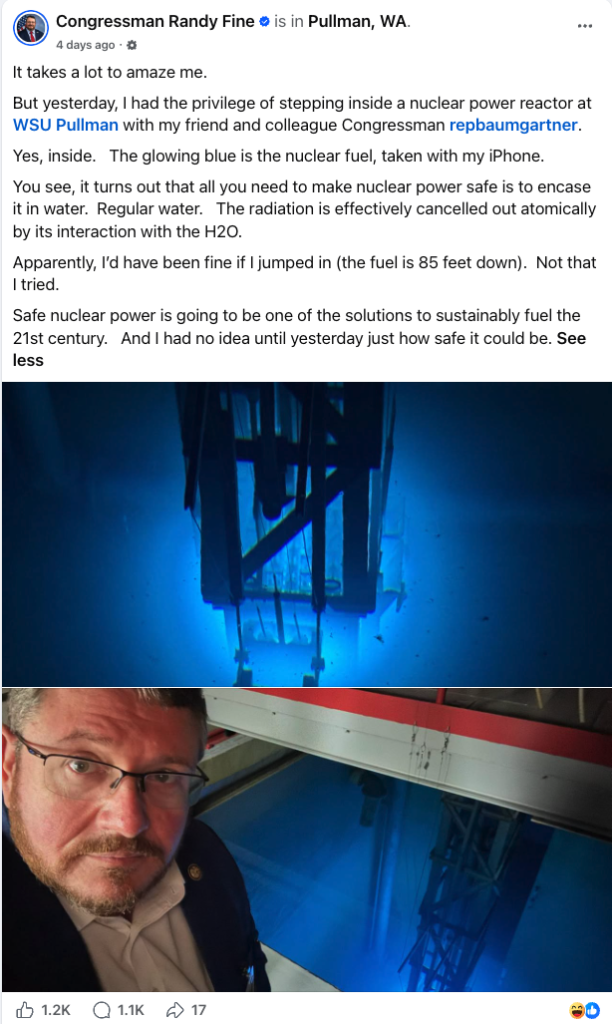
The rest of the letter (on official U.S. Congress letterhead) was not about scheduling. Fine called the case “a travesty,” said it had been brought by “an out-of-district perennial Democrat candidate, disgraced former Brevard School Board Member, failed U.S. Senate Candidate, failed Congressional Candidate, and now again a Congressional Candidate in the 8th Congressional District, Jennifer Jenkins, in coordination with her longtime partner, convicted felon Robert Burns,” and complained that “political appointees” had twice overruled professional staff who sided with him.
He also counted the house. “Perhaps fortunately, I believe none of the current members of the Commission were serving during the previous three votes of the Commission, and it is my hope that they will remedy this gross injustice and bring an end to this proceeding.” Yes it is true that Fine had delayed this matter for so long that none of the original voting members that found probable cause were still serving on the Commission any longer, perhaps by design.
Then came the offer that defined the whole two and a half years: “You are authorized to tell the Commission that I am willing to waive my right to attend in person for the sole purpose of the ‘complaint’ being dismissed.”
He would waive the very right he had used to stop the case for two and a half years, but only if the case ended in his favor.
Deputy Executive Director and General Counsel Steven J. Zuilkowski treated the letter as a continuance request and wrote back on Aug. 14 with four questions, due at noon on Aug. 17. He asked Coates to identify any legal authority applying the Speech or Debate Clause to conduct occurring before his client entered Congress, and any authority requiring a continuance when a member cannot attend.
The fourth question was the one that mattered. Zuilkowski pointed to Masad v. Fine, No. 6:26-cv-00442, then pending in the U.S. District Court for the Middle District of Florida, where Fine “recently allowed his legal representative to attend a motion hearing that your client did not attend,” and where a mediation was set for Aug. 20, 2026, “just a week before the August 28, 2026 Commission on Ethics meeting,” for which Fine had “requested that his Chief of Staff be allowed to appear in his stead as a surrogate with full settlement authority.”
Coates answered on Aug. 17 that the federal case was different: there Fine had official duties, was represented by House General Counsel, and the proceeding was civil rather than penal.
Philipson denied the request on Aug. 18, primary election day.
“Mr. Coates has not provided a legal argument based on the Speech or Debate Clause to preclude the proceeding,” he wrote. On the federal case, he quoted Fine’s own filing back at him: “contrary to Mr. Coates’ letter, Mr. Coates’s client did seek his Chief of Staff to attend the mediation based on his official duties as a Congressman,” citing the motion’s argument about “the nature and press of [Congressman Fine’s] official congressional duties.”
Philipson added that the hearing was already set during the House’s August recess, and that “based on the Commission’s procedures, Congressman Fine’s physical presence is not required for the Commission to proceed with this matter.”
Stillman notified Coates at 11:32 a.m. that day: “The Chair has denied your request for a continuance.”
Fine did not attend. Coates appeared for him, which is what the Commission’s rules had permitted all along.
During the commissioners’ discussion, the Commission’s general counsel warned against sending the case back for a fresh investigation after Fine had refused to take part in the first one and then offered material that had never been tested. He said he was concerned it would become a playbook: “not to participate in the investigation, to ask for continuances … state new evidence, get a new investigation and repeat the loop.” That precisely is the playbook.
After 52 minutes of argument, three commissioners voted for Hadley’s recommendation, two voted against, and one abstained. You can listen to the audio of the probable cause hearing here.
The older case: a finding from 2023, half erased in 2026
At a public session the same day, the Commission took apart part of the case that made Fine’s ethics record famous.
Jenkins filed Complaint No. 22-079 on May 18, 2022, after a fight over “Cops on the Coop,” an April 22 fundraiser the West Melbourne Police Department held at a Chick-fil-A for Special Olympics Florida. All five School Board members were invited. Jenkins accepted, promoted a mock booking photo of herself in a jail uniform, and told investigators she saw it as a way to turn the “Jail Jenkins” attacks into something useful. She raised about $2,000 in 48 hours.
West Melbourne Councilman John Dittmore then posted a public apology to Fine and then-Attorney General Ashley Moody for Jenkins’s participation. The next day Fine texted him: “Thanks for taking care of it. Jenkins just put your project and Special Olympics funding on the veto list.”
Dittmore offered to seek her removal and donate $500 in her place. Fine answered that the “problem is their funding is now at risk too” and suggested canceling the event. Invited to attend, Fine replied that he would not go anywhere “that whore is at,” and later: “I’m not doing anything involving that whore. You guys will need to raise a lot of money given that’s who you want to honor, not the person who got you the money in the budget.”
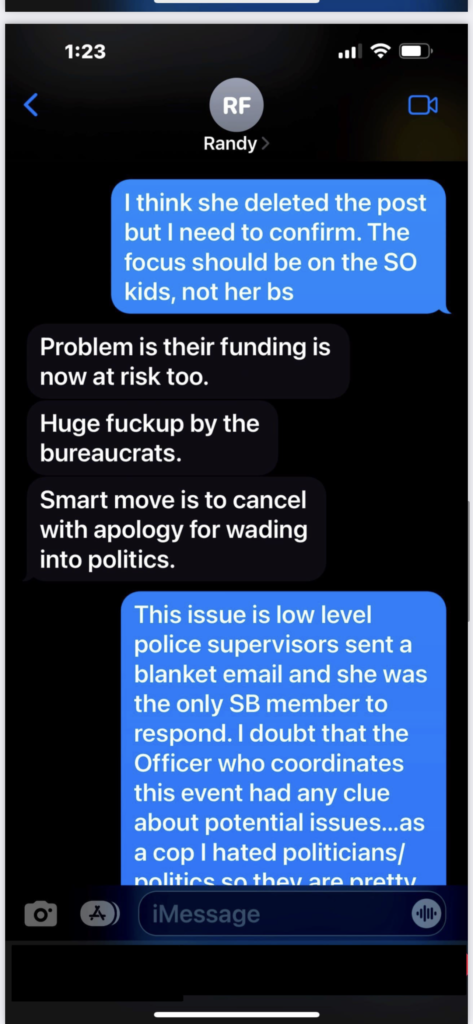
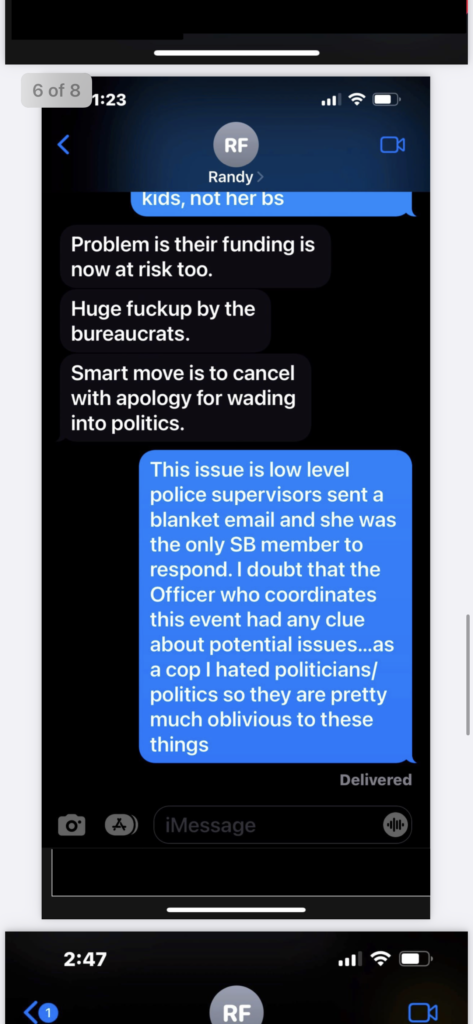
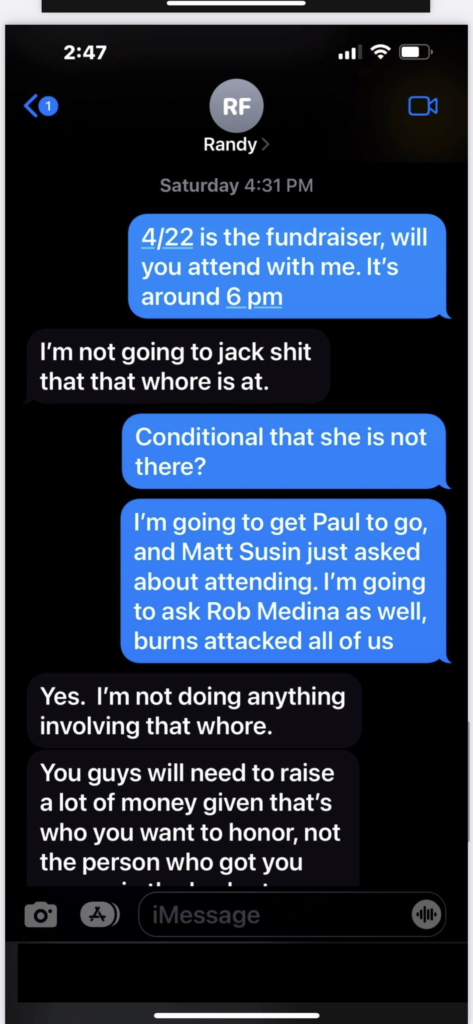
When Jenkins requested the texts as public records, Dittmore told investigators Fine urged him not to release them and wanted City Attorney Morris Richardson (now Brevard County Commission’s Attorney) fired for advising that they were public. Dittmore released them anyway. He told investigators he took the funding statement as a credible threat, because the governor had not yet signed the budget containing West Melbourne’s Westbrooke stormwater project.
Fine told investigators the funding comments were jokes. He acknowledged the remarks about Jenkins were “not a great decision on my part.”
Commission staff recommended dismissing the complaint as legally insufficient in July 2022. The Commission overruled staff and ordered an investigation. When the Advocate then recommended no probable cause, the Commission overruled staff again by a vote of 7-1. On April 21, 2023, with one commissioner voting no, it found probable cause that Fine violated both Article II, Section 8(h)(2) of the Florida Constitution, the ban on abusing office for a disproportionate benefit, and Section 112.313(6), corrupt misuse of public position. The order was filed April 26.
“I find what Representative Fine has done reprehensible,” the commissioner who made the motion said in the closed hearing, according to audio and investigative records published by The Space Coast Rocket in 2023. “There is nothing here that is the proper exercise of your duties as a state legislator.” Florida Today reported that Fine called the Commission a “kangaroo court.”
That finding has still never been tested at a hearing.
The case went to the Division of Administrative Hearings and was set for trial May 14-16, 2024. On April 16, 2024, Coates moved to send it back to the Commission for reconsideration, citing “potential disparate treatment.” The administrative law judge relinquished jurisdiction the next day and the trial was canceled. Fine formally moved for reconsideration on Aug. 27, 2024. The Commission denied that motion on Oct. 25, 2024, leaving the 2023 finding intact.
By Aug. 28, 2026, 1,225 days had passed since the Commission found probable cause, and 1,563 days since Jenkins filed.
A law passed mid-case took three of the six allegations
What came back to the Commission was not the case the 2023 commissioners had decided, because the Legislature changed the rules while it sat.
Senate Bill 7014, signed by Gov. Ron DeSantis on June 21, 2024, amended Section 112.324(1)(a) to require that an ethics complaint be based on the complainant’s personal knowledge or on information other than hearsay. That provision took effect on signing. Separate deadlines on Commission investigations did not take effect until Oct. 1, 2024, a distinction Stillman later used to tell Burns that no timeline applied to his complaints.
Commission officials concluded the new evidentiary threshold reached pending cases, including complaints already investigated and already found to have probable cause. Journalist Jason Garcia reported in January 2025 that staff had begun auditing active cases after lawyers invoked an appellate ruling applying similar restrictions retroactively to pending Elections Commission matters.
On June 2, 2026, Stillman wrote Burns that 22-079 was “currently pending dismissal of certain allegations and is on the Commission’s agenda for consideration at its meeting on August 28, 2026,” and that the Commission “has made no referrals to any other agency regarding this complaint.” Burns was concerned that the statute of limitations (2 years) for the potential criminal charges for the same behavior have now run out because of the excessive delay. A similar thing happened when disgraced former Brevard County COmmissioner Bryan Lober avoided felony charges because the investigation into him took longer than the statute of limitations for the alleged crimes.
At the Aug. 28 public session, the Commission invoked Section 112.324(12), which allows it to dismiss all or part of a complaint at any stage when the public interest would not be served by continuing. It did not find the allegations false. It found that the face of a 2022 complaint did not establish whether they rested on personal knowledge or admissible non-hearsay information.
The three allegations dismissed:
- That Fine encouraged Dittmore to write the Facebook post criticizing Jenkins. The Commission said the complaint did not identify Jenkins’s basis for the allegation.
- That Fine told Dittmore to disregard the city attorney’s advice to release the records and said the attorney should be fired. The Commission said the complaint relied on Dittmore’s statements to others, making the basis hearsay.
- That Fine hired a private investigator to surveil Jenkins and posted false claims from that work on a website. The Commission said the complaint attributed the information to Dittmore without identifying personal knowledge or non-hearsay support.
The three that survive, still under the 2023 probable cause finding:
- That Fine posted disparaging and allegedly false comments about Jenkins on Dittmore’s Facebook post, including a link to a website with other allegations about her. Jenkins saw those herself, and Fine’s own statements qualify as admissions.
- That Fine told Dittmore and Mayor Hal Rose he would veto or reduce funding for a city project and Special Olympics because Jenkins took part in the fundraiser. The complaint attached Fine’s own texts.
- That Fine failed to respond to Jenkins’s public records request for his communications with Dittmore and Rose. Jenkins knew firsthand that she asked and got nothing.
The pattern in what survived is worth noting: the allegations the Commission could keep are the ones Fine documented himself, in his own words, in writing.
The draft order in the Aug. 28 public-session packet confines any hearing to those three. The Commission’s Sept. 2 press release confirms it: allegations were dropped because “it could not be determined from the complaint whether those allegations were based on personal knowledge or information other than hearsay,” and the rest “will move forward with a public hearing or stipulation.”
A law enacted more than two years after Jenkins filed and probable cause already found, removed half her factual allegations, after investigators had finished their work and commissioners had already found probable cause on all of them.
The one count he won
The Commission found no probable cause on the 2023 Form 6 allegation in Complaint No. 24-135.
That complaint alleged Fine improperly reported Jayvid Holdings, LLC as an asset worth $21,212,079 and a primary income source of $329,707, when Florida records show the company was filed May 5, 2016 and administratively dissolved Sept. 22, 2017 for failing to file an annual report. It also questioned the valuation of his residence, undisclosed personal assets, and a $250,000 loan.
The Commission narrowed the complaint at the outset to the Jayvid asset and income question alone. Hadley recommended no probable cause, reasoning that because Fine reported the company as an asset and income source, there was evidence he “was still operating the business” despite the dissolution, and therefore “insufficient evidence to reflect that Respondent’s form was inaccurate.” The Commission agreed. That allegation will not be at issue in any hearing.
What happens next
Probable cause is not a finding of guilt. It means the Commission found enough evidence to move the allegations into a public enforcement proceeding, where the Advocate must prove them.
Fine can demand a formal hearing before an administrative law judge, take an informal hearing before the Commission, or settle. The order points him to Rule 34-5.020 and gives him the Advocate’s phone number. The Commission may recommend removal from office or employment and fines of up to $20,000 per violation, and Section 112.31485 adds its treble penalty on top.
The same two options now apply to what is left of 22-079, where probable cause has stood unadjudicated for more than three years.
Since Jenkins filed that complaint and since the Commission found probable cause he abused his office and position, Fine has been elected to the Florida House, the Florida Senate and the U.S. House. He has never sat for a hearing on either case. Fine has made a mockery of the entire Florida Commission on Ethics, and it is not clear, actually it is doubtful that he will face any real consequences for his actions against the state of Florida and its citizens
For years, the Florida Commission on Ethics bent over backward to accommodate Randy Fine, only for him to brand it a ‘kangaroo court,’ invoke a constitutional privilege that did not apply, and then fail to appear. While the Commission delayed, the man it found probable cause to believe abused his public office continued climbing to higher office without facing a single consequence. At some point, delay stops being due process and becomes impunity. If the Commission cannot deliver accountability before power carries the accused beyond its reach, the public has every right to ask what purpose the Commission actually serves.
Records cited here were produced by the Florida Commission on Ethics on Sept. 2, 2026 in response to a public records request and include the Order Finding Probable Cause, the Report of Investigation, the Advocate’s Recommendation, the response of Fine’s counsel, the orders to investigate, the hearing recording, the continuance correspondence, and the Florida Elections Commission file in Case No. 24-130. The records are available for you below.
Criminal Defense
Bankruptcy · Evictions
WICKS LAW P.A.
Call or text for
free consult
321-733-2700
Eric Wicks, Esq.
1250 West Eau Gallie Blvd. G
Melbourne, FL 32935
Abogado Wicks habla español