


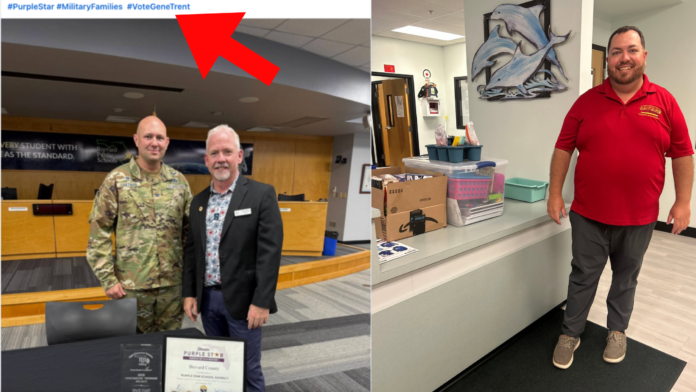
Military officials acted after Trent used a uniformed commander in reelection material. Months later, Brevard Public Schools warned challenger Kyle Savage about campus campaign content, then sent Trent a private legal assessment 94 minutes later.
VIERA, Fla. – The U.S. Space Force requested the removal of a campaign photograph posted by Brevard County School Board member Gene Trent after military officials concluded the image of an active-duty commander in uniform could be perceived as an endorsement, according to a written statement from Space Launch Delta 45.

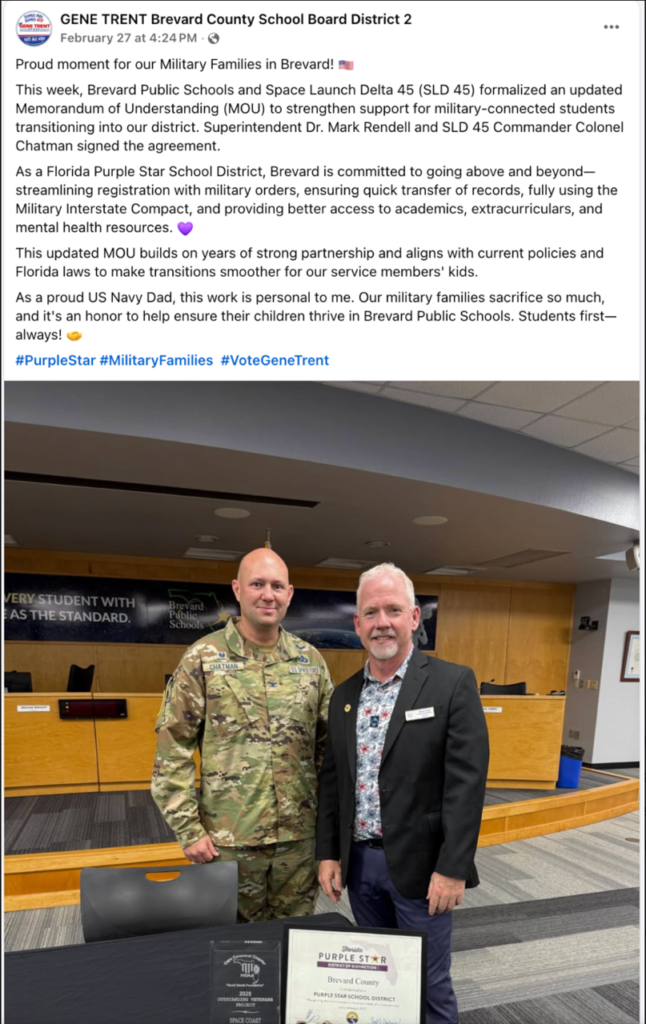
The photograph showed Trent beside Space Launch Delta 45 Commander Col. Brian L. Chatman during an official community engagement concerning an agreement between Brevard Public Schools and the military installation. Chatman was in uniform. Trent placed the image on the Facebook page for his School Board District 2 reelection campaign, paired it with language promoting his commitment to military families and ended the post with the hashtag #VoteGeneTrent.
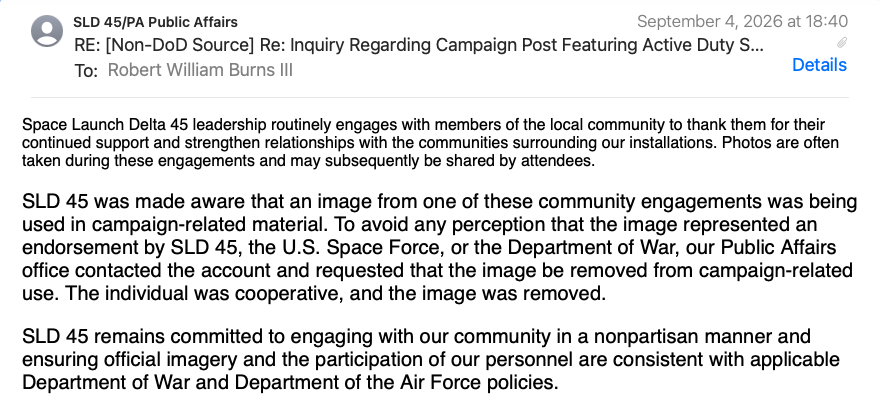
Space Launch Delta 45 said its Public Affairs office intervened after learning the official-looking photograph had been placed in campaign material.
“To avoid any perception that the image represented an endorsement by SLD 45, the U.S. Space Force, or the Department of War, our Public Affairs office contacted the account and requested that the image be removed from campaign-related use,” the command said. “The individual was cooperative, and the image was removed.”
The command said military leaders routinely meet with community members and that attendees sometimes share photographs from those engagements. It did not say Trent was prohibited from attending the event or possessing the photograph. The objection arose when the image was repurposed as campaign content.

The military’s response stands in sharp contrast to Brevard Public Schools’ handling of campaign photographs posted by Trent’s opponent, Kyle Savage, according to district emails Savage obtained through a public-records request.
Those records show BPS General Counsel Paul Gibbs formally warned Savage about “campaign activity on school property” after Savage posted photographs from an August school-supply donation. Gibbs then forwarded the warning, along with a private legal assessment of the district’s case, to Trent 94 minutes later.
An apparent election-law issue
Trent’s use of Chatman’s image raises a question under Section 106.143(4), Florida Statutes. The law makes it unlawful for a candidate or anyone acting for a candidate to represent that a person or organization supports the candidate without that person or organization’s specific written approval.
The photograph did more than document an official meeting. It placed a uniformed military commander inside a reelection message that expressly asked voters to support Trent. The Space Force said the presentation created enough risk of a perceived military endorsement that it requested removal.
The command’s statement does not expressly answer whether Trent possessed any written authorization before publishing the post. For that reason, the available evidence supports an apparent violation that could be investigated by the Florida Elections Commission, not a final legal finding. Trent’s campaign and the Space Force would possess any written approval if one existed.
The episode also raises a separate ethics question under Section 112.313(6), Florida Statutes, which prohibits a public officer from corruptly using an official position, or property or resources within the officer’s trust, to secure a special benefit.
The electoral benefit is explicit in the hashtag #VoteGeneTrent. What has not yet been officially established is whether Trent used a BPS resource, district staff time, nonpublic official access or another resource of his School Board position to obtain or prepare the photograph. That fact matters. The Florida Commission on Ethics has said a private political act does not violate the statute unless the official used the public position or a public resource. An ethics violation therefore remains an allegation requiring additional records or firsthand evidence about who took the photograph, who distributed it and how Trent obtained it. According to those familiar with the event however, Trent indeed did use BPS staff for the photograph and it did in fact occur in the School Board Meeting room.
The military’s political-activity rules govern Chatman and the Space Force, not Trent. Department of Defense Directive 1344.10 establishes restrictions intended to keep military participation from implying official sponsorship, approval or endorsement in political activity. SLD 45 said its removal request was designed to prevent that appearance. Nothing in the command’s response suggests Chatman knowingly participated in Trent’s campaign.
Savage received a warning, then Trent received the legal analysis
Savage, a U.S. Army veteran and former BPS teacher, said he delivered donated school supplies to a District 2 school on Aug. 17, one day before the primary election. He posted photographs of the visit on Aug. 21, after the primary results placed him and Trent in the Nov. 3 general election.
According to Savage, a senior district official called him that day and asked why he had been on campus and whether he had been campaigning.
At 3:17 p.m. on Aug. 24, Gibbs emailed Savage and quoted BPS Policy 3232: “candidates for public office or their representatives shall not be permitted to solicit support during work hours or on Board property.”
“From the photos and post shared alongside the donation, it looks like the visit doubled as campaign content, images taken on campus that were then used to promote your candidacy,” Gibbs wrote. He asked Savage to keep future campus visits separate from campaign photographs and promotion.
At 4:51 p.m., Gibbs forwarded the warning to Trent, Savage’s opponent and a member of the board that employs Gibbs.
The assessment Gibbs gave Trent was more qualified than the warning Savage received.
“I believe it is a grey area, and our policy does not explicitly prohibit the wearing of campaign shirts, deemed a passive activity, on property,” Gibbs wrote.
Gibbs said the district would have had no basis to ask Savage to stop if he had merely worn the shirt and delivered the supplies without posting the photographs. He also wrote that because Savage was not a BPS employee, “I do not believe we have any grounds to stand on prohibiting passive promotion based on the policies,” unless Savage was presenting to students in a classroom.
Gibbs nevertheless concluded that the photographs and subsequent post suggested a planned campaign activity and that, “in totality,” the warning was justified. He told Trent the district’s policies “would perhaps benefit from additional updating.”
The same-policy problem
BPS Policy 3232 says candidates and their representatives may not solicit support during work hours or on Board property. The text does not expressly say that a candidate violates the policy merely by later posting a photograph taken during an otherwise permitted visit. Gibbs’ email acknowledges that ambiguity.
But the reasoning BPS used against Savage creates an obvious comparison with Trent. Both matters involved candidates using photographs from BPS property or official district activity as campaign content after the event. Trent’s post went further by adding an express vote hashtag and pairing his campaign with a uniformed military commander. The Space Force acted to stop that use. No comparable BPS warning to Trent has been produced or identified.
There is an important records limitation. Savage requested Office of General Counsel communications concerning Policy 3232 from May 24 forward. Trent’s Space Force post was online by March 11, more than two months before the request’s start date. Savage’s production therefore does not prove BPS never contacted Trent about the military photograph. It does show that the district’s legal office warned Savage in August, then promptly gave Trent a private explanation of the district’s legal reasoning about his challenger.
Savage called the sequence unequal treatment and questioned why the board’s attorney briefed one candidate about an enforcement matter involving his opponent.
“When the district’s lawyer told me I had crossed a line, I asked the district to show its work,” Savage said. “What came back was that same lawyer telling my opponent, an hour and a half later, that the district had no grounds.”
That description slightly compresses Gibbs’ full position. Gibbs said the district lacked grounds to prohibit passive promotion by a nonemployee, but he also said the photographs and online post justified sending Savage a warning.
Savage is asking BPS to disclose who initiated the review of his visit, state whether Policy 3232 has been applied to any sitting board member’s campaign activity, and adopt a rule preventing district counsel from privately briefing a board member about an enforcement matter involving that member’s election opponent.
Questions still unanswered
The records and Space Force statement establish that military officials objected to Trent’s campaign use of the image and obtained its removal. They also establish that BPS warned Savage and sent its internal legal assessment to Trent less than two hours later.
They do not yet establish whether Trent had specific written permission to represent military support, how he obtained the official photograph, whether BPS personnel or equipment were involved, who triggered the district’s review of Savage, or whether the district contacted Trent before May 24.
Those answers will determine whether the contrast amounts only to inconsistent judgment or supports formal findings under Florida election law, state ethics law or district policy.
Criminal Defense
Bankruptcy · Evictions
WICKS LAW P.A.
Call or text for
free consult
321-733-2700
Eric Wicks, Esq.
1250 West Eau Gallie Blvd. G
Melbourne, FL 32935
Abogado Wicks habla español