


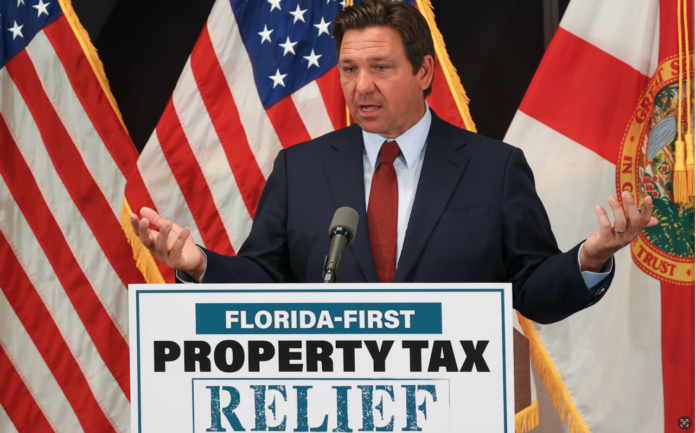
Florida voters will decide this November whether to enact one of the largest property tax cuts in the state’s history, after the Republican-controlled Legislature on Tuesday approved Gov. Ron DeSantis’ proposed constitutional amendment and sent it to the ballot.

The House passed the measure, HJR 1F, by a vote of 75 to 26, three more than the 60 percent supermajority required to place a constitutional amendment before voters. The Senate followed with a 30 to 9 vote. In the Senate, Democratic Sens. Barbara Sharief and Darryl Rouson crossed over to join the Republican majority, though their votes were not needed to reach the threshold. In the House, two Panhandle Republicans, Patt Maney of Shalimar and Nathan Boyles of Baker, voted no. Both chambers then adjourned the special session “sine die,” meaning without a set date to return, and are not expected to reconvene before this year’s elections.
What the amendment would do
DeSantis’ plan would raise Florida’s homestead exemption from $50,000 to $150,000 on Jan. 1, 2027, then to $250,000 on Jan. 1, 2028. The exemption lowers the taxable value of a primary residence, which reduces the annual property tax bill. According to the governor’s office, raising it to $250,000 would eliminate property taxes entirely for roughly 60 percent of Floridians who own and live in their homes. DeSantis unveiled the plan in Tampa on May 27 and launched a campaign website, saveourhomesfl.com.
The change matters because property taxes are the financial engine of county and city governments in Florida. The state has no personal income tax and is barred from creating one under its constitution, which leaves local governments heavily dependent on property tax revenue to operate.
What it means for the Space Coast
For Brevard County and its municipalities, the stakes are direct. Property tax revenue funds the bulk of the local services Space Coast residents rely on, from the Sheriff’s Office and fire rescue to road maintenance, libraries and parks. A House staff analysis estimated the larger exemption could cost counties statewide about $4.6 billion in non-school revenue in its first year and as much as $8.4 billion by the second year. Cities including Palm Bay, Melbourne, Titusville and Rockledge, along with Brevard County government, would have to decide how to absorb that loss or where to cut.

Firefighters from across the state packed committee rooms in Tallahassee in uniform on Monday, warning of cuts of up to 25 percent in services if the amendment is approved, the Orlando Sentinel reported. Jennifer Abdelnour, executive director of the Florida Library Association, told lawmakers libraries could face reduced hours and possible branch closures without a stable revenue base.
How lawmakers reshaped the plan
The version voters will see is substantially different from what DeSantis first proposed. After analyses showed school districts could lose roughly $5 billion, lawmakers added protections for public school funding. Sen. Jay Trumbull, a Panhandle Republican, sponsored the Senate carveout, and Rep. Sam Garrison, R-Fleming Island, carried a similar amendment in the House. Lawmakers also ensured that constitutional county offices, including sheriffs, clerks of court and property appraisers, could continue receiving property tax dollars.
The resolution restricts how local governments may spend their remaining revenue to a handful of broad categories such as public safety, education, debt service and employee retirement, with a seventh category added by Senate sponsor Bryan Avila, R-Miami Springs, to cover constitutional officers.
One of the most consequential changes was the removal of a proposed state trust fund that would have helped financially strained counties backfill lost revenue. Sen. Erin Grall, R-Vero Beach, stripped references to the fund from the ballot summary, arguing it would mislead voters because the Legislature never actually funded it. “There is not a pot of money for this backfilling,” she said. Grall also moved to cut $5.5 million DeSantis had sought to mail homeowners notices explaining the ballot question.
Supporters and critics
Avila, who chairs the Senate Finance and Tax Committee and sponsored the chamber’s version, urged colleagues to let voters have the final say, telling the Senate that leadership sometimes requires tough decisions and that cities and counties will have to talk through their spending priorities. Sen. Corey Simon, R-Tallahassee, who has two fiscally constrained rural counties in his district, said he wavered until hearing from residents who feel ignored by their government, and said the amendment gives them a chance to “vote their wallet.”
Critics, including most Democrats and some Republicans, warned the cuts would devastate local services. Orlando Democratic Sen. Carlos Guillermo Smith called the legislation a “Frankenstein bill” that amounts to the “defunding of police” and would leave communities in a “financial straitjacket.” His proposed five-year sunset provision, intended as a safeguard if the policy backfires, failed in the full Senate. Sen. Tina Polsky, D-Boca Raton, said the proposal was rushed to boost the governor’s political profile before he leaves office and described it as the ultimate preemption of local government.
Even Republican supporters voiced reservations. Sen. Gayle Harrell, R-Stuart, said she was won over by the school-funding protection but warned the Senate faces “significant challenges moving forward” because the measure shifts costs onto already strained counties. The watchdog group Florida TaxWatch, which generally favors lower taxes, called the proposal unnecessary and rushed, and recommended letting the state’s Taxation and Budget Reform Commission study the issue instead.
Several Democratic amendments were voted down along party lines, including efforts to protect children’s services councils, water management districts, programs for veterans and seniors, mosquito control and libraries. One House Democrat, Rep. Daryl Campbell of Fort Lauderdale, registered his opposition with an elaborate floor statement modeled on Greek tragedy, invoking the deep service cuts that followed tax reductions in Kansas under former Gov. Sam Brownback.
What happens next
The amendment now heads to the November 2026 general election ballot. For it to take effect, at least 60 percent of Florida voters statewide must approve it. Brevard County voters will weigh in alongside the rest of the state, deciding a question that could permanently change how their county, cities and school district are funded.
If voters approve it, the overhaul would likely stand as the signature achievement of DeSantis’ time in office. The governor is term-limited and leaves office in January. House Speaker Daniel Perez, R-Miami, who presided over the session, was nominated this week by President Trump to serve as U.S. ambassador to Brazil.
Criminal Defense
Bankruptcy · Evictions
WICKS LAW P.A.
Call or text for
free consult
321-733-2700
Eric Wicks, Esq.
1250 West Eau Gallie Blvd. G
Melbourne, FL 32935
Abogado Wicks habla español