

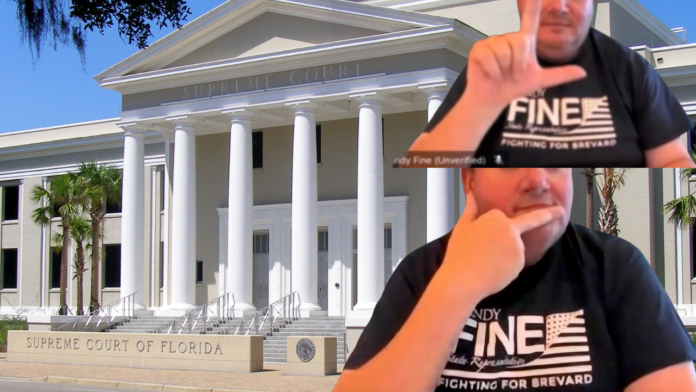
The congressman’s lawyer says two conflicting appellate standards can coexist because the cases differ on their facts. The petition argues Florida’s district courts have announced opposite rules for the same courtroom ruling.

Editor’s note: This report concerns litigation in which the Rocket’s editor and publisher, Robert W. Burns III, is a named party and the petitioner seeking review. That relationship is disclosed in the interest of transparency. This account is drawn from the parties’ filings and the courts’ orders and opinions.
U.S. Rep. Randy Fine has asked the Florida Supreme Court to stay out of the fight over his vacated contempt order.
In a jurisdictional brief filed Monday evening in case SC2026-1072, Fine’s attorney, Ryan Rodems of Morgan & Morgan, urged the state’s highest court to decline review of the Fifth District Court of Appeal’s June 19 decision, which erased the civil contempt finding entered against Fine in October 2024 over obscene gestures witnesses said he made during a virtual court hearing. The filing came six days after Burns, the petitioner, invoked the Court’s discretionary jurisdiction and three days after his brief argued that Florida’s appellate districts have announced conflicting legal standards governing the same courtroom ruling.
The Supreme Court will now decide, on the papers alone, whether to take the case. No reply briefing is permitted at this stage.

What each side argues
The dispute at this stage is not about middle fingers. It is about a single question of appellate law: what happens when a trial judge refuses to give a lawyer time to prepare a written motion to disqualify the judge.
The Fifth District held that the answer is automatic reversal. Relying on the Florida Supreme Court’s 1993 decision in Rogers v. State, the panel wrote that denial of the requested recess “was error that requires reversal,” and it vacated Judge Scott Blaue’s contempt order outright.
Burns’s petition argues that answer collides with the announced rules of two other Florida courts. In Aquasol Condominium Association v. HSBC Bank, the Third District Court of Appeal confronted the same request, a lawyer asking mid-trial for a continuance so he could “go back to my office” and prepare a written disqualification motion, and reviewed the trial judge’s handling of it for abuse of discretion, asking whether the movant was prejudiced. And in Davis v. State, the Florida Supreme Court itself held in 2022 that even the erroneous denial of a completed, legally sufficient disqualification motion is not automatically reversible, but is instead subject to harmless-error review. The petition contends a trial judge in Miami and a trial judge in Melbourne now operate under contradictory commands for the identical ruling: discretionary and prejudice-dependent in one district, reversible per se in another.
The petition also points out that the Fifth District’s own opinion relies on Meredith v. Meredith, a 2025 decision of the same court, and that Meredith applied the Davis harmless-error test to a disqualification error in a civil case.
Fine’s response takes a different tack. Rather than defending the per se rule on its merits, the brief argues the cases simply do not conflict because their facts differ. Quoting the Supreme Court’s 1962 decision in Kyle v. Kyle, Rodems writes that if two cases “are distinguishable in controlling factual elements,” no conflict can arise. Aquasol is different, the brief argues, because that lawyer eventually received drafting time after the initial denial; Fine’s lawyer received none. Davis is different, it argues, because that case involved a written motion that was actually filed and denied, not a request for time to write one. The brief concludes there is “no conflict” and asks the Court to decline jurisdiction.
The two briefs, notably, argue past each other on the governing test. Burns’s filing is built on the Supreme Court’s 2024 decision in Askew v. Florida Department of Children and Families, which describes two independent ways conflict jurisdiction can arise: a conflicting outcome on substantially the same facts, or “the announcement of a conflicting rule of law.” Fine’s brief addresses only the first and does not mention Askew, Meredith, or Viera v. Viera, the civil-application authority the petition cites alongside Davis. Fine’s brief also describes the “requires reversal” language as the holding of Rogers itself; that phrase appears only in the Fifth District’s opinion, while Rogers says a qualifying recess “must be granted,” a distinction that sits at the center of the petition’s argument about whether automatic reversal is settled law or a newly announced rule.
The road through the Fifth District
The Supreme Court petition exists because the Fifth District declined a narrower request first.
After the June 19 opinion, Burns filed a motion for rehearing, clarification, and certification. That motion did not ask the appellate court to reweigh the contempt evidence. It made a record-based argument: that the opinion’s dispositive premise, that Fine’s counsel sought disqualification “based upon matters that occurred during the hearing,” did not match the certified transcript of the October 1, 2024 hearing.
According to the transcript cited in the motion, the grounds Fine’s counsel gave were raised at the outset of the hearing, before any witness testified, and concerned events that predated the hearing entirely: Judge Blaue’s September 13, 2024 order appointing attorney Scott Widerman to gather evidence and issue subpoenas, the subpoenas served the prior week, witness contacts, and returns of service filed that morning. The trial judge did not simply refuse a pause, the motion argued; he expressly ruled the objection untimely because the appointment order had been entered more than two weeks earlier and had drawn no objection. The motion also noted that what counsel requested was not a brief pause at counsel table but time to leave and “go back to the office,” and that the same defense had already pursued the judge’s removal repeatedly, through disqualification motions filed in August and September 2024 and petitions for writ of prohibition, all denied or pending before the October hearing began.
The motion asked the panel to reconcile its reading of Rogers with the text of the rule it cited, Florida Rule of General Practice and Judicial Administration 2.330(g), which provides that a disqualification motion made during a hearing “must be based on facts discovered during the hearing or trial.” It also asked the court to clarify two things: that its opinion made no finding that Judge Blaue was actually biased or that Fine’s conduct did not occur, and why the court chose outright vacatur, on “unique facts” the opinion never identified, rather than the ordinary remedy of sending the case back.
On July 14, the panel, Judges Adrian Soud, Brian Lambert, and James Edwards, denied the motion in a single sentence, without explanation. That denial made the opinion final and started the clock for Supreme Court review. The notice invoking the high court’s jurisdiction was filed the same day.
What the ruling did and did not decide
Throughout the appeal, one fact has remained constant and is worth restating precisely. The Fifth District reversed on a single procedural ground. It made no finding that Judge Blaue was biased. It did not decide that the gestures and mouthed obscenities described in the contempt order, conduct the trial court found was directed at Burns for at least 33 minutes, did not occur. It expressly declined to reach Fine’s other arguments. The contempt order is gone, but no court has ever ruled that what it described did not happen.
Fine has characterized the reversal differently, telling Florida Today the ruling was “the strongest rebuke of a sitting judge I have seen in my time in office” and suggesting the Legislature consider Judge Blaue’s “future on the bench.” The opinion contains no rebuke of Judge Blaue and no finding about his conduct or impartiality.
What happens next
There is no deadline for the Supreme Court to act. The justices will decide whether to accept the case based on the notice and the two jurisdictional briefs, typically by an unexplained order, on a timeline that can run from weeks to months. If the Court accepts review, the full record, including the hearing transcript, comes to Tallahassee and the case is briefed on the merits. If it declines, the Fifth District’s vacatur stands as the final word.
The Space Coast Rocket will report the Court’s decision when it issues.
Criminal Defense
Bankruptcy · Evictions
WICKS LAW P.A.
Call or text for
free consult
321-733-2700
Eric Wicks, Esq.
1250 West Eau Gallie Blvd. G
Melbourne, FL 32935
Abogado Wicks habla español