
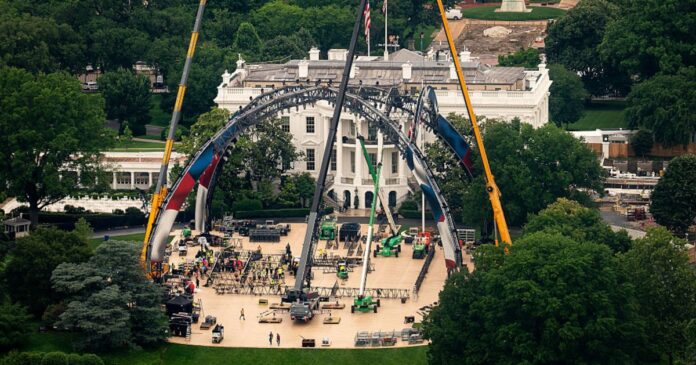
WASHINGTON. A federal lawsuit filed over the weekend asks a judge to pull the plug on the cage fights the Ultimate Fighting Championship plans to stage on the South Lawn of the White House on June 14, President Trump’s 80th birthday, arguing the administration broke its own rules to hand a private, for-profit sports promotion run by the President’s close friend unprecedented access to two of the nation’s most sacred public spaces.

The complaint was filed Saturday, June 6, in the U.S. District Court for the District of Columbia by the watchdog group Public Integrity Project on behalf of two Virginia residents, a senior-citizen activist named Susan Douglas and a Vietnam War veteran named Paul Romano. It names the National Park Service, Interior Secretary Doug Burgum, and other federal officials as defendants. President Trump himself is not named.
“This is fundamentally a private, commercial, corrupt use of our most sacred national monuments for private gain,” plaintiffs’ attorney Brendan Ballou said in remarks reported by the Associated Press.
The event, billed as “UFC Freedom 250,” is set for a seven-bout card on the South Lawn, with ceremonial weigh-ins the night before at the Lincoln Memorial and fighter walkouts that reportedly begin inside the Oval Office. Below are the most newsworthy claims in the 35-page filing, with the relevant passages clipped directly from the complaint.
1. The core allegation: a public monument turned over to a private business ally
The suit’s opening pages do not mince words. The plaintiffs allege the President is giving UFC chief executive Dana White and his company something no private promoter has ever received: open access to the White House grounds and the Lincoln Memorial to run a profit-driven sports show, complete with branding and sponsorship opportunities steps from the Executive Residence.

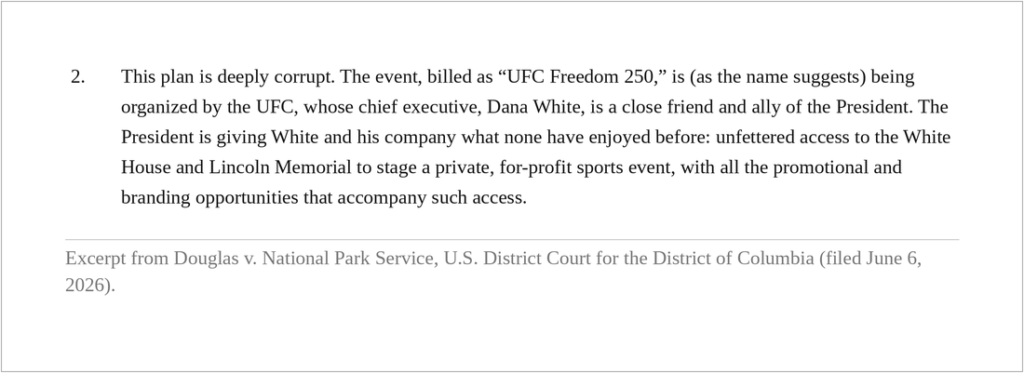
White, who introduced President Trump before his speech at the 2024 Republican National Convention, has insisted the event is a celebration of “the 250th birthday of America” and that landing it on the President’s birthday is pure coincidence. The complaint flags two facts it says undercut that story: White has admitted the event “was Trump’s idea,” and the UFC almost never holds Sunday-night cards in the United States, having last done so in February 2019. America’s actual 250th birthday, July 4, falls on a Saturday this year, yet no UFC event is scheduled for that date.
2. The President stands to profit from the company in the spotlight
One of the most explosive paragraphs concerns money flowing toward the President himself. The complaint alleges that earlier this spring President Trump bought up to $50,000 in stock of TKO Group Holdings, the publicly traded company that owns the UFC.
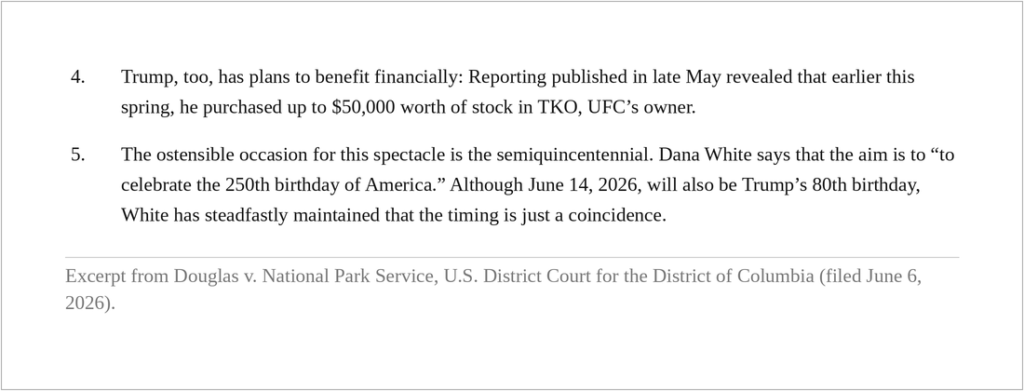
That detail tracks public reporting. According to a HuffPost review of the President’s May 12 financial disclosure, Trump purchased between $15,001 and $50,000 of TKO stock on March 25, weeks after the White House event was announced. TKO shares climbed in the days after the disclosure became public. Jordan Libowitz of Citizens for Responsibility and Ethics in Washington called using the White House to promote a company whose stock the President holds “one of the worst conflicts of interest you could imagine.” The White House has said the President’s assets are managed in a trust by his children and that there is no conflict.
3. “The Claw”: a 600-ton steel arch that dwarfs the White House
The physical footprint of the event is its own count in the lawsuit. The UFC is building a 92-foot-tall, 154-foot-wide, 600-ton steel structure that White calls “the Claw” on the South Lawn. For scale, the White House itself stands only 70 feet at its highest point. The complaint says the structure is visible from the National Mall and is destroying the lawn in the process, with White himself estimating $700,000 in repairs.
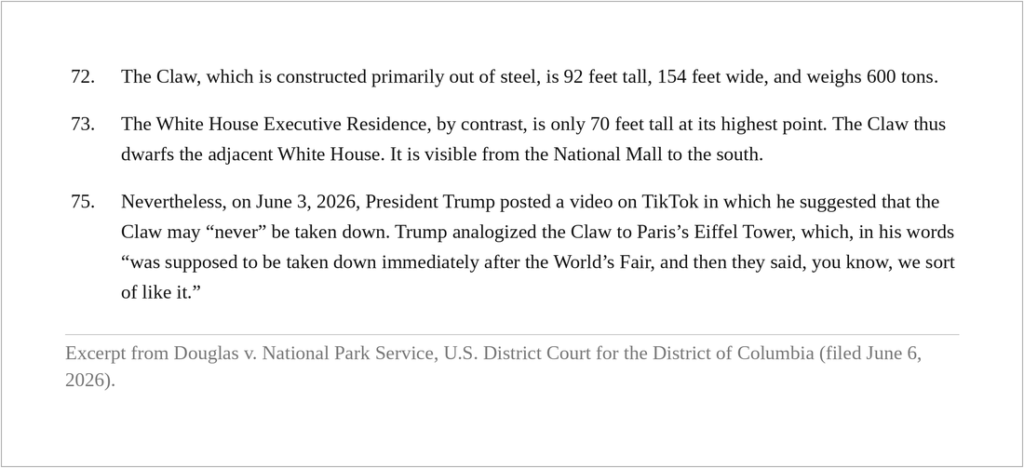
That last point matters legally. Under the Park Service’s Organic Act, 40 U.S.C. § 8106, no structure may be erected on federal public grounds in the District of Columbia without express authorization from Congress. The plaintiffs say Congress never authorized the Claw, whether temporary or, as the President has floated, permanent.
4. Even the “Freedom 250” organization says the fight is not its event
This is the legal heart of the case. The administration is relying on a 2025 temporary Park Service rule that lets the agency waive its normal ban on special events in the “White House area” and at the Lincoln Memorial, but only for America250 events “planned, organized, and executed by executive departments and agencies or the Semiquincentennial Commission.” The plaintiffs argue UFC Freedom 250 meets neither condition.
Their strongest piece of evidence is recent reporting in which a spokesperson for Freedom 250, the public-private entity many had assumed was running the show, disclaimed any involvement.
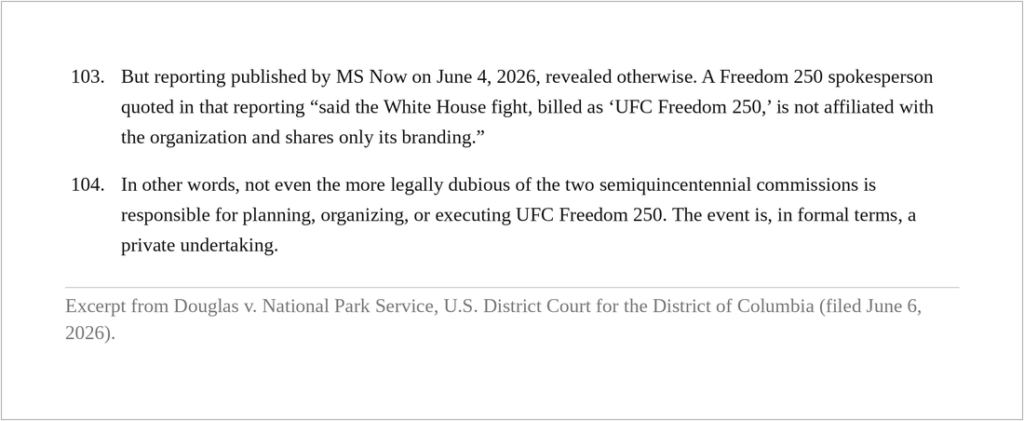
If accurate, that admission would mean the only government role is security coordination by the Secret Service, which the suit says is not enough to make the federal government the “planner, organizer, and executor” the rule requires.
5. The for-profit hallmarks: VIP packages, a fitness test for free seats, and a crypto sponsor
To show the event is a commercial venture rather than a national celebration, the complaint catalogs its business mechanics. Capacity is reported at more than 4,000 seats, split roughly into thirds among the UFC, White House personnel and families, and servicemembers. The catch for the troops is hard to miss.
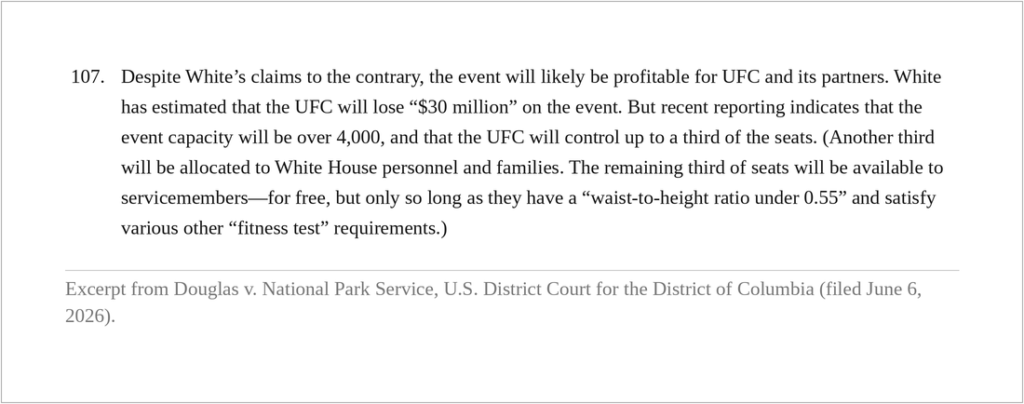
On the revenue side, the complaint takes apart White’s public claim that the UFC will lose $30 million. It points to “sponsorship packages” that the suit says are really expensive tickets in disguise.
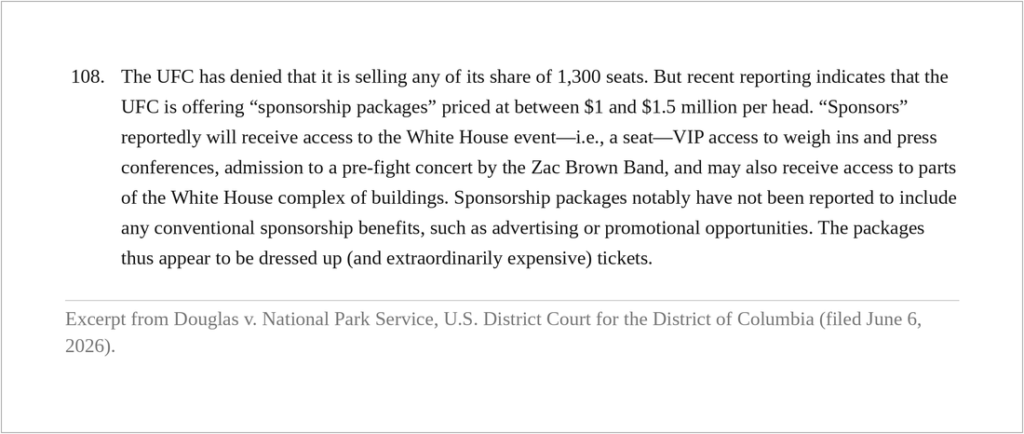
Those figures match outside reporting. Coverage of the package sales has pegged the top tier at $1.5 million per head. The suit also notes that the broadcast goes out on a paid platform, with the marquee main card available only on Paramount Plus at $8.99 a month, and that Singaporean cryptocurrency exchange Crypto.com is a lead branding partner, splashing the White House across its promotional art and dangling $1 million in crypto performance bonuses to fighters. TKO President Mark Shapiro, the complaint notes, has called the event “the greatest earned-marketing tool of all time.”
6. The Lincoln Memorial weigh-ins and the Vietnam Veterans Memorial
The two plaintiffs frame their personal injuries around the monuments. The suit describes UFC weigh-ins as “raucous, profane, and sometimes violent affairs,” citing past face-offs that turned into shoving matches and slurs, and argues that staging one at the Lincoln Memorial desecrates a space inscribed with the Gettysburg Address and the Second Inaugural and marked at the spot where Dr. Martin Luther King Jr. delivered “I Have a Dream.” Romano, the veteran plaintiff, says amplified sound from the weigh-ins would carry to the nearby Vietnam Veterans Memorial, where several men he grew up with are named on the wall.
The five legal claims
The complaint pleads five counts: that the authorization violated Park Service regulations barring sporting events on the South Lawn and at the Lincoln Memorial; that erecting the Claw without congressional sign-off violated the Organic Act; that the administration skipped environmental review required by the National Environmental Policy Act; that the agencies acted beyond any lawful authority (ultra vires); and a request for a declaratory judgment. The plaintiffs are asking the court for a temporary restraining order and injunction to stop the event and the construction before June 14.
The administration’s response
The White House has dismissed the suit. In a statement reported by the Associated Press, it called the challenge “an obstructionist, baseless, and dilatory” attempt to block the President from hosting the fight, and said the event was “no different than the various other White House-hosted events on the South Lawn.” The UFC did not immediately respond to reporters’ requests for comment.
Analysis: What happens if a judge says no and the fight goes on anyway?
My personal analysis here. Set the merits aside for a moment and game out the part nobody in the wire copy is asking: suppose the plaintiffs win an order, and the administration stages the fight on June 14 regardless. What then? A few things are worth understanding, with the caveat that this is analysis of how these mechanics generally work, not a prediction of what any particular judge will do.
First, who an injunction would actually bind. President Trump is not a defendant, and that is deliberate. Courts since the 1860s have been extremely reluctant to issue orders directly commanding the President to perform or stop an official act. So any injunction would run against the Park Service, Interior, and the named officials, ordering them to revoke or stop relying on the event authorization. The practical target is the permit, not the man.
Second, the timing problem cuts against the plaintiffs. The fight is June 14. A court has to decide a temporary restraining order in days, not weeks. If the event simply happens before a judge rules, the claims about the fight itself could be dismissed as moot, the legal way of saying the horse has left the barn. The one thing that likely survives is the Claw. The President’s own TikTok musing that the structure might stay up “forever,” like the Eiffel Tower, hands the plaintiffs a live, ongoing controversy over the steel arch even after the cage is folded up, along with the environmental-review claim.
Third, defying an order is legally possible but costly. There is no button a judge can push to enforce an injunction. The federal officers who carry out court orders, the U.S. Marshals, answer to the executive branch. What a court can do is hold named officials in civil contempt, which is coercive: think escalating daily fines, or in theory detention, until they comply. Criminal contempt is also on the table for willful defiance. In modern American practice the executive has complied with adverse court orders even when it loathed them, precisely because open defiance triggers a constitutional crisis that administrations have judged not worth provoking. Whether that norm holds is the genuinely unsettled question this case could test.
So, could the UFC sue? This is the question I find most interesting, and the short answer is that a new lawsuit by the UFC is the weakest of its options.
The UFC has no claim against Douglas and Romano. Private citizens challenging a government permit are exercising a legal right, not committing a wrong the promoter can sue over. A claim against the government is not much better. A permit to use federal parkland is a revocable privilege, not a vested property right, and you generally cannot build a takings or breach-of-contract case on reliance on a permit that a court has just declared was unlawful in the first place. Sovereign immunity blocks most damages suits against the United States, and the specialized court that hears contract claims against the government, the Court of Federal Claims, needs an actual contract to work with. There isn’t one here in the ordinary sense.
The realistic move for the UFC is not to file its own case but to intervene in this one. Under Federal Rule of Civil Procedure 24, a company whose $60 million investment is directly threatened by the outcome has a strong argument to join as a defendant-intervenor and defend the permit alongside the government. That also lets the UFC press the one financial lever it does have: under Rule 65(c), a party that wins a temporary restraining order can be required to post a bond to cover the other side’s losses if the order later turns out to be wrongful. The UFC would surely argue for an enormous bond given its outlay. Plaintiffs in public-interest cases, by contrast, often ask the court to set a nominal bond or waive it entirely. That fight over the bond number could quietly decide the whole case.
One more wrinkle. If a court does enjoin the event and the UFC proceeds anyway, the promoter is not necessarily in the clear just because it isn’t a defendant. Rule 65(d) extends an injunction not only to the named parties but to their agents and to anyone “in active concert or participation” with them who has notice of the order. A promoter running the very event a court just blocked, hand in glove with the federal agencies that authorized it, could find itself exposed to contempt right alongside the officials. That is a long way from where things stand today, but it is the scenario the “ignore it and go forward” question actually leads to.
The bottom line: the plaintiffs’ real race is against the calendar, the strongest piece of their case is the structure that may outlast the fight, and the UFC’s smartest play is to climb into this lawsuit rather than start a new one. We will be watching the docket.
The Space Coast Rocket will update this story as the court acts. The complaint is Douglas v. National Park Service, U.S. District Court for the District of Columbia, filed June 6, 2026.
Criminal Defense
Bankruptcy · Evictions
WICKS LAW P.A.
Call or text for
free consult
321-733-2700
Eric Wicks, Esq.
1250 West Eau Gallie Blvd. G
Melbourne, FL 32935
Abogado Wicks habla español