
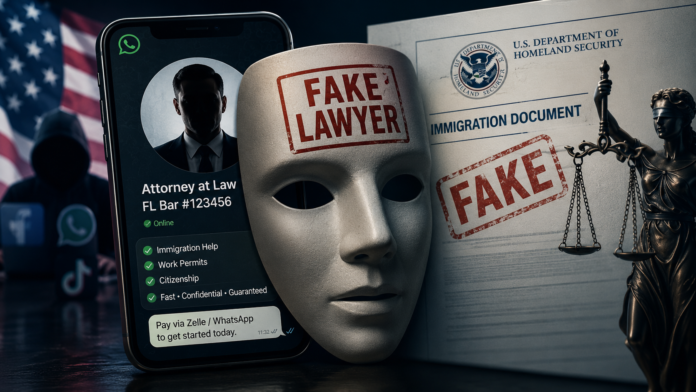
The Florida Bar is warning the public about a fast-growing fraud scheme in which criminals steal the identities of licensed attorneys, complete with their real names and bar numbers, to sell fake immigration services to frightened, vulnerable people. In a notice published June 5, the Bar echoed an alert from the American Bar Association describing a sophisticated operation that has already produced real financial losses and, in some cases, missed court deadlines and deportation orders.

According to the ABA, fraudsters are pulling attorneys’ names and bar numbers off publicly available websites and pairing them with fake retainer agreements, fabricated credentials, and bogus documents stamped with the seals of U.S. immigration agencies. By attaching a legitimate bar number to the pitch, scammers borrow the credibility of a real lawyer and make the deception much harder to spot. In many cases, the impersonated attorney has no idea their identity is being used until a stranger calls to ask about the status of a case the lawyer never took.
The schemes run almost entirely through social media and messaging apps, with the ABA singling out WhatsApp, Facebook, and TikTok as the primary channels. The organization said it has reported the activity to multiple federal agencies, including the Department of Homeland Security Office of Inspector General and the Executive Office for Immigration Review’s Fraud and Abuse Prevention Program, and that federal investigators are actively engaged.
Florida Lawyers Are Among the Targets
This is not a distant problem. Some of the most striking cases involve attorneys practicing right here in Florida. Angel Leal Jr., an immigration lawyer in Doral, told NBC News and Noticias Telemundo that scammers cloned his image, his name, and even his voice using artificial intelligence, then used the manipulated videos to promise things no lawyer can deliver, including citizenship without an exam and near-instant work permits.
Leal said the fraud forced him to shut down every WhatsApp channel his firm operated and to hire an outside company that does nothing but hunt down and report fake accounts. That firm has taken down thousands of profiles impersonating him. The effort has cost him thousands of dollars, but he said the deeper wound is the harm done to the people who trusted the fake version of him.

At the University of Miami School of Law, Immigration Clinic associate director Andrea Jacoski discovered an impostor was circulating a counterfeit University of Miami ID card and a business card carrying her real Florida Bar number. Three victims contacted her in a single week. One person in Colorado missed an immigration court hearing after a scammer claimed a $500 payment could buy a new hearing date. Because immigration law is federal, Jacoski warned, a single stolen bar number can be used to file fraudulent applications anywhere in the country.
Why the Surge, and Why Now
Experts point to a combination of fear, demand, and technology. The ABA’s Adonia Simpson, deputy director of policy and pro bono services for the group’s Commission on Immigration, said heightened anxiety over President Trump’s immigration enforcement has pushed many people to try to fix their status quickly, while AI tools now make fake videos, photos, and contracts look convincingly real.
The demand for help vastly outstrips the supply of legitimate lawyers. The Transactional Records Access Clearinghouse at Syracuse University counted more than 3.3 million active cases pending in the immigration court system at the end of February, and as of March only about a third of immigrants had legal representation when deportation orders were issued. That gap is exactly the opening fraudsters exploit.
The losses are staggering in aggregate. The Federal Trade Commission reported more than one million identity theft scams in the U.S. last year, with losses topping $3.5 billion, an increase of nearly 20 percent over the prior year. In May, the FBI in Chicago issued its own public warning about criminals posing as lawyers and immigration officials. A spokesperson for U.S. Citizenship and Immigration Services said the agency has declared “all-out war on immigration fraud in all its forms.”
How the Fraud Plays Out
The script tends to follow a pattern. Contact begins on a social media platform, moves to private messages, and then shifts to WhatsApp, where the victim is asked to pay through a money transfer app. Simpson described how scammers adapted after the ABA publicly clarified that it never charges for its services: the criminals simply relabeled their contracts as “pro bono” and tacked on a long list of invented expenses, such as “flight risk” premiums and nonexistent government fees, then collected thousands of dollars anyway.
The financial hit, as severe as it is, may not be the worst part. A poorly filed application, a missed deadline, or a hearing skipped because the victim believed a fake lawyer was handling everything can permanently close the door to legal status. In documented cases, people paid for Photoshopped green cards and work permits while a real deportation order sat unanswered in their file, exposing them to detention and removal they never saw coming.
How to Protect Yourself and Your Family
The guidance from the ABA and the Florida Bar is straightforward, and it applies to anyone in our community who is helping a friend, neighbor, or relative navigate the immigration system.
Reputable legal organizations do not cold-contact people through social media or WhatsApp to solicit business. The ABA generally does not charge for legal services, and no legitimate attorney or nonprofit will demand payment through Zelle, WhatsApp, wire transfer, or gift cards. Before paying anyone, verify the attorney’s credentials directly through an official source rather than a link or phone number the contact provides. Florida residents can look up any lawyer through the Florida Bar’s official attorney directory and call the listed office to confirm the person is real and is actually handling the case.
If you believe an attorney’s identity has been stolen, or you suspect you are being scammed using a Florida lawyer’s name, the Florida Bar’s Attorney/Consumer Assistance Program takes reports at 866-352-0707. The Bar can place a temporary alert on a member’s profile warning the public and directing anyone with doubts to contact the attorney directly. The ABA Commission on Immigration has also published resources for the public on spotting and reporting these scams.
One factor keeps this fraud thriving: many victims are afraid to come forward because of their immigration status. That fear is precisely what the scammers count on. Reporting the crime, even anonymously through a trusted nonprofit or bar association, is how investigators build cases and how the next family avoids the same trap.
Criminal Defense
Bankruptcy · Evictions
WICKS LAW P.A.
Call or text for
free consult
321-733-2700
Eric Wicks, Esq.
1250 West Eau Gallie Blvd. G
Melbourne, FL 32935
Abogado Wicks habla español