
A newly surfaced state procurement document shows the Florida Highway Patrol is quietly gauging interest from construction firms in building a new round of “temporary adult detention facilities” across Florida, with site criteria that could put parts of Brevard County in the running.

The Request for Information, numbered FLHSMV-RFI-027-27 and titled “Temporary Detention Facilities,” was posted to the state’s MyFloridaMarketPlace Vendor Information Portal on Aug. 3 and closes Aug. 10 at 2 p.m. It was flagged publicly this week by state Rep. Anna Eskamani, D-Orlando, who posted the document to Facebook.
The Florida Department of Highway Safety and Motor Vehicles, which oversees FHP and is led by Executive Director Dave Kerner, a Democrat DeSantis appointed to the post in 2023, says the RFI is for planning purposes only and is not a solicitation or a commitment to buy anything. But the document lays out what the agency is planning for: a network of small, short-term holding sites built to house detainees “under the oversight of the U.S. Government,” each with a maximum capacity of about 50 adults, male and female, held “up to 48 hours or more.”
What the state is asking builders
The RFI asks vendors with detention or correctional construction experience to weigh in on nearly every piece of building a holding facility: masonry or cinder block construction, security-rated doors and windows, perimeter fencing and sallyports, camera and access control systems, kitchen and food service, showers and restrooms, control rooms, and office space for “state and federal personnel, including interview/case management spaces.”
On siting, the department asks respondents to recommend “five (5) or more” specific locations “south of the Interstate 4 (I-4) corridor,” or general guidance by county, where a facility would be feasible to build and permittable under local zoning rules. The RFI does not name Brevard County specifically, and the geography is not as clean as it sounds. I-4 runs diagonally from Tampa to Daytona Beach, gaining latitude as it goes east, so “south of I-4” isn’t a flat line across the state. South and Central Brevard, including Melbourne and Palm Bay, sit clearly south of where the interstate passes through Orlando. North Brevard, near Titusville and Mims, sits close enough to that same latitude that it’s a harder fit for the state’s own criteria.

The document also instructs vendors to address how facilities built with federal grant money can comply with future use restrictions, and it recommends the state hold onto ownership rather than lease the land, “ensuring facilities are built on state-owned (not leased) property.” Responses go to Joley Owens in FLHSMV’s Bureau of Purchasing and Contracts by the Aug. 10 deadline. Hard copy submissions will not be accepted.
Notably, the RFI’s own paperwork carries a sign of how quickly it came together. Page one’s footer still reads “FLHSMV-RFI-035-25,” an apparent leftover from an earlier document the department reused as a template, even though every other page in the packet is correctly labeled RFI-027-27.
Part of a bigger buildout
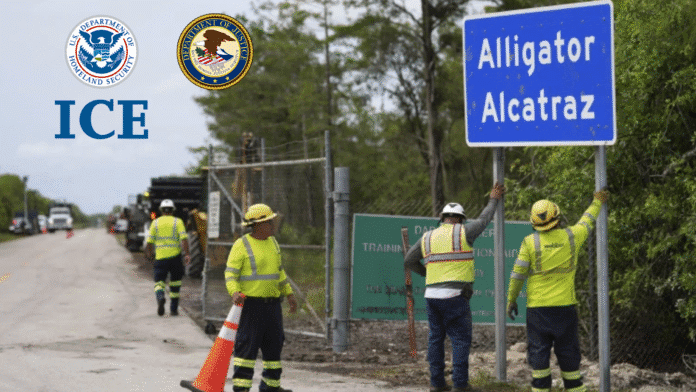
This RFI follows two detention facilities Florida has already stood up under Gov. Ron DeSantis in partnership with President Trump’s deportation push. The first, built on a former Everglades airstrip and nicknamed “Alligator Alcatraz,” opened last July with capacity officials have put anywhere from 3,000 to as high as 5,000, and projected to cost about $450 million a year to run, with Florida taxpayers footing the bill upfront before federal reimbursement, according to the ACLU. The second, called “Deportation Depot,” opened last September inside the shuttered Baker Correctional Institution near Lake City with room for roughly 1,300 to 1,500 detainees.
What this RFI describes is different in scale. Rather than one or two large camps, the document points toward a scattering of much smaller sites, each capped around 50 people and meant for short stays, which on paper reads more like staging or short-term processing capacity than a long-term detention camp.
The timing lines up with a major shift in federal immigration policy. Temporary Protected Status for roughly 350,000 Haitian nationals nationwide, an estimated 150,000 to 158,000 of them in Florida, formally ended this week after a federal judge signed off on the Trump administration’s move to terminate the program, following a U.S. Supreme Court ruling that cleared the way. Homeland Security officials have said people who lose TPS and have no other pending immigration relief are now subject to enforcement and removal.
Eskamani’s reaction
Eskamani, who has repeatedly clashed with the DeSantis administration over its detention facilities, including being denied entry to Alligator Alcatraz last year, described the new RFI as essentially a taxpayer-funded push to build for-profit detention capacity, and said she believes it is aimed at people who have lost Temporary Protected Status. “I’m sure this is them prepared to detain immigrants who have lost TPS status,” she wrote.
FLHSMV had not issued any public statement connecting the RFI to TPS, and the Rocket found no comment from the department, the Governor’s Office, or DHS addressing the document as of publication.
What’s next
Because this is an RFI and not a solicitation, the state is under no obligation to move forward with anything vendors submit, and firms that respond aren’t barred from bidding if a formal contract opportunity follows. But RFIs are typically the first visible step toward a real procurement, and this one gives the clearest look yet at how large the state’s next expansion of detention capacity could be, and where it might land. Given the site guidance, South and Central Brevard could see interest from vendors scouting locations well before any formal bid goes out.
The Rocket will continue following this story as the RFI period closes and any resulting solicitation becomes public.
Criminal Defense
Bankruptcy · Evictions
WICKS LAW P.A.
Call or text for
free consult
321-733-2700
Eric Wicks, Esq.
1250 West Eau Gallie Blvd. G
Melbourne, FL 32935
Abogado Wicks habla español