

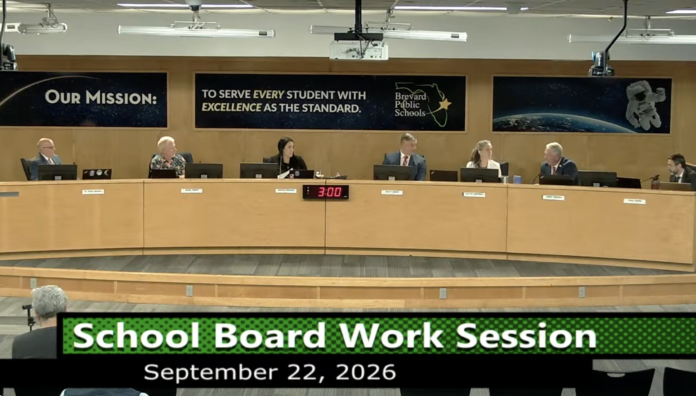
VIERA, Fla. – Brevard County School Board members agreed Tuesday that all public comment at board meetings, including non-agenda comment that has been kept off the district’s livestream since 2023, should be broadcast and archived.

Board members did not settle whether to combine the agenda and non-agenda comment periods, whether non-agenda comment should move to the start of meetings, or how to structure proposed community conversations with the board. Those questions were pushed to the board’s Oct. 6 work session.
The discussion, requested by District 3 board member John Thomas, ran just over an hour at the board’s Sept. 22 work session. Work sessions do not include votes, so any change will still need to go through the board’s formal policy process.
Board chair Matt Susin summarized the areas of agreement near the end of the discussion: streaming all public comment, some form of speaking time limits, regular community conversations, and keeping the board’s authority to adjust speaking times in extraordinary circumstances.
How the discussion got here
Under the policy adopted in 2023, the board splits public comment into two parts. Residents may speak for three minutes on agenda items before the board acts, and for three minutes on non-agenda topics later in the meeting. Only the agenda portion is included in the district’s livestream and archived video. The board made that change amid concerns that speakers might read explicit passages from challenged library books aloud under HB 1069, the state law governing objections to school materials.

The board’s public comment rules had already drawn legal challenges. Moms for Liberty’s Brevard chapter and several parents sued the district in 2021 over rules barring “abusive,” “personally directed” and “obscene” comments. A federal judge initially sided with the district, but in October 2024 the 11th U.S. Circuit Court of Appeals reversed that decision in a 2-1 ruling, finding the rules unreasonable and vague. Susin, then the board’s vice chair, was a named defendant. When the plaintiffs’ attorneys said the board kept enforcing the rules, a federal judge issued a temporary restraining order in January 2025 barring the board from enforcing or even reciting them.
Thomas, who took office in November 2024, had asked for months to revisit the policy. A “Public Comment Policy Discussion” was listed on the agenda for the board’s Sept. 10 work session, with supporting documents attached. According to Brevard Public Schools Watch, a political action committee that tracks the board, the item appeared on the agenda posted at 11:30 a.m. that day but was gone from a version posted at 12:30 p.m., about 30 minutes before the meeting began. The group attributed the removal to Susin.
During that Sept. 10 work session, Thomas said he wanted the discussion held at the board’s regular Sept. 22 work session. Susin proposed taking it up instead at the board’s off-site workshop on Sept. 15 at the Brevard Veterans Memorial Center on Merritt Island, and Trent agreed. Thomas objected. BPS Watch argued that off-site workshops are generally not televised and draw few members of the public.
In a Sept. 11 Facebook post, Thomas announced both dates, writing that discussions about the public’s ability to address the board “should be open, accessible, and easy for the public to follow.” He said he would reserve substantive discussion for properly noticed public meetings under Florida’s Sunshine Law.
At the Sept. 15 workshop, Thomas gave board members a memorandum outlining his original proposals: livestream and archive all public comment, move non-agenda comment ahead of the consent agenda, and give residents up to three minutes on each individual agenda item before the board votes, rather than a single three-minute window covering all agenda items. The public comment discussion itself was then placed on the Sept. 22 work session agenda.
In the memo, Thomas wrote that every restriction on public participation “should serve a legitimate and necessary purpose,” and that while order and efficiency qualify, “Our own comfort or convenience should not be.” BPS Watch said it supports his proposals and urged residents to attend Tuesday’s session.
Thomas revises his proposal
Thomas opened by saying he had revised the proposals in the memorandum he gave board members at the Sept. 15 off-site workshop after reading a memo from board attorney Paul Gibbs, hearing from residents and reviewing how other school boards handle public comment.
He said the entire board, himself included, was responsible for the current policy and that his memo was not meant to suggest anyone acted with ill intent. “I think we need to take steps to correct it,” he said.
His revised proposal would move non-agenda comment before the consent agenda, give speakers three minutes when 15 or fewer sign up and two minutes when 16 or more sign up, and livestream and archive both agenda and non-agenda comment under the same broadcast standard.
Thomas said keeping two separate comment periods preserves a resident’s chance to speak twice, for a total of six minutes. Combining them into one period would cut that to three. “My goal is to maximize the opportunity that they have for participation,” he said.
He also told the board he did not recall speakers trying to raise non-agenda topics during agenda comment when all comment was televised. “It only became an issue when it became non-televised,” he said.
“I would venture to guess we’re probably one of the only all-conservative boards,” Thomas said, “and if anybody has an open government and maximum public participation, it should be us. We should be leading the charge.”
Wright: ‘It’s not working’
District 1 board member Megan Wright said the current approach “is not working” and the board has a responsibility to acknowledge it.
“It’s not our job to control what the public says,” Wright said. She said all public comment should be streamed and recorded, noting there have been times she could not defend her own position on an issue because no recording existed.
Wright initially said she favored a single, combined public comment period that would be fully televised, calling it the simpler approach. Later in the discussion, she said she preferred keeping non-agenda comment at the end of the meeting, with the cameras turned on.
She said the board has seen “out of town paid protesters” speak on non-agenda topics, and that hearing from residents about items before a vote matters. “None of us are in our best form to govern adequately and be able to articulate what we need to say on what’s happening with the agenda after you get beat down for three minutes for two hours,” she said.
Trent open to cameras, favors a time cap
District 2 board member Gene Trent said he had “no problem putting everything under the camera” if that is what the board wants.
Trent said many Florida districts cap public comment at 30 minutes to an hour. He suggested a one-hour limit, which would allow 20 speakers at three minutes each, with shorter times if more people sign up. He said he had not seen any district in the state give speakers six minutes before business begins.
Trent said the decision to keep non-agenda comment off camera was not only about criticism of the board. He said some parents wanted to bring young children to speak without having them appear on YouTube.
“I think we’re looking for a solution in search of a problem in many of these cases,” Trent said, adding the board had not seen an outcry over the change “until it was brought up.” He also noted that phone calls, emails and meetings are more effective ways to reach board members than public comment.
Campbell explains why cameras were turned off
District 5 board member Katye Campbell, who noted she will not be on the board after November, said the decision to stop broadcasting non-agenda comment was tied to the Moms for Liberty lawsuit against the district.
In October 2024, the 11th U.S. Circuit Court of Appeals ruled that the board’s bans on “abusive,” “personally directed” and “obscene” comments violated the First Amendment. In January 2025, a federal judge in Orlando barred the board from enforcing those rules.
Campbell said the ruling went beyond what the plaintiffs asked for and meant the board could no longer stop speakers from naming students or staff. She said she pushed to turn off the cameras during non-agenda comment because she did not want students’ names on the district’s YouTube channel, and that in several meetings after the change, speakers mentioned students or staff members in derogatory ways during the unbroadcast portion.
Gibbs confirmed the board can still stop speakers for prohibited profanity but cannot stop them from naming people, including students. Staff members who believe they have been defamed would have to sue the speaker on their own, he said. “The board has no control over the speaker,” Gibbs said, adding that he had been in a district where a defamed principal sued a parent and won a $75,000 judgment.
Campbell said the simplest solution would be to either return to a single comment period or keep the current structure and turn the cameras back on. She urged the board to keep its existing authority to change speaking times by majority vote, recalling that during the COVID-era mask debates, 132 people signed up and each was given one minute.
She also argued against combining comment periods, citing a representative of Ford and Associates who had to wait through public comment Tuesday for a vote on the district’s TAN. Staff and outside representatives who attend for specific agenda items would have to wait longer if all comment came first, she said.
Susin floats comment before the business meeting
Susin suggested holding public comment before the business portion of evening meetings, followed by a short break, so district staff could research concerns raised by speakers and board members could respond before the meeting ends.
Gibbs said the board can place public comment wherever it chooses. Trent said Orange County schools hold public comment before their meetings, while Pinellas County adjourns and then hears non-agenda comment with cameras still running.
“There’s been people that have trash talked me. I said, ‘Let them go,'” Susin said. “I have no problem listening to anybody say anything. I just want the ability to have the time to address them.”
Campbell cautioned against starting meetings as early as 4:30 p.m., saying bus drivers and parents already struggle to arrive by 5:30. Thomas said the board should not write policy around people who might abuse the process.
Cameras could return before the policy changes
Campbell said the board does not have to wait for a formal policy revision to turn the cameras on. She said that in 2020 or 2021, after the board voted to turn cameras off, it voted at every meeting to keep them on until the policy was changed. Gibbs said the board would have to vote either to change the policy or to override it for a given meeting.
Campbell said she heard at least a three-member consensus for keeping the current structure and turning the cameras back on.
Thomas agreed with taking that first step. “Leave everything else as is. Let’s hear from the public over the next few weeks,” he said, adding that the board could bring back larger revisions at a later work session.
Community conversations
Board members also backed Wright’s proposal for regular “community conversations,” which she said would allow back-and-forth discussion that public comment does not. She said she prefers that name over “town hall” and wants the sessions held at the district office so they can be recorded and posted to YouTube.
Superintendent Dr. Mark Rendell said that during his first year he held five town halls across the county, with a maximum attendance of 18 and most drawing fewer than 10. Campbell said the sessions should be set as a practice rather than written into policy, and suggested the board schedule its first one in January after its new member is seated.
What happens next
The board will take up the unresolved questions at its Oct. 6 work session: whether to keep agenda and non-agenda comment separate, whether non-agenda comment should come at the start or end of meetings, and how to structure the community conversations.
Thomas said he will not attend that meeting. Gibbs said Thomas can submit his position in writing, which Gibbs will share with the board at the workshop.
Closing the discussion, Susin thanked board members for their research. “I think under these rules, we’ll probably have the most open opportunities with the town halls that I think anybody has in our county,” he said.
Criminal Defense
Bankruptcy · Evictions
WICKS LAW P.A.
Call or text for
free consult
321-733-2700
Eric Wicks, Esq.
1250 West Eau Gallie Blvd. G
Melbourne, FL 32935
Abogado Wicks habla español