


A three-judge panel took more than a year after it was assigned the case to decide it, and when it did, it never reached the question of whether the congressman’s courtroom conduct happened at all.

Editor’s note: This report concerns litigation in which the Rocket’s editor and publisher, Robert W. Burns III, is a named party. That relationship is disclosed here in the interest of transparency. This account is drawn from the appellate opinion, the certified hearing transcript, the trial court’s orders, and filings in the case.
It started with a middle finger and mouthing the words “F you” during a virtual court hearing in August 2024. It ended, for now, on June 19, 2026, when the Fifth District Court of Appeal wiped the resulting contempt order off the books. Between those two dates sat nearly two years, a state Senate election, a special election to Congress, and a three-judge panel that took more than twelve months from the day it was assigned the case to issue a four-page opinion. Fine never paid his fine nor took his court ordered anger management assessed by the judge. (The entire opinion is embedded at the end of this article)
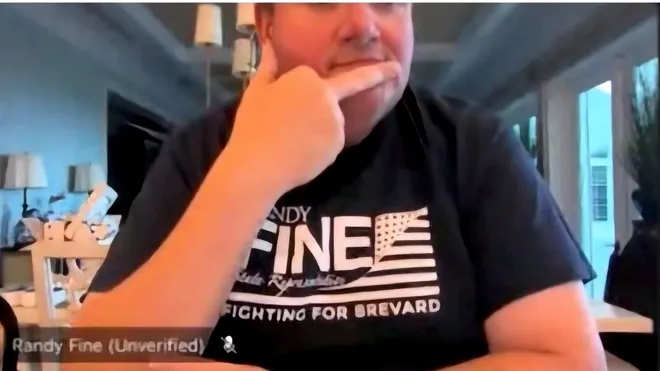
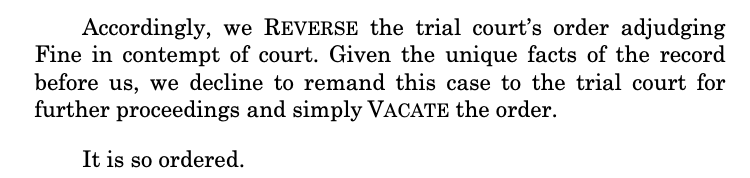
The man at the center of it, Randy Fine, was a state representative when a Brevard circuit judge found him in contempt. He is now a member of the United States House of Representatives, representing Florida’s 6th Congressional District since April 2, 2025. (He also has a handful of ethics violations cases in the Florida Commission on Ethics that have been pending FOR YEARS) By the time the appellate court ruled, the order it vacated was almost twenty months old and the man it once sanctioned had moved from Tallahassee to Washington.
What the contempt was about
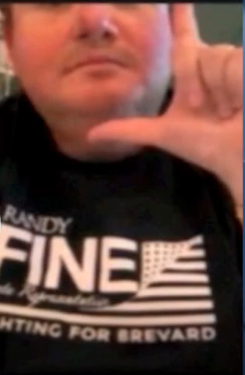
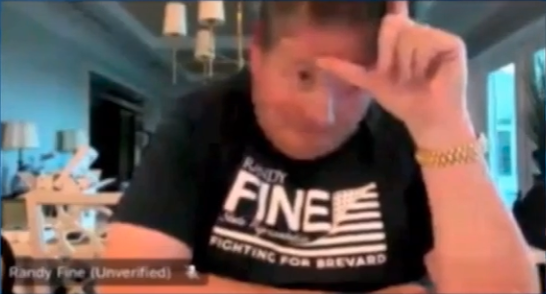
The underlying dispute was a ballot fight. In the summer of 2024, Burns petitioned to disqualify Fine and Wayne Twiddy as candidates for a Republican State Committeeman post, naming Brevard County Supervisor of Elections Tim Bobanic. During an August 19, 2024 virtual hearing in that case, witnesses said Fine repeatedly flipped his middle finger, formed an “L” for “loser,” and mouthed obscenities. Circuit Judge Scott Blaue later found Fine in civil contempt, writing in his order that the gestures and mouthed words went on for at least 33 minutes and were directed at Burns rather than at the court.

Blaue dismissed the ballot petition itself with prejudice due to Burns having lack of standing not being a candidate, then proceeded with the contempt matter. After an October 1, 2024 hearing, he ordered Fine to pay a small purge amount and complete an eight-hour, in-person anger management course through the Florida Safety Council. The order followed a string of show-cause proceedings that drew statewide and national coverage. Fine publicly called the hearing a “clown show,” said he would not comply, and announced complaints and impeachment papers against the judge. The Florida House did not entertain Fine’s impeachment request.
The ruling, and what it did not say
Fine appealed. The case was assigned to a panel of the Fifth District Court of Appeal on June 4, 2025. The panel did not issue its decision until June 19, 2026, more than a year later.
When the opinion arrived, it was narrow. Judge Adrian Soud, joined by Judges Brian D. Lambert and James A. Edwards, reversed on a single procedural ground. During the October 2024 hearing, Fine’s counsel had asked for time to return to his office in Orlando, to prepare a written motion to disqualify Judge (for the 5th time) Blaue, and the judge denied that request. Citing the Florida Supreme Court’s 1993 decision in Rogers v. State, the panel held that when a disqualification issue arises during a hearing, a brief recess to prepare the written motion must be granted, and that denying it required reversal. The court described the request as resting on “matters that occurred during the hearing.” Rather than send the case back, the panel chose, in its words, to “simply VACATE the order.”
What the opinion did not do is just as important. It made no finding that Judge Blaue was actually biased. It did not decide whether Fine’s gestures happened, whether the 33 minutes of conduct occurred, or whether any of it was contemptuous. It expressly declined to reach those questions, resolving the appeal entirely on the recess issue and reaching nothing else. The reversal was about process, not about whether the underlying behavior took place.
The panel that changed twice
The case did not reach those three judges by a straight line. When the Fifth District assigned it on June 4, 2025, the panel was Chief Judge James A. Edwards, Judge Joseph Boatwright II, and Judge Jordan Pratt. By the time the decision issued a year later, two of those three were gone. An amended panel notice in December 2025 reconstituted the bench, and the opinion was ultimately decided by Soud, Lambert, and Edwards. Only Edwards sat on both versions.
One of the departures is worth noting. Jordan Pratt, appointed to the Fifth District by Governor Ron DeSantis in 2023, was already on a path off the state bench when he was assigned to this case. President Trump announced his intent to nominate Pratt to the U.S. District Court for the Middle District of Florida on May 28, 2025, six days before the panel in this appeal was set. Trump formally nominated him weeks later, the Senate confirmed him on October 28, 2025 by a vote of 52 to 47, and Pratt took the federal bench on November 3, 2025. His move to that lifetime appointment is what required his replacement on this panel.
The timing forms an unusual picture. Trump endorsed Fine during this time, and Trump elevated a judge briefly assigned to Fine’s appeal to a federal judgeship, all within the same months the panel was being formed. It should be said plainly that Pratt left the court roughly seven months before the opinion issued and took no part in deciding it. The three judges who ruled have no connection to that thread, and nothing in the record suggests the endorsement, the appointment, and the outcome are linked. The coincidence is in the calendar, not in the decision. Boatwright, the other judge dropped from the original panel, remains on the Fifth District; the court records reviewed for this report give no reason for his replacement.
Burns has filed a motion for rehearing, clarification, and certification, asking the panel to reconsider. The motion does not ask the court to reweigh the evidence. It argues, from the certified transcript, that the panel misapprehended a key fact: that the disqualification grounds were not events that arose during the hearing at all. They were raised at the very outset, before any witness testified, and concerned pre-hearing matters, including the judge’s appointment weeks earlier of an attorney to gather evidence and issue subpoenas, an order entered September 13, 2024. In fact, the transcript reveals that Fine’s attorney specifically precluded his motion with “before we get started,” conceding his motion wasn’t based off of something that happened during the hearing as the cited law by opinon requires.
The motion further points out that the trial judge did not simply refuse a recess. He ruled the request untimely, noting the appointment order was more than two weeks old and had drawn no objection. And it raises the text of the rule the panel itself cited, Florida Rule of General Practice and Judicial Administration 2.330(g), which provides that a disqualification motion made during a hearing or trial must be based on facts discovered during the hearing or trial. The motion contends the panel never addressed that built-in requirement. The record also reflects that Fine’s side had already sought the judge’s removal multiple times before October 1, through motions filed in August and September 2024 and petitions for writ of prohibition, all of which had been denied or were pending.
Finally, the motion asks the court to clarify two things: that its opinion makes no finding that Judge Blaue was biased or that Fine’s conduct did not occur, and why it chose outright vacatur instead of sending the case back to the trial court.
Why the calendar matters
Strip away the legal mechanics and a plainer fact remains. The conduct happened in August 2024. The contempt order was entered in October 2024. The appellate panel was set in June 2025. The decision came in June 2026. For most of that stretch, a sitting state legislator, and then a sitting member of Congress, was under a court order he had publicly vowed to ignore, while the appeal that would eventually erase it moved at the pace of years rather than months.
Whether the rehearing motion succeeds or not, the timeline is its own story. Courts speak through their dockets as much as their opinions, and this docket says that in Brevard County, a contempt fight over a virtual middle finger took the better part of two years to resolve, and was resolved without anyone ever deciding whether the finger was raised.
Criminal Defense
Bankruptcy · Evictions
WICKS LAW P.A.
Call or text for
free consult
321-733-2700
Eric Wicks, Esq.
1250 West Eau Gallie Blvd. G
Melbourne, FL 32935
Abogado Wicks habla español