


TALLAHASSEE, FL – The one man who can say under oath whether he intended to retire or resign, the single fact that decided whether Brevard County voters would elect their next county judge, will not have to answer the question. And he fought to keep it that way.

Leon County Circuit Judge Joshua Hawkes on Wednesday granted Brevard County Judge Benjamin Garagozlo’s motion to quash the deposition subpoena issued by petitioners Maggie Wagner and Marcie Adkins in their constitutional challenge to the cancellation of the Brevard County Court Group 8 election, Wagner and Adkins v. DeSantis
. The written order came down at 3:49 PM, just hours after a Zoom hearing that The Space Coast Rocket broadcast live.
The ruling means Judge Garagozlo’s deposition, which had been reset for Friday at 12:30 PM, will not happen.
The Question He Will Not Answer Under Oath
At the center of this case is a single page. On April 15, 2026, Judge Garagozlo wrote to Florida Supreme Court Chief Justice Carlos Muniz: “Please accept my notice to retire from the bench effective December 31, 2026.” The letter was copied to Eighteenth Judicial Circuit Chief Judge Melanie Chase. It was not addressed to Governor Ron DeSantis. It does not contain the word “resign.”

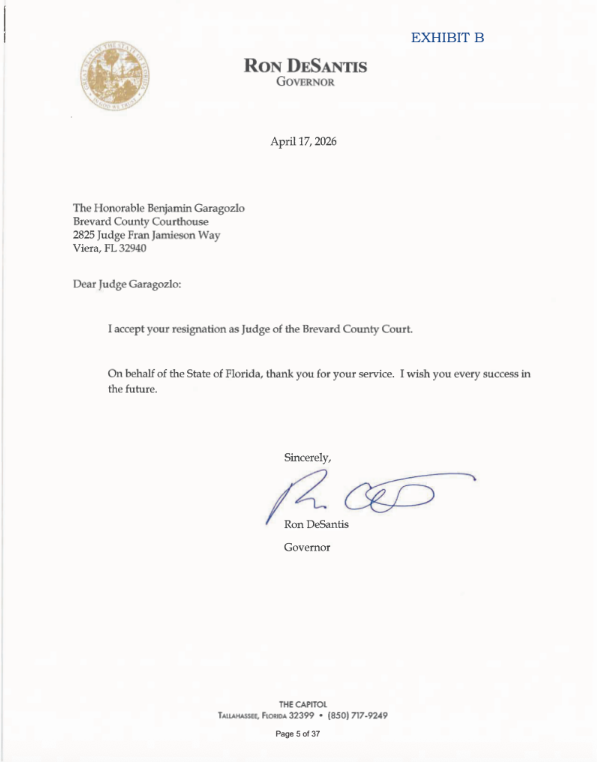
Two days later, court records show, April Copp, the circuit’s Chief of Personnel Services, forwarded the letter to three officials in the Governor’s office under a subject line calling it a “Retirement Letter.” Judge Garagozlo was not copied on that email. That same afternoon, Governor DeSantis wrote back accepting Garagozlo’s “resignation,” and by 4:00 PM the Brevard County Supervisor of Elections had notified Wagner, a qualified candidate, that the Group 8 seat was “no longer up for election” because the Governor would fill it by appointment.
Retirement or resignation. Under Section 114.01, Florida Statutes, a vacancy occurs upon “the resignation of the officer and acceptance thereof by the Governor.” The statute does not list retirement. Whether Judge Garagozlo tendered a resignation to the Governor is the factual hinge on which the entire constitutional case turns.
Petitioners’ attorney Jessica Travis of DefendBrevard.com first asked Judge Garagozlo for a voluntary affidavit limited to narrow factual points, including that his letter was a retirement notice and was never addressed or sent to the Governor. He did not provide one. Travis then issued a subpoena for a remote deposition built around eight questions, including “When you submitted your letter, was it your intent to cancel the election?” Rather than answer them, Judge Garagozlo retained Glenn Burhans Jr. of Stearns Weaver Miller, one of Tallahassee’s most prominent firms, to fight the subpoena.
On Wednesday, he won.
Inside the Hearing: “We’re Just Really Asking for Caution”
At the hearing, Burhans told Judge Hawkes the deposition was unnecessary because “the letter speaks for itself.” Garagozlo “said he’s retiring,” Burhans argued. “Period. End of story. He did not send it to the EOG. A court staffer did.” He represented to the court that no communication from Judge Garagozlo to the Executive Office of the Governor exists.
Burhans repeatedly invoked the Code of Judicial Conduct, arguing that in a deposition chair the judge “cannot refuse to answer a question” and that compelled testimony could place him “in jeopardy of violating” the canons. “We’re just really asking for caution here, judge, more than anything else,” he said. “We’re not trying to obstruct anything or deny anybody due process.”
Pressed by Judge Hawkes, however, Burhans made a significant concession. “Is there anything that says the judge cannot give this deposition? No. And that’s not our argument,” he acknowledged. “Our argument is a prudential one.” Burhans also conceded that writing a retirement letter is not an adjudicative act, telling the court he “could not find a case that said anything differently.”
Judge Hawkes tested the canons argument with a hypothetical. What about a judge who simply witnesses a car accident, he asked. Is he barred from testifying about whether the light was red? Burhans answered that this case is different because the testimony sought “goes to his intent as to whether or not he was intending to cause a resignation that would trigger the vacancy, which is the key issue to be decided here.”
Hawkes worked through the eight proposed questions on the record, sorting questions one through four as “ways and means of the letter” and questions five, seven, and eight as “why questions” going to intent.
“Judges Can Make Facts, Too”
Travis told the court she had “the utmost respect for Judge Garagozlo,” had practiced before him for years, and had sought the affidavit precisely to spare him a deposition. But she argued the letter is not as clear as Garagozlo’s lawyers claim. Though titled a retirement notice, it sets an effective date of December 31, 2026, five calendar days and one business day before his term expires on January 5, 2027. That unfinished sliver of term is the entire basis on which the Governor’s office treated the letter as a resignation.
“The document, the letter itself, is internally inconsistent,” Travis argued. “Is this a retirement letter or is this a resignation letter? He’s the only one that can speak to that.” If the letter were clear on its face, she told the court, “we wouldn’t be here.”
Travis distinguished the Scott v. Trotti line of cases on which both Garagozlo and the court relied, noting that in every one of those cases the judge sent a resignation letter directly to the Governor, so the foundational fact of tender was never in dispute. Here, she argued, it is the central issue.
She also stressed that she was prepared to live with whatever the judge said under oath. If Garagozlo testified that he intended an early resignation to create the vacancy, “then I think we have a problem on the petitioner’s side, to be honest,” she conceded. But the petitioners are entitled to the answer either way. “I still have not heard why he can’t help establish two facts,” she told the court. “All I’ve heard is he’s a judge and he shouldn’t be required to testify. Judges can make facts, too.”
Denying the testimony, Travis warned, would itself undermine the purpose of the canons. “What will put the thumb on the scale is if the petitioners are not allowed to develop their record,” she argued, adding that quashing the deposition “really violates my clients’ due process rights to come into court and make their case.”
The Ruling: Intent Is Irrelevant, and a Narrow Door Is Left Open
Judge Hawkes sided with Garagozlo on the central point. “The Court finds the intent-related questions irrelevant to the issues presented in this case,” the order states, citing the binding First District precedent disclaiming the relevance of a retiring judge’s intent. Hawkes expressly preserved the intent issue for appeal.
The order leaves one narrow path open. Hawkes wrote that “narrow factual questions relating to the ways and means of submitting the letter may be the subject of a deposition of Judge Garagozlo as a matter of last resort,” but only if the petitioners first show the information cannot be obtained any other way. The petitioners may move for a new subpoena “upon a showing of good cause” for topics other discovery cannot reach.
In practice, that means Wagner and Adkins must first exhaust other avenues Burhans laid out at the hearing: deposing Copp, whose deposition was set for Thursday and to which there is no objection, serving requests for admission on the Governor, deposing personnel from the Office of the State Courts Administrator, or seeking testimony from the Governor’s office itself. Travis noted the problem with that route in an expedited case: requests for admission alone carry a 30 day response clock.
And Copp can only go so far. She can testify to what she sent and when. She cannot testify to what Judge Garagozlo intended, authorized, or knew. In fact, it is arguable that no amount of public records requests, or requests for admissions can establish the fact that is being sought; the intent of the judge himself. The only person who can speak to the intent of the judge is the judge. There’s also a question of whether he would have ever submitted the letter in the first place had the governor’s office not repeatedly solicited it. Only he can answer that.
The Governor Did Not Oppose Keeping the Judge Off the Record
One detail in the court file deserves attention. According to the motion’s certificate of conferral, counsel for Governor DeSantis advised that “the Governor does not oppose the motion” to quash, taking the position that the testimony sought would be entirely irrelevant. The Department of State respondents took no position. Brevard Supervisor of Elections Tim Bobanic took no position. At the hearing, Burhans went further, telling the court “we have no dog in this fight” while arguing the petitioners simply want “some sort of concession that he retired, not resigned.”
In other words, the officials whose actions converted a retirement notice into a cancelled election raised no objection to an order that keeps the author of that notice from ever being asked about it under oath.
What makes the outcome all the more striking is that Judge Garagozlo’s position is not a secret. According to an April 23, 2026 email from Eighteenth Judicial Circuit Public Information Officer Michelle Kennedy, now part of the court record, the judge was “shocked to learn that his letter somehow initiated the judicial appointment process,” assured her “this was never his intention,” and “did not resign from office.” Kennedy wrote that Garagozlo views the episode as “a black mark on his good name.” That email was sent in response to questions this publication forwarded to the judge about his reported “resignation.” But as the petitioners told the court, Kennedy’s account is unsworn hearsay that the Governor’s lawyers are free to attack, and it cannot substitute for the judge’s own testimony.
The result, for now: the Governor’s characterization of the letter stands unchallenged by the one witness who could contradict it from personal knowledge, because that witness went to court to avoid testifying and the judge presiding over the case agreed he does not have to.
What Comes Next
The declaratory judgment action remains alive before Judge Hawkes, and the intent question is now teed up for appellate review. The petitioners can proceed with the Copp deposition and other discovery, then return to court to argue that the remaining factual gaps can only be filled by Judge Garagozlo himself.
One open question from the hearing remains. Garagozlo’s motion did not just seek to block his own deposition; it asked the court to prohibit any other witness, including Copp, from being asked about the judge’s intent, his reaction to the Governor’s actions, or his understanding of his letter’s legal effect. Burhans flagged that request on the record in the hearing’s final minutes. The written order grants the motion but speaks only to the subpoena, leaving the scope of the Copp deposition to be tested in real time.
The 2026 election cycle, meanwhile, continues to run. The Group 8 seat that was scheduled for the August ballot remains slated to be filled by gubernatorial appointment.
The Space Coast Rocket has covered this case from the beginning and broadcast Wednesday’s hearing live. The order, the motion, and the petitioners’ response are public records on file with the Leon County Clerk of Court.
Criminal Defense
Bankruptcy · Evictions
WICKS LAW P.A.
Call or text for
free consult
321-733-2700
Eric Wicks, Esq.
1250 West Eau Gallie Blvd. G
Melbourne, FL 32935
Abogado Wicks habla español