


A review of daily jail bookings from April through July shows a steady stream of sex-crime arrests on the Space Coast, most of them involving children. Here is what the numbers say, why they may be climbing, and what the community can do.

BREVARD COUNTY, FLORIDA: Readers of The Space Coast Rocket’s daily arrest reports have noticed a grim pattern in recent months: page after page listing men and women booked into the Brevard County Jail on charges of sexual battery, lewd and lascivious molestation, and the online luring of children. It is not their imagination.
A review of every daily booking report published on this site between April 19 and July 11, 2026, covering 82 days of records, found that 62 people were arrested in Brevard County on sex-offense charges during that span. Of those, 27 faced charges specifically involving a child victim: a minor under 18, or the possession and production of child sexual abuse material. That works out to a child sex-crime arrest in this county roughly once every three days, and a sex-crime arrest of some kind nearly every other day.
The figures are drawn from the Brevard County Sheriff’s Office public booking system and reflect arrests, not convictions. Every person named in the county’s records is presumed innocent unless and until proven guilty in a court of law. An arrest reflects law enforcement’s allegations at a single moment; charges are frequently amended, reduced, or dropped as cases move through the State Attorney’s Office and the courts.
What the data shows
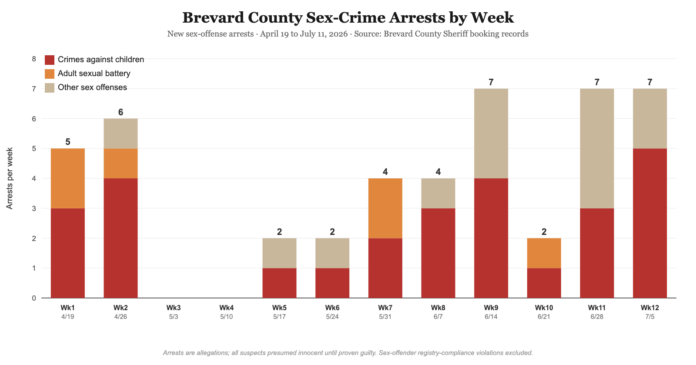
Across the twelve weeks reviewed, the arrests broke down into a few clear groups. The largest was crimes against children, at 27 arrests, an average of just over two per week. These are not inferred from vague charge language; each was booked under a statute that names a minor, such as sexual battery on a victim under 12, lewd or lascivious molestation of a child, transmitting material harmful to minors, or using a computer to seduce, solicit, or lure a child. A second group of six arrests involved sexual battery with an adult victim. A third group of 13 covered other sex offenses: indecent exposure, video voyeurism, and prostitution-related charges.

Separately, 16 people already on the state’s sex-offender or predator registry were arrested for failing to comply with its requirements, such as not reporting a new address, a phone number, a vehicle, or an employer. Those 16 are counted apart from the 62 new-offense figure here because they are compliance violations rather than fresh allegations of abuse. But they are their own signal: over twelve weeks, registered offenders were booked into the county jail more than once a week for falling out of compliance with the system meant to track them.
Those arrests capture a flow of new cases; the county also carries a standing count. As of mid-2026, roughly 912 registered sexual offenders and predators live in Brevard County, according to the Florida Department of Law Enforcement’s registry, about one for every 575 adults. That figure reflects people with past qualifying convictions who are required to register; it is separate from the new arrests above rather than an addition to them, but it is the standing backdrop against which those arrests occur.
The trend line is not flat. The four weeks with the most new sex-offense arrests all fell in the back half of the period, from mid-June onward, and the single busiest week, with five child-related arrests, was the first week of July. Early May, by contrast, saw a stretch with no new sex-offense arrests at all. Twelve weeks is too short a window to declare a durable trend, but the direction over this particular quarter was upward.
The cases behind the numbers
The statistics describe a pattern; the individual affidavits describe what it looks like up close. Several of the period’s cases, all previously reported on this site, illustrate the range.
In early July, a 33-year-old Palm Bay man was arrested and held without bond on 15 counts of sexual battery after, according to a Palm Bay Police Special Victims Unit affidavit, telling a detective he repeatedly assaulted a minor and acknowledging that what he described amounted to rape. In late June, a separate case charged an adult with a cluster of offenses that included using a computer to lure a child, traveling to meet a minor, and an authority figure soliciting sexual conduct from a student, a fact pattern that runs through a striking number of the child cases. Charges built around a computer, a phone, and a lured child appeared again and again across the quarter, in arrests weeks apart and involving unrelated suspects.
That online dimension is one of the clearest throughlines in the data. Of the child-victim arrests, a meaningful share involved the internet as the point of contact, whether soliciting, transmitting harmful material, or arranging to meet, rather than a stranger in a physical public space. Again, these are allegations; but as a pattern in charging decisions, it points investigators and parents toward where much of the risk now lives.
Why the numbers may be climbing
No single explanation accounts for a quarter’s worth of arrests, and honest analysis resists the temptation to name one. Law-enforcement agencies and researchers who study these crimes nationally point to several overlapping factors, and several likely apply here.
The first is detection. Florida participates in federally funded Internet Crimes Against Children (ICAC) task forces, and reports of online child exploitation routed through the National Center for Missing & Exploited Children have risen sharply nationwide over the past decade. More proactive investigation and more tips mean more cases that would once have gone unseen now end in an arrest, which can raise the arrest count even where underlying offending is stable.
The second is reporting and awareness. Many child sex-abuse cases involve delayed disclosure, sometimes by months or years; a rise in arrests in any given quarter can reflect victims and families coming forward about older conduct, not only new events. Broader public awareness and mandatory-reporting requirements for teachers, coaches, and medical staff push more of these cases into the system.
The third is simply scale and visibility. Brevard County is home to more than 630,000 people and growing, and Florida’s public-records laws make every jail booking immediately visible. A daily report like this one surfaces arrests that in an earlier era would have surfaced, if at all, only as scattered court filings. Consistent visibility can make a persistent problem newly legible without the problem itself having changed.
None of these factors makes the arrests less real or less serious. Together they suggest the numbers reflect both a genuine volume of offending and a system that is catching more of it than it used to.
What can be done
For readers who see these reports and ask what they can actually do, there are concrete answers.
Report what you see or suspect. Florida’s Abuse Hotline takes reports of known or suspected child abuse 24 hours a day at 1-800-962-2873 (1-800-96-ABUSE), with online and TTY options. Suspected online exploitation, such as grooming messages, explicit material sent to a minor, or a stranger arranging to meet a child, can be reported to the National Center for Missing & Exploited Children’s CyberTipline at 1-800-843-5678 or report.cybertip.org. If a child is in immediate danger, call 911. Florida law makes reporting suspected child abuse a duty, not merely an option.
Know your neighborhood. The Florida Department of Law Enforcement maintains a public, searchable database of registered sexual offenders and predators at offender.fdle.state.fl.us, searchable by name, address, and county, with email alerts available for a given radius. The Brevard County Sheriff’s Office offers its own mapping and alert program.
Focus prevention where the contact happens. Because so many of the child cases in this data began online, the practical front line for many families is a phone or a game console: knowing which platforms children use, keeping conversations open about who they are talking to, and treating requests to move a chat “private” or to meet in person as red flags worth reporting.
Support the response. Sustained funding for special-victims units, ICAC investigators, forensic interviewers, and child-advocacy centers determines how many of these cases are investigated well and prosecuted successfully. Those are budget and policy choices that residents can weigh in on.
The bottom line
Over a single spring-to-summer quarter, Brevard County averaged roughly two arrests a week for sex crimes against children and nearly four a week for sex crimes overall, with the pace rising toward the end of the period. The reader who senses that this site is reporting “a lot” of these cases is reading the data correctly.
The arrests are allegations, and the justice system exists to test them. But the volume is not a matter of interpretation, and it is not going away on its own. Understanding the scale is the first step toward doing something about it.
This analysis is based on daily Brevard County Sheriff’s Office booking records published on TheSpaceCoastRocket.com between April 19 and July 11, 2026. All individuals referenced were arrested and are presumed innocent unless and until proven guilty in a court of law. Arrest charges are drawn from the jail booking system and may differ from the charges ultimately filed by the State Attorney’s Office.
Criminal Defense
Bankruptcy · Evictions
WICKS LAW P.A.
Call or text for
free consult
321-733-2700
Eric Wicks, Esq.
1250 West Eau Gallie Blvd. G
Melbourne, FL 32935
Abogado Wicks habla español