


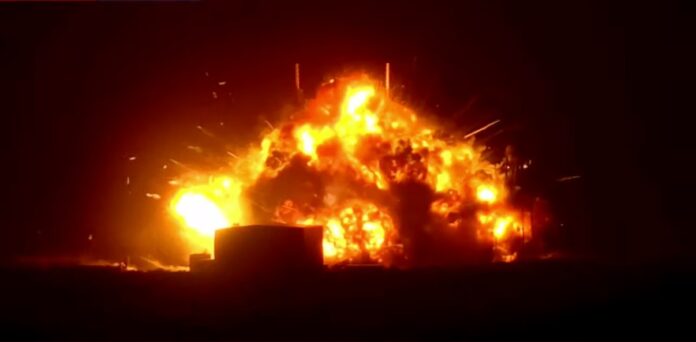
CAPE CANAVERAL — A Blue Origin New Glenn rocket erupted into a massive fireball on its launch pad at Cape Canaveral Space Force Station around 9 p.m. Thursday, lighting up the night sky, rattling homes across the Space Coast and prompting warnings that hazardous debris could wash ashore on Brevard beaches in the days and weeks ahead.

The roughly 320-foot rocket, named for Mercury astronaut John Glenn, was undergoing a hot-fire test at Space Launch Complex 36 when it exploded. A hot-fire, or static fire, test ignites the rocket’s engines while the vehicle remains anchored to the pad, a standard check of its systems ahead of a launch. No one was hurt.
“We experienced an anomaly during today’s hotfire test. All personnel have been accounted for. We will provide updates as we learn more,” Blue Origin said on X. Founder Jeff Bezos followed with his own post, calling it a “very rough day” and pledging to “rebuild whatever needs rebuilding and get back to flying.”
The fireball was visible for miles, with residents reporting the blast as far inland as downtown Orlando and homeowners near the coast saying the explosion shook their houses.
Debris warning for Brevard beaches
For Space Coast residents, the most immediate concern is what comes next on the shoreline. Officials at Cape Canaveral Space Force Station cautioned that debris from the explosion could wash up along Florida’s beaches in the coming days and weeks, and warned the public not to touch, move or attempt to recover any of it. The wreckage could be hazardous, and direct contact could pose health risks.

Anyone who spots suspected debris was being told to call 911 by The Space Force for proper removal. However Brevard County EOC told members of the public to NOT call 911. Instead, Blue Origin established a recovery line at 321-222-4355 and an email address, missionrecovery@blueorigin.com, for reporting wreckage. Beachgoers heading out over the holiday weekend should keep their distance from anything unfamiliar that turns up in the sand or surf.
A rip current statement was already in effect for the coast Thursday night, an added reason for caution along the water.
Local officials: no threat to the community
Brevard County Sheriff Wayne Ivey moved quickly to reassure residents. “A Blue Origin rocket exploded on the launchpad just moments ago during a static fire test ahead of a pending launch,” Ivey said in a statement, adding that there were no reported injuries and that the plan was to let the contained fire burn itself out. The Sheriff’s Office, Brevard County Emergency Management and Brevard County Fire Rescue all said they were monitoring the scene.
Brevard County Emergency Management described the incident as an “anomaly” posing no threat to the general public. The U.S. Space Force’s Space Launch Delta 45, which oversees launch operations on the Eastern Range, confirmed emergency responders were on scene and that all personnel were accounted for. The Federal Aviation Administration said the ground test fell outside the scope of its licensed activities and that there was no impact to air traffic.
What it means for the Cape
The explosion is a significant setback for a rocket the Space Coast has been counting on. New Glenn debuted from Cape Canaveral in 2025 and is central to Blue Origin’s ambitions to compete with SpaceX, but the program has stumbled. The heavy-lift vehicle was grounded in April after an engine failure left a satellite in the wrong orbit, and Thursday’s blast came as the company prepared for what would have been only the rocket’s fourth flight, a mission to carry dozens of Amazon Leo internet satellites to low-earth orbit. Those satellites were not aboard during the test.
The extent of the damage to Launch Complex 36 and its supporting infrastructure remains unknown. A damaged heavy-lift pad can take weeks or months to inspect, repair and recertify, which raises questions about how long this corner of the Cape stays offline and what that means for the local launch cadence and the workforce tied to it.
The timing stings. Just two days before the explosion, NASA awarded Blue Origin a contract to launch the first of three missions to begin building its Moon Base on the lunar surface later this year, work that depends on New Glenn. NASA Administrator Jared Isaacman said the agency was aware of the incident and would assess near-term mission impacts, including its plan to return American astronauts to the Moon in 2028. “Spaceflight is unforgiving, and developing new heavy-lift launch capability is extraordinarily difficult,” Isaacman said.
The rest of the range keeps flying
Space Force officials stressed that the explosion would not affect launches from other pads, and the Cape proved the point within hours. A SpaceX Falcon 9 lifted off successfully roughly 12 hours after the blast, and United Launch Alliance’s Atlas V was on the schedule to fly Friday night carrying a batch of the same Amazon Leo satellites New Glenn had been slated to launch.
Even SpaceX founder Elon Musk, no stranger to pad explosions of his own, offered a word of support to his rival, posting that he hoped Blue Origin would recover quickly.
For longtime Space Coast residents, the scene carried an echo of history. Thursday’s fireball came nearly a decade after a SpaceX Falcon 9 exploded on a Cape Canaveral pad during a similar test in 2016, a reminder that even on the nation’s busiest launch coast, the work of building rockets remains dangerous and unpredictable.
Investigators have not identified a cause. A failure during a static fire can originate in the engines, the propellant systems, the ground equipment, the software or the connections between the rocket and the pad, and teams will pore over telemetry, pressure data, video and debris patterns before drawing conclusions. The Space Coast Rocket will update this story as more information becomes available.
Criminal Defense
Bankruptcy · Evictions
WICKS LAW P.A.
Call or text for
free consult
321-733-2700
Eric Wicks, Esq.
1250 West Eau Gallie Blvd. G
Melbourne, FL 32935
Abogado Wicks habla español