

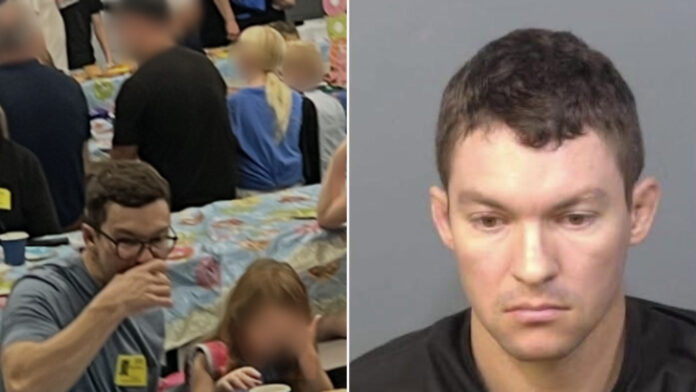
A Satellite Beach man facing felony charges of possessing child sexual abuse material appears in photos taken at a recent event at Sea Park Elementary School. Brevard Public Schools says it did not believe it had a legal basis to keep him off campus, and court records show the judge who set his release terms placed no restrictions on his contact with children.

Luke William Martineac, 39, was arrested by the Florida Department of Law Enforcement on Dec. 18, 2025, on 20 counts of possession of child sexual abuse material and 372 counts of promoting the sexual performance of a child.
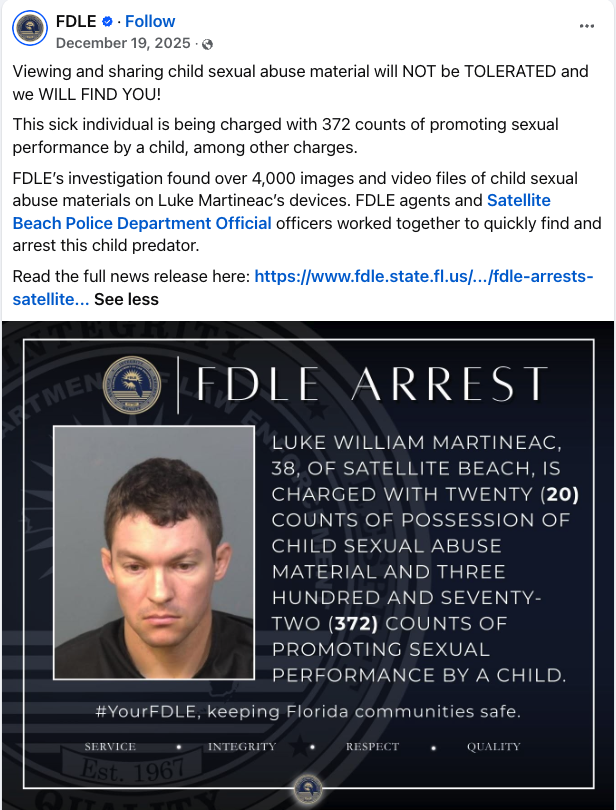
On Feb. 13, 2026, the Office of Statewide Prosecution filed formal charges accusing Martineac of 10 counts of possessing child sexual abuse material under section 827.071(5)(a), Florida Statutes. Each count is a third-degree felony. The promoting charges were not officially filed.
The Space Coast Rocket acquired photos showing a man matching Martineac’s description seated at a table during the school event and wearing a visitor badge. We blurred the faces of others in the photos.

The school event is not the first time community members have raised concerns. In April, a separate reader contacted The Space Coast Rocket reporting that Martineac had continued picking up his younger child from preschool and attending preschool activities after FDLE searched his home.

What the arrest affidavit alleged
According to the arrest warrant affidavit, FDLE Special Agent Debra Titkanich began an undercover investigation on Aug. 25, 2025, into the sharing of child sexual abuse material over the BitTorrent peer-to-peer network. The affidavit states agents downloaded thousands of files from internet connections registered to Martineac at his Satellite Beach home in August and September 2025.
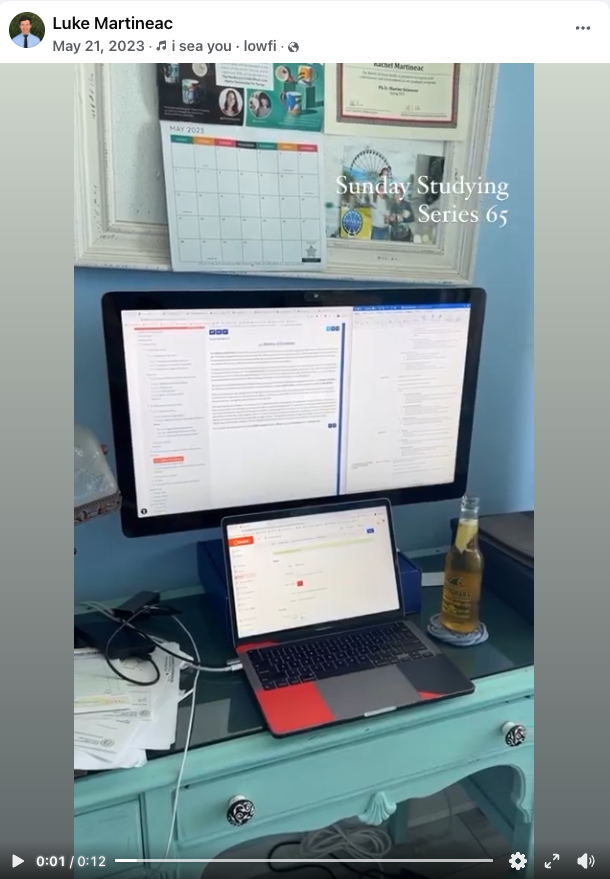
Agents executed a search warrant at the home on Oct. 15, 2025, and seized an Apple laptop and an external storage drive. A forensic examination recovered more than 4,000 files depicting child sexual abuse from deleted space on the drive, according to the affidavit, including files depicting children investigators estimated to be as young as approximately 1 year old. That same laptop and storage device appears to be in a video Martineac posted publicly on his Facebook page.
The allegations involve possessing and sharing material online. The affidavit does not allege that Martineac produced the material or committed any offense at a school.
The affidavit states Martineac told agents he believed some of what he downloaded may have contained child pornography, but that it was not what he was seeking. But the affidavit also states that his viewing history on the computer’s VLC app showed that videos he allegedly viewed were titles specifically and obviously as child pornography. Some of the videos described in the affidavit were extremely graphic and depicted children the same age as his. He told investigators he and his wife have two young children, that the family planned to relocate to Nevada, and that he had previously lived in China for several years.
How he was released
The arrest warrant listed a total bond of $70,000 for two of the counts, and he was released on his own recognizance . A notice of bond correction filed Dec. 18, 2025, changed the bond entries to no bond under the bail schedule. Under section 903.011, Florida Statutes, a person arrested for child pornography offenses cannot be released before a first appearance hearing, where a judge must set bail based on an individualized review of factors including the nature of the charges and the danger the defendant’s release poses to the community.
Martineac went before Brevard County Judge Michelle Vitt Baker, who was handling first appearance hearings, on Dec. 19, 2025. According to the bond order she signed that day, the court heard argument from counsel before ruling. The order set bond at $35,000 cash or surety on each of two counts. Martineac was released on his own recognizance on the remaining counts, and the two surety bonds were posted Dec. 20, 2025.
Neither the bond order nor the recognizance bond imposes any condition beyond the general requirements that apply to every defendant on release. Neither document restricts Martineac’s contact with minors, bars him from schools or places where children gather, or requires electronic monitoring or limits on internet use.
After the formal charges were filed, the bonds tied to the dropped counts were discharged. Court records show Martineac remains free on his own recognizance on nine counts and on a $35,000 surety bond on the remaining count. The docket shows no motion by prosecutors or the defense to detain Martineac or change his release terms.
Martineac is represented by attorneys Gregory McFarlane of Fort Lauderdale and Brent Del Gaizo of Plantation. The case is assigned to Circuit Judge Charles G. Crawford. Early resolution hearings set for March and April were continued and later cancelled, and every docket sounding since April has been continued at the defense’s request. Martineac waived his right to a speedy trial in June and filed a waiver of appearance in July, which allows his attorneys to appear on his behalf. His next docket sounding is scheduled for Oct. 8, 2026, at the Moore Justice Center in Viera.
Martineac has not been convicted and is presumed innocent. Because he has not been convicted, he is not on Florida’s sexual offender registry.
What the school district says
Brevard Public Schools officials told The Space Coast Rocket that, under the circumstances, it does not appear the district has a legal basis to bar Martineac from attending with his child based on pending charges alone. The district said he has not been convicted, is not a registered sex offender, is not accused of conduct on school property, and is not under a court restriction that would flag him as prohibited.
The district said Martineac would be disqualified if he applied to volunteer or work at a school. Florida’s Level 2 background screening standards disqualify people who have been arrested for and are awaiting final disposition of certain offenses. Those standards apply to employees and approved volunteers, not to parents attending school functions.
Under BPS Policy 8475, a visitor who comes to campus for personal reasons must sign in, undergo a sexual predator check and wear a visitor badge. Visitors must be escorted to their destination, supervised by staff at all times, and never left alone with students. A pending criminal charge does not appear in a sexual offender registry check.
The district does have general authority over who enters its schools. BPS Policy 9150 allows the superintendent or a principal to prohibit anyone from entering a school when there is reason to believe the person’s presence would be detrimental to the good order of the school. Whether that policy could be applied to a parent facing pending charges, without a court order, is a separate legal question. BPS has stated they will follow up with us on that.
District policies do not reach private child care centers, where access by parents is governed by each facility’s rules and any court order.
What the court could have ordered
Florida judges set release conditions under Florida Rule of Criminal Procedure 3.131, which allows restrictions on a defendant’s travel, association, or place of abode while a case is pending. Either side may ask the court to modify release conditions while a case remains open.
At the time of Martineac’s arrest, state law did not classify his charges as “dangerous crimes.” Under section 907.041, Florida Statutes, that meant the law presumed release on nonmonetary conditions. A 2026 Florida Senate staff analysis lists the dangerous crimes in effect then, which did not include possession of child sexual abuse material.
That presumption does not prevent judges from restricting access to children. In Sewell v. Blackman, a 2020 case from Highlands County, a man charged with 305 third-degree counts under the same possession statute was ordered, as conditions of release, to have no contact with anyone under 18, including minors in his family, and not to go near any school, facility or grounds where minors are located. He was also barred from using the internet. The Second District Court of Appeal reviewed the case over his monetary bond, which it found excessive, and described those other conditions in its opinion.
Federal courts go evenfurther. Under the Adam Walsh Child Protection and Safety Act, federal judges releasing a defendant charged with child exploitation offenses involving a minor must impose electronic monitoring and a curfew. Florida law has no equivalent mandatory condition for state defendants facing similar charges.
A new state law, but not for this case
On March 31, 2026, Gov. Ron DeSantis signed House Bill 445, known as “Missy’s Law,” which took effect July 1, 2026. The law adds certain computer pornography and child exploitation offenses to Florida’s dangerous crimes list, meaning people arrested for those offenses cannot be granted nonmonetary release at their first appearance.
The law took effect more than six months after Martineac was released and does not change his existing release. The House staff analysis also shows the added offenses are those defined in section 847.0135, which covers computer-related crimes such as using the internet to solicit a child. Martineac’s charges fall under section 827.071(5)(a), a separate statute. The text leaves open whether defendants facing possession charges like his would fall under the new pretrial release rules.
A companion bill signed the same day, House Bill 1159, replaced the term “child pornography” with “child sexual abuse material” (otherwise known as CSAM) in state law and increased penalties for several related offenses.
Editor’s Analysis: The Question Florida Should Require Judges to Answer
The following section is analysis and opinion from The Space Coast Rocket’s editor Robert Burns. The reporting above is presented separately.
Two things are true in this case. Luke Martineac is presumed innocent by our legal system and is entitled to a fair process. And the parents who raised concerns about his presence at a school event are not being unreasonable. Florida law already agrees with them in other settings.
The Legislature decided long ago that pending charges like these matter around children. That is why Martineac would be disqualified if he applied to volunteer at his child’s school. But that judgment disappears the moment the same person signs in as a visitor, because visitor systems check the sexual offender registry and a pending charge is not on it. Without a court order, the front office has nothing to act on, and parents are left relying on word of mouth and court records. In fact in this case, because of the age of his daughter, it appears as though he was charged before she was enrolled in the school system.
The tools exist. Nothing requires anyone to use them.
Judges do not lack authority here. As the Sewell case shows, a Florida judge can bar a defendant charged under this same statute from contact with minors and from places where children gather. Martineac’s bond order imposed nothing of the kind, and the records reviewed do not show that prosecutors asked for it, then or in the nine months since.
I think that points to the real problem. First appearance hearings move quickly, often before judges handling long dockets of new arrests. A safeguard that depends on a prosecutor remembering to ask, or a judge thinking to raise it, will sometimes go unused, and no one notices until a parent recognizes a face in a school cafeteria that they saw me report about their arrest. Missy’s Law did not fix that. It covers a different statute, and dangerous crime status mainly governs release at first appearance, not the conditions that come with it.
So the answer to whether the law is adequate is both yes and no. Judges and prosecutors have the power they need today and should be using it, including in this case. But the Legislature should stop leaving it to chance.
What a better law would look like
Any reform has to respect real limits. Florida’s constitution guarantees most defendants release on reasonable conditions, parents accused of crimes still have constitutionally protected rights to raise their children, and federal courts have split over mandatory release conditions applied without individual review. A Florida law should require judges to decide and explain, not strip them of discretion. Within those limits, I believe Brevard’s legislative delegation should push for five changes.
Require findings. In any case charging child sexual abuse material or a sexual offense against a child, the judge setting release terms must decide on the record whether to restrict contact with minors and presence at schools and child care centers, and explain in writing if the answer is no.
Start with protective conditions and tailor from there. The default should be no unsupervised contact with minors and no presence on school or child care grounds, with judges free to adjust. For a defendant’s own children, a judge could allow contact supervised by a court-approved adult and school visits arranged in advance with the principal and escorted by staff.
Close the Missy’s Law gap. Add section 827.071 and the child sexual abuse material offenses in Chapter 847 to the dangerous crimes list.
Make the order visible. Child-related release conditions should be entered into the statewide criminal justice information system, and the principal or child care director where the defendant’s children are enrolled should be notified, so a front office can see a court order the same way it sees the registry.
Put the burden on the State. Prosecutors should be required to request child-safety conditions in these cases or state on the record why they are not.
These conditions would end when the case ends, and a defendant could ask the court to modify any of them. Nothing about this presumes guilt. It presumes only that when a judge has already found probable cause that a person possessed images of children being sexually abused, the court should at least have to consider whether that person belongs in an elementary school cafeteria. I read graphic arrest affidavits involving crimes against children almost daily. They are extremly graphic and explicitly descriptive. Seeing a man accused of possessing and consuming videos like the ones described in this case captured on camera looking around and sitting among children the same age as those victims makes my blood boil, as a father and as a human being.
Legislation takes time, but this case does not have to wait. Prosecutors can ask the court to add conditions before Martineac’s Oct. 8 hearing, and Brevard Public Schools can decide whether its general authority over school visitors could be used when a parent faces charges like these. The parents at Sea Park noticed something wrong and asked why. They deserve and our children deserve better protections.
FDLE offers online safety resources for parents.
Criminal Defense
Bankruptcy · Evictions
WICKS LAW P.A.
Call or text for
free consult
321-733-2700
Eric Wicks, Esq.
1250 West Eau Gallie Blvd. G
Melbourne, FL 32935
Abogado Wicks habla español