

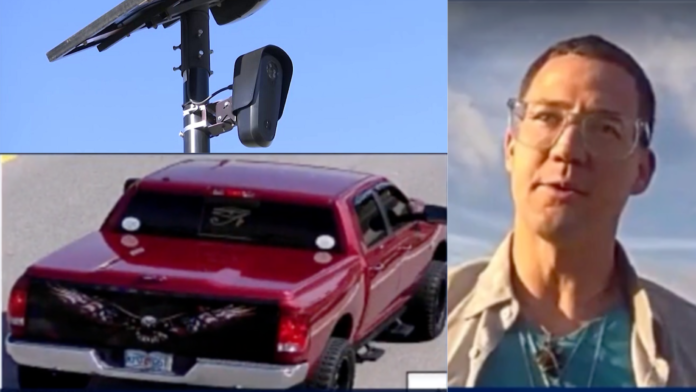
Melbourne, FL – The estate of a Palm Bay man shot and killed by an airport police officer in 2024 has filed a federal lawsuit naming six defendants, and one of them is not a police agency at all. It is Flock Group, Inc., the Atlanta company whose license plate reading cameras have spent the past month at the center of a national argument over surveillance.

Katie J. Niebuhr, as personal representative of the estate of her brother John Jay Niebuhr, filed a 148-page first amended complaint on Sept. 3 in the U.S. District Court for the Middle District of Florida. It names Melbourne Airport Police Department Officer Sherif Brown, Sgt. Raynisha Wheeler, the Melbourne Airport Authority, the City of Melbourne, the City of Palm Bay and Flock. The suit raises 13 counts and demands a jury trial.
Niebuhr, 40, was killed in the Melbourne airport police shooting on the morning of June 28, 2024, in a parking lot at 750 Harry Sutton Road, on the outer perimeter of Melbourne Orlando International Airport. He was pronounced dead at Holmes Regional Medical Center at 10:23 a.m., according to the complaint. In November 2024, State Attorney Phil Archer reviewed the case and found the use of force lawful, writing that “no further actions will be taken by this office as to this case.” Less than five months later, Brown was named the 2024 Brevard County Law Enforcement Officer of the Year.
None of the allegations in the complaint have been tested in court, and the account that follows is drawn from the estate’s filing unless otherwise noted. Flock has moved to dismiss.
The Flock claim
Count XII is the count that ties this case to the surveillance debate now running through Brevard County and the country.

According to the complaint, on June 19, 2024, nine days before the shooting, Palm Bay Police Department crime analyst Jessica Welzenbach, logged in the system as operator “J. WEL,” ran a search on Niebuhr’s red Dodge Ram, Florida tag KPQQ61. Flock’s platform requires the user to type a reason for every search. The reason recorded was a single word: “Intel.”
The complaint alleges that the search returned a chronological reconstruction of where Niebuhr’s truck had been from May 20 through June 19, 2024, a 30-day window, assembled from captures made by roughly 4,760 devices across the Flock network.
That number is the heart of the legal theory. The complaint concedes that the reading of a license plate in public view is not, standing alone, a search. What it alleges instead is that aggregating thousands of those observations, holding them on a private company’s servers and querying them backward in time produces something no single camera produced: “a comprehensive, retrospective, and effortlessly compiled chronicle” of a person’s movements, revealing “the privacies of a person’s life, and his familial, political, professional, religious, and other associations.”
The complaint also argues Flock cannot be treated as a passive vendor. Palm Bay subscribes to 17 Flock Falcon cameras under a 2021 agreement carrying a $42,500 annual recurring charge and a 60-month initial term, and under that agreement the cameras remain Flock’s property. The roughly 4,760 devices that answered the query, the filing says, belonged to the Flock network, not to Palm Bay. “Flock did not merely supply PBPD with a tool and step away,” the complaint states. “Flock performed the search.”
It further points to Flock’s own contract language, which limits the system’s sole “Permitted Purpose” to “facilitate gathering evidence that could be used in a lawful criminal investigation” and reserves to Flock the right to monitor an agency’s use and suspend it. “‘Intel’ is not a lawful criminal investigation on its face,” the complaint argues. “Flock’s system executed the search anyway.”
Flock’s answer
Flock, represented by Greenberg Traurig attorneys James E. Gillenwater and Huiping Liu, moved on July 30 to dismiss the Flock count with prejudice. The motion was directed at the original complaint, which the September amendment substantially expanded and rewrote.
Flock’s argument runs on three independent tracks. First, that a vendor contract with a police department does not convert a private company into a state actor under 42 U.S.C. § 1983, and that the complaint pleads no agreement or meeting of the minds to violate anyone’s rights. Second, that there is no Fourth Amendment violation to begin with, because motorists have no reasonable expectation of privacy in a plate they are legally required to display in public. Flock cites Eleventh Circuit and Middle District precedent, along with a 2026 Sixth Circuit decision affirming dismissal of a separate suit against the company. Third, that there is no causal link between a Palm Bay database query and a shooting nine days later by an officer of a different agency that had no Flock contract.
On that last point the motion notes that Niebuhr himself called the airport police multiple times that morning and disclosed his location to Brown, and that an airport operations employee independently discovered and reported him. “Neither Brown, nor the MAPD, is alleged to have had any connection to Flock,” the motion states.
The amended complaint pleads around that in the alternative. Its primary position is now that the June 19 search was a completed constitutional injury on its own, independent of the death. Its fallback is that a Flock photograph of Niebuhr’s truck went into a Palm Bay bulletin that shaped how Melbourne airport officers approached him.
The bulletin
Before the Flock search there was a Situational Awareness or “Be On the Look Out” (BOLO) bulletin issued by Palm Bay police.
According to the complaint, the bulletin identified Niebuhr by full name, date of birth, height, weight, eye color, home address, vehicle description and tag. It carried a photograph of his truck taken from a Flock camera. It listed criminal history from roughly two decades earlier, described in the complaint as mostly minor drinking-related citations, and alerted officers that he had lawful access to firearms. It identified no active offense and no case number.
The complaint alleges the bulletin either was created after and post-dated, or was updated to include, a June 17, 2024 encounter on Kirkland Road. That morning, the complaint says, three Palm Bay officers spent close to an hour investigating Niebuhr’s presence on private property roughly three tenths of a mile from his home. He had called the department’s non-emergency line himself at about 6:52 a.m. to say he was there for a legitimate business purpose. The property owner confirmed to officers that Niebuhr had permission. The call was cleared at about 8:15 a.m. with no violation found. Internally, according to the complaint, officers characterized him as “sovereign-like.”
On June 24, according to the complaint, Niebuhr walked into the Palm Bay police lobby and reported to the on-duty sergeant that the government was watching and tracking him. He then went next door to City Hall. Dispatch notes logged the report as an “S20,” a signal for a mental illness incident, which the complaint says was applied with no clinical basis, assessment or referral. He called again on June 25 and June 26 asking for a supervisor and asking that his complaint about one of the Kirkland Road officers be reassigned to someone without a conflict. It was assigned back to that same officer.
Those facts drive Count XIII, a First Amendment retaliation claim against Palm Bay, and Count X, a negligence claim over what the suit calls an unwarranted bulletin.
The airport
On June 28, Niebuhr drove to the airport with his dog, three cats and his dry cleaning in the truck. Phone records cited in the complaint show he called the airport police department at about 8:58, 9:01 and 9:11 a.m. Brown, a probationary officer with roughly eight months on the job, later told investigators he spoke with Niebuhr on one of those calls.
Airport maintenance and operations employees had begun watching and following the truck, the complaint says. At about 9:22 a.m., Brown pulled his marked unit in behind Niebuhr’s truck, blocking it, and activated his body camera. An airport maintenance van blocked the lot’s only entrance and exit.
What followed lasted about 30 minutes. The complaint describes Niebuhr attempting to leave at 9:26, when Brown waved him back into the parking spot, and again at 9:32, when he braked, looked at the van still blocking the exit and pulled back in on his own. It describes a conversation that included a fist bump. At 9:41, after Brown asked whether he was carrying, Niebuhr asked him directly, “You going to shoot me with it?” Brown answered, “No, no, no, nah, I’m not. This is not that type of call.”
Roughly a minute later, at 9:42:13, the complaint alleges Brown pulled his own gun to his side and switched off the safety, holding it out of Niebuhr’s view and giving no verbal warning that he was preparing his weapon. Sgt. Wheeler arrived about six minutes before the shooting and never drew her weapon.
The complaint’s account of the final minute runs this way. At 9:51:53, Brown opened the passenger door with Niebuhr’s empty hands raised, pointed his firearm at him and said, “I’m not playing.” He asked for identification, and when Niebuhr moved to hand it over, told him, “I’m not here for that.” At 9:52:24 Brown directed him to “Just hold it up.” At 9:52:48, Niebuhr raised his pistol with one hand and pointed it upward, not at Brown or anyone else. Brown shot him. Niebuhr never fired.
That sequence is the grounds for Count I against Brown for objectively unreasonable deadly force, Count II against Wheeler for failure to intervene, Count VIII, an alternative battery claim against Brown, and Counts III through VII and IX against the Melbourne Airport Authority and the City of Melbourne, including claims that a probationary officer who had not completed field training was allowed to conduct a solo contact with an armed citizen without a field training officer present.
After
Melbourne Airport Police Chief Renee Purden briefed reporters that Friday morning, saying the man had been “deemed suspicious” and that his condition was unknown. She later confirmed the shooting happened outside the secure area. It was also confirmed publicly that a citywide BOLO had been issued.
The department then released the Palm Bay bulletin to the media, home address and photograph included. FDLE Special Agent Christopher Imel later said of it, according to the complaint, “It was something they never should have released.” The complaint says Agent Imel then helped coordinate its removal from the airport department’s Facebook page, by which point the information had circulated widely.
Brown was not interviewed on the day of the shooting. FDLE took his sworn statement on July 23, 2024, nearly a month later, the complaint says.
What the public was told
The account the public received on June 28, 2024 came from a press conference held in a grass field near NASA Boulevard and from a department news release.
Official statements reported were htat Neibuhr “threatened the officers with a weapon before he was shot.” The complaint states based on body-cam footage that at 9:52:48 Niebuhr raised his pistol with one hand and pointed it upward, “not toward BROWN or any other officer,” and that he never fired.
Airport Police Chief Reneè Purden said Niebuhr “initially attempted to enter airport property at a secure gate” and that airport personnel first made contact with him off Ed Foster Road at a secure gate. At the same press conference she also said: “So, this incident occurred outside of our secure area, out on the outer perimeter of airport property.” The complaint states that no physical evidence was located or presented showing Niebuhr attempted to access any secure area of the airport or to breach any fence or gate. On the body camera, according to the filing, Brown told him he did not have permission to go inside the perimeter gates and Niebuhr answered, “I’m not.”
The gate detail traveled. WFTV reported that Niebuhr “drove up to a security gate at Ed Foster Road and tried to enter airport property at an aircraft maintenance facility.” WESH ran the headline “Melbourne police shoot, kill armed person who tried to gain access to airport through secure gate,” directly above the airport’s own statement that the incident happened outside the secured perimeter. The complaint devotes a paragraph to the coverage as a whole, listing the versions that ran: that he tried to gain access through a secure gate, that he tried to break through a gate and then went to another entry point, that he tried to breach a fence at an aircraft maintenance facility, that he tried to enter in order to board a flight, and that witnesses at a neighboring hotel saw a high-speed chase and officers pursuing on foot with weapons drawn. “None of these accounts were supported by the recovered evidence,” the filing states.
Purden also said: “He was attempting to gain access onto airport property and stated that he wanted to make entry onto a plane.” According to the complaint, the airport maintenance employee who spoke with Niebuhr stated in his affidavit that Niebuhr said he was “trying to meet with somebody” and asked about STS Aviation Services. The mechanic parked beside him at the final location was waiting on a man named Dave, and Niebuhr said he was waiting on the same man. Roughly five minutes after the shooting, Dave Zabinski arrived, told responding officers it was his hangar, and said he was with that guy, pointing toward the scene.
On how Niebuhr was found, Purden said: “The airport personnel contacted airport police, who found the subject located over here off of Harry Sutton Road.” Phone records cited in the complaint show Niebuhr called the airport police department three times that morning, at about 8:58, 9:01 and 9:11, before any officer contact, and that Brown later acknowledged speaking with him on at least one of those calls. An airport operations employee also texted Brown his location.
Purden said “two airport police officers met the suspect.” The complaint describes Brown arriving alone at about 9:22 and remaining alone with Niebuhr for roughly twenty-four minutes. Sgt. Raynisha Wheeler’s body camera does not begin until 9:46:18, about six minutes before the shooting, and the filing states she never drew her weapon.
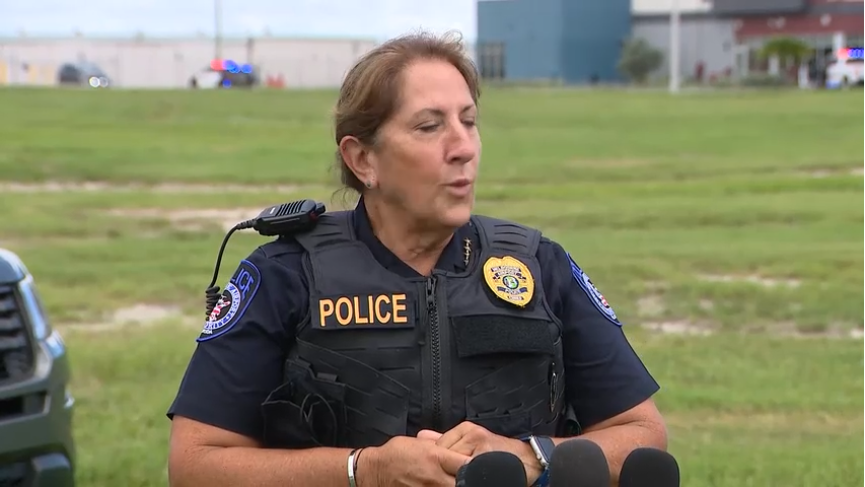
Purden compressed the encounter into one sentence: “They approached the vehicle. The subject was in the vehicle. He had a weapon. Shots were fired.” The body camera timeline in the complaint runs about thirty minutes, from 9:22 to 9:52:48, and includes two attempts by Niebuhr to leave and Brown drawing his weapon roughly ten minutes before firing. The complaint notes that Purden told reporters it was uncertain whether officers had little time to assess the situation, “when in fact the containment of NIEBUHR lasted over thirty minutes, during which he made multiple attempts to leave.”
That evening, a release from the airport police department said Palm Bay had issued a situational awareness bulletin about Niebuhr and his recent interactions with authorities there “in which he declared himself a ‘sovereign citizen’ who was being harassed by the government.” The complaint alleges that Palm Bay officers characterized Niebuhr as “sovereign-like” based on the Kirkland Road encounter “without any evidentiary basis and without any statement by NIEBUHR invoking sovereign citizen status,” and that the bulletin described him as demonstrating sovereign citizen behaviors. The filing states that news accounts then “imported the sovereign citizens’ movement into the reporting of NIEBUHR’s death.”
There is also a timing question. Niebuhr was pronounced dead at Holmes Regional Medical Center at 10:23 a.m. Purden held her press conference just before noon and, according to Florida Today, “did not have information on his medical condition available.” The complaint states that multiple “Signal 7” calls, the dispatch code for a death, were declared and broadcast over dispatch before the press conference, and that Purden made no mention of loss of life. The department confirmed the death in a release that evening.
Reporting that day also said police rendered aid. According to the complaint, the number of officers and vehicles that responded created physical barriers that obstructed access to medical care, the ambulance drove onto the grass to get around them and reached the gated entrance about twelve minutes after the shooting, and Brevard County Fire Rescue did not leave for the hospital until 10:14:51, roughly twenty-two minutes after the gunfire, on a route that averages a six-minute drive.
The background sections of the initial coverage track the language of the Palm Bay bulletin closely. News accounts described a June 17 call about a suspicious person on Kirkland Road who had been sitting in his truck for hours and driving back and forth, and reported that Niebuhr was evasive and not friendly with officers. The complaint describes the bulletin as documenting Niebuhr “sitting in his truck, driving back and forth, and allegedly becoming non-friendly with PBPD officers.” What the coverage did not carry, according to the filing, is that the property owner confirmed by phone that Niebuhr had permission to be there, that a nearly hour-long investigation by three officers found no legal violation, that the owner had never called police, that the 911 caller was a neighbor who reported that truck noise had woken her, and that one of the responding officers told the owner Niebuhr was “literally just sitting in his truck on the property.” WESH also published a list of five prior offenses without dates. The complaint says that history dated to when Niebuhr was approximately twenty years old, nearly twenty years earlier, and consisted primarily of a few minor drinking-related citations.
Coverage that night also reported, as one item in a list of concerning behavior, that Niebuhr had gone to the Palm Bay Police Department four days earlier to say the government was watching and tracking him. The complaint’s position is that the statement was accurate, and that the Flock search of his vehicle, the bulletin circulated to area agencies and the database queries on him had all already occurred. It alleges that broadcasts displayed the bulletin on screen while reporting that he had made the claim, and that the coverage presented him as paranoid “for accurately reporting that the government was watching, tracking, and investigating him.”
One smaller discrepancy runs through the early reporting. Purden said there was “an animal” and that the dog was fine. There were also three cats in the truck. Dispatch records cited in the complaint show Animal Control did not retrieve them until 4:17 p.m., more than six hours after the shooting, and that all three showed signs of heat stress and were taken to an emergency animal hospital. They survived.
Two claims from the original coverage are not addressed anywhere in the 148-page complaint. The first, reported by WESH, is that Niebuhr armed himself during an eviction process in August 2023 and told police the firearm was unloaded. The second is that he had been removing stakes along a property line at Kirkland Road. Neither appears in the filing, and neither has been rebutted.
The wider Flock fight
The suit lands in the middle of a bad stretch for Flock in Brevard County and nationally.
In August, Palm Bay ordered an immediate suspension of its Flock system after questions about whether the cameras were properly permitted and installed, and the cameras throughout the city were physically hooded. They came back online later that month after an administrative review. Since then, Palm Bay has stopped their use all-together.
On Aug. 31, Sheriff Wayne Ivey terminated the Brevard County Sheriff’s Office Flock program outright, pulling agency cameras and suspending BCSO access to the countywide database, including privately owned cameras, pending state privacy legislation. That decision followed a case in which a former BCSO deputy was found to have used Flock to search his ex-girlfriend’s plate.
Nationally, a proposed nationwide class action was filed against Flock in Georgia federal court in late August on behalf of anyone whose plate data the company has collected since Jan. 1, 2024, citing reporting that dozens of officers around the country have used plate reader systems to track romantic partners. The Institute for Justice has catalogued similar cases.
Flock has consistently maintained that its cameras are constitutional and that courts have agreed, pointing to rulings holding that a license plate carries no reasonable expectation of privacy. The Niebuhr complaint quotes Flock CEO Garrett Langley from July 2026 acknowledging the other side of it: “The abuse is a problem. We need to continue to get that down to zero. Any level of abuse is unacceptable.” Asked about the company’s own culpability, the complaint says, Langley answered, “I think it’s a shared responsibility.”
The complaint also notes that Palm Bay’s first written general order governing Flock use is dated May 21, 2026, nearly two years after Niebuhr’s death and five years after the system went in on a 2021 council consent agenda. At that same May 2026 council presentation, the filing says, Chief Jeffrey Spears said the system was “not even being used for crimes” but rather to “identify and gather intel.”
Where the case stands
On Sept. 4, U.S. District Judge Paul G. Byron issued an order to show cause after Brown, Wheeler, the Melbourne Airport Authority and the City of Melbourne failed to comply with a June 29 order to file a notice of pendency of other actions and a disclosure statement. The airport authority, Brown and Wheeler filed the notice on Sept. 9, disclosing two related Brevard County cases: a state court action against the Melbourne Airport Authority, Case No. 05-2026-CA-043881, and the estate’s probate case, Case No. 05-2026-CP-035220.
The estate is represented by Melbourne attorney Jessica J. Travis of DefendBrevard.com. It seeks compensatory and punitive damages, attorney’s fees under 42 U.S.C. § 1988, and judgment in excess of Florida’s statutory sovereign immunity cap under Fla. Stat. § 768.28(5), with the excess to be pursued through a legislative claims bill.
The Space Coast Rocket will continue following this case.
Criminal Defense
Bankruptcy · Evictions
WICKS LAW P.A.
Call or text for
free consult
321-733-2700
Eric Wicks, Esq.
1250 West Eau Gallie Blvd. G
Melbourne, FL 32935
Abogado Wicks habla español