

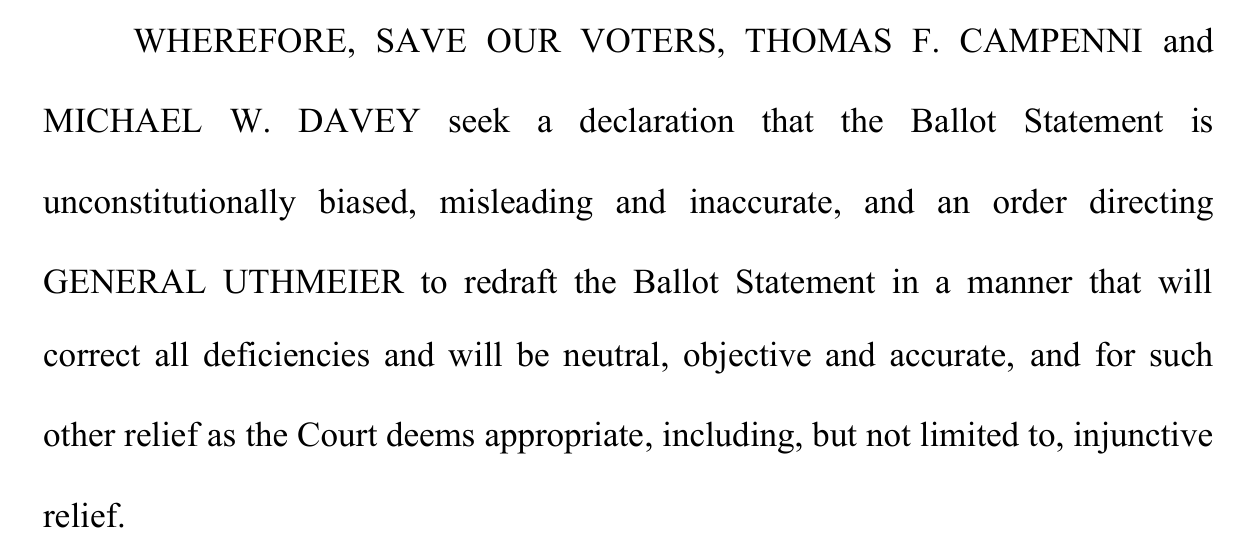
TALLAHASSEE, Fla. – Two former Florida mayors and a newly formed nonprofit filed a lawsuit Thursday in Leon County Circuit Court asking a judge to declare that the ballot language for HJR 1F, the property tax amendment headed to voters in November, is unconstitutionally biased, misleading, and inaccurate.

The plaintiffs are Save Our Voters From Misleading Ballot Language, Inc., along with Thomas Campenni, the former mayor of Stuart, and Michael Davey, the former mayor of Key Biscayne. Both men sued in their individual capacities as registered voters. They are represented by the law firm Weiss Serota Helfman Cole + Bierman, and the suit names Secretary of State Cord Byrd and Attorney General James Uthmeier as defendants.
The complaint does not attack the substance of the amendment itself. Instead, it targets the words voters will actually see on the ballot, arguing the Legislature wrote a campaign advertisement rather than a neutral summary.
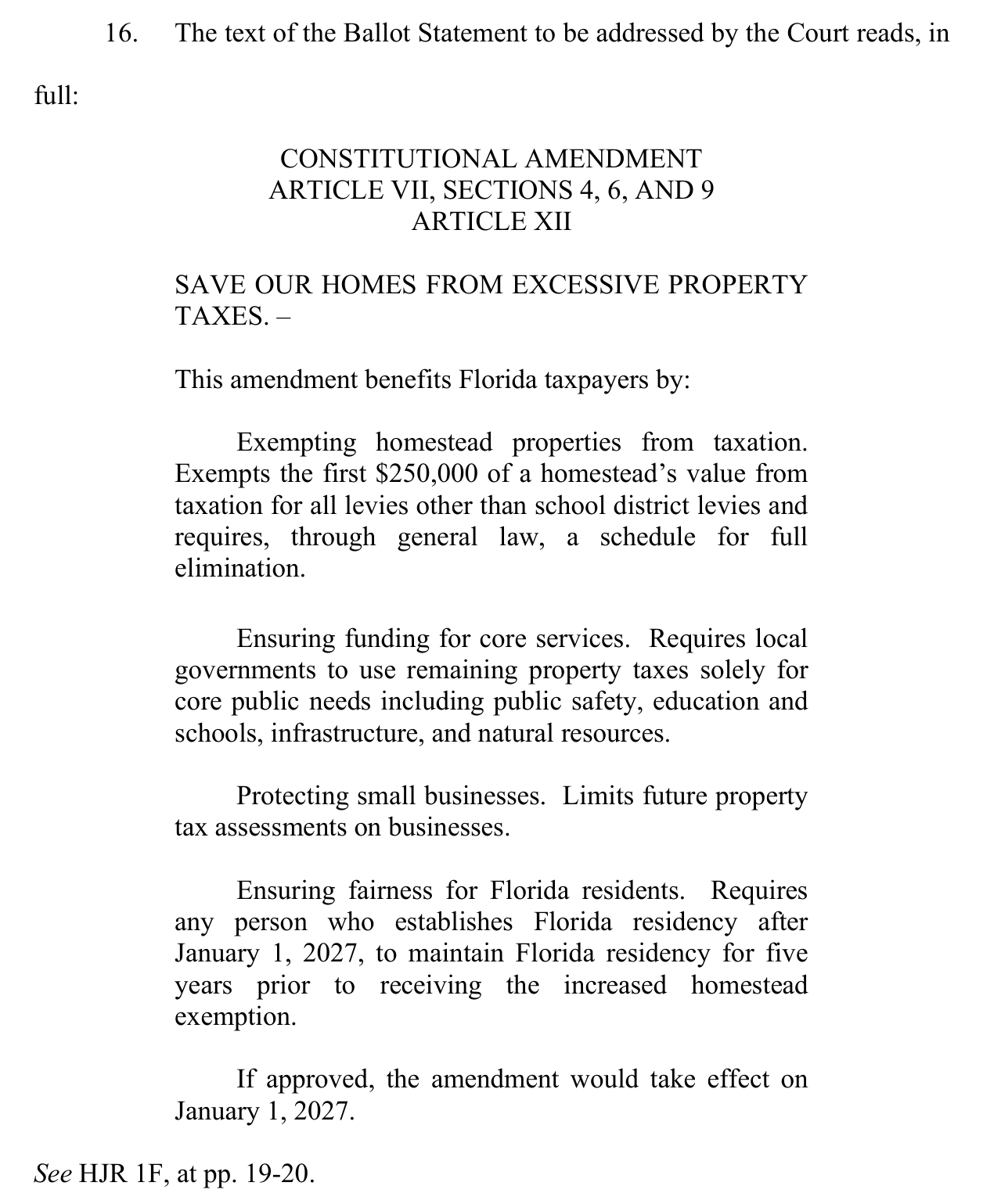
Here is the full ballot title and summary at the center of the lawsuit, exactly as voters will see it in November:
A Title That Reads Like a Slogan
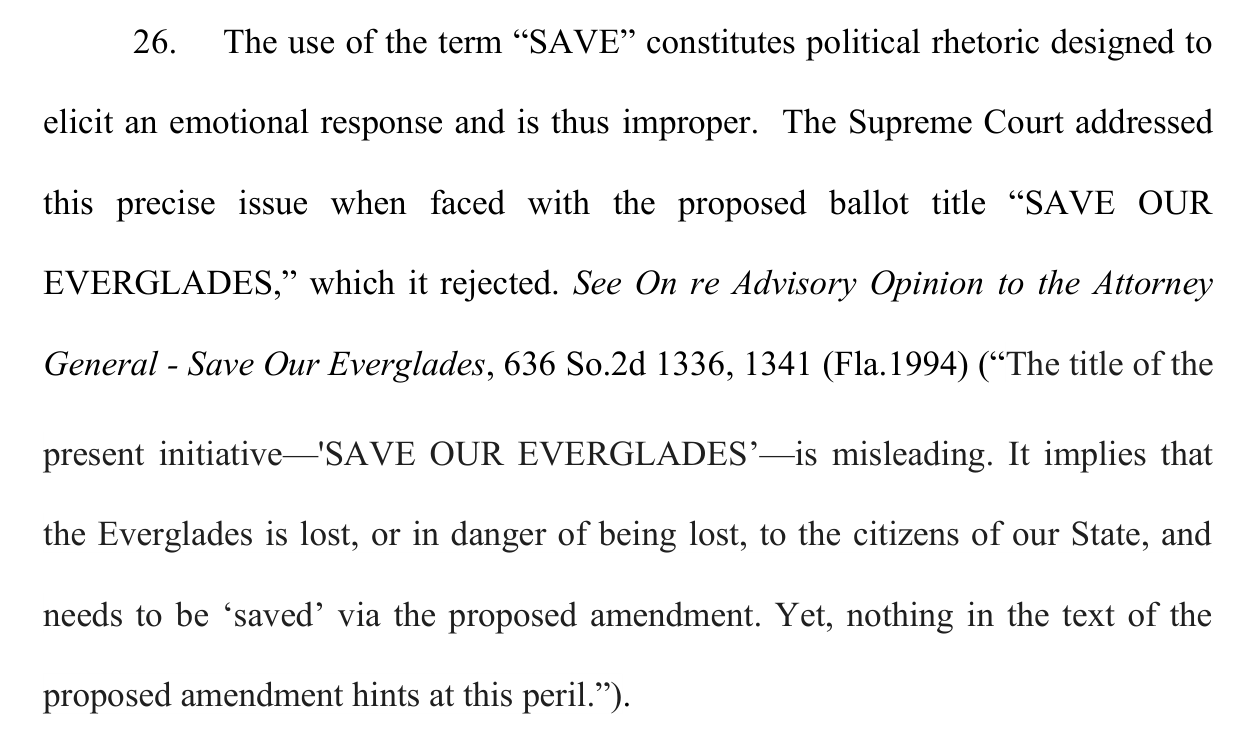
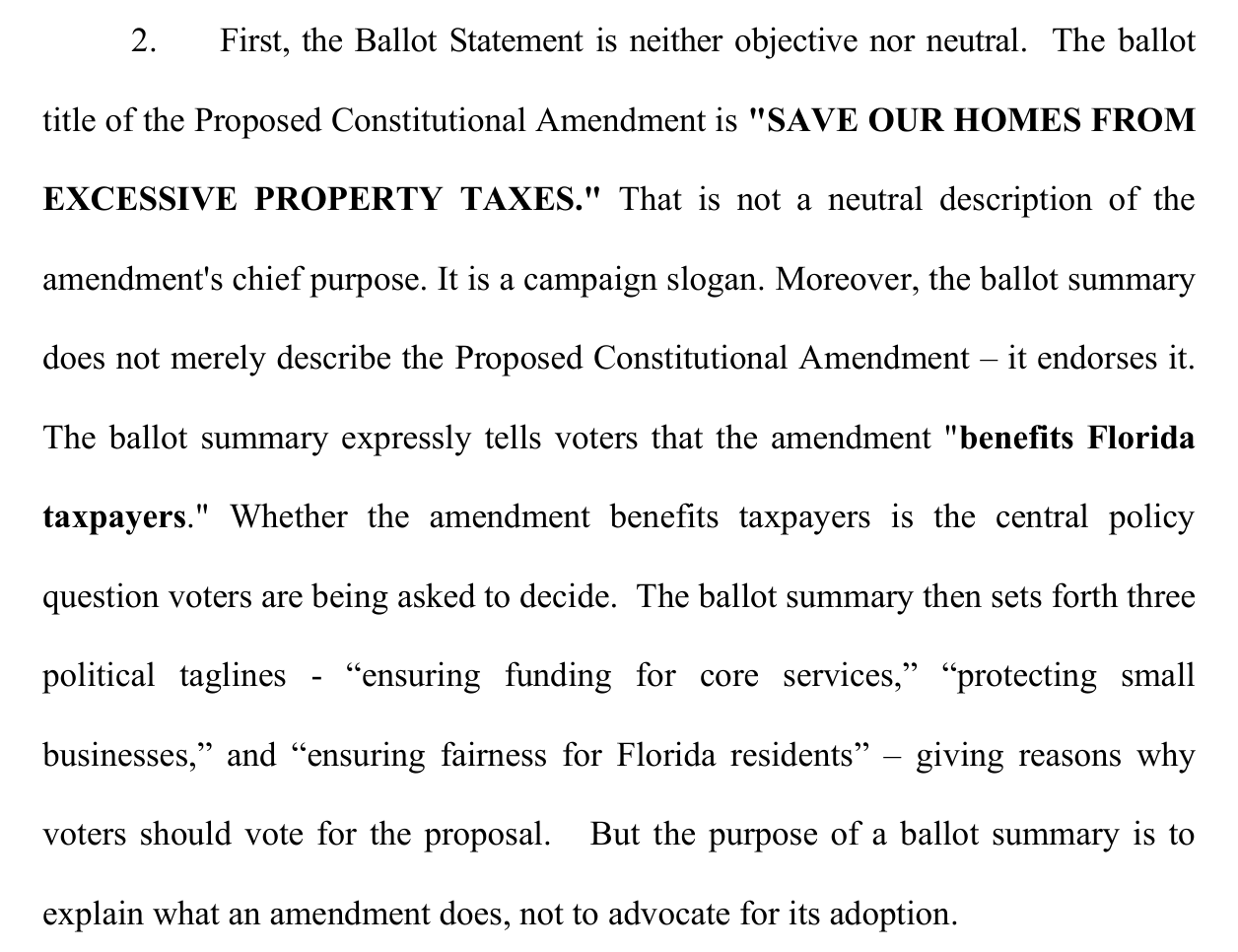
The ballot title approved by lawmakers is “SAVE OUR HOMES FROM EXCESSIVE PROPERTY TAXES.” The lawsuit argues that is not a description of what the amendment does. It is a sales pitch.

The plaintiffs point out that the measure has nothing to do with the actual “Save Our Homes” cap voters approved in 1992, and that borrowing the familiar name while adding the loaded phrase “excessive property taxes” pushes voters toward a yes vote before they read a single word of the summary. The complaint leans on a 1994 Florida Supreme Court decision that struck the proposed ballot title “SAVE OUR EVERGLADES” for exactly this kind of emotional framing. Notably, when the original Save Our Homes amendment went before voters in 1992, its ballot title was the dry and neutral “HOMESTEAD VALUATION LIMITATION.”
A Summary That Endorses Instead of Explains
The ballot summary opens by telling voters the amendment “benefits Florida taxpayers,” then lists three taglines: “ensuring funding for core services,” “protecting small businesses,” and “ensuring fairness for Florida residents.”
The lawsuit takes each tagline apart.
“Ensuring funding for core services.” The complaint argues the amendment does the opposite. By slashing the property tax base, it reduces the money available to local governments for police, fire, schools, and infrastructure. The suit also reveals a detail buried in the final version of HJR 1F: while Governor DeSantis’s original draft may have restricted local spending to core services, the version the House and Senate actually passed added a catch-all category allowing spending on anything “approved by county officers or municipal governing bodies, except those expenditures prohibited by general law.” In other words, the amendment imposes no new spending restrictions at all.
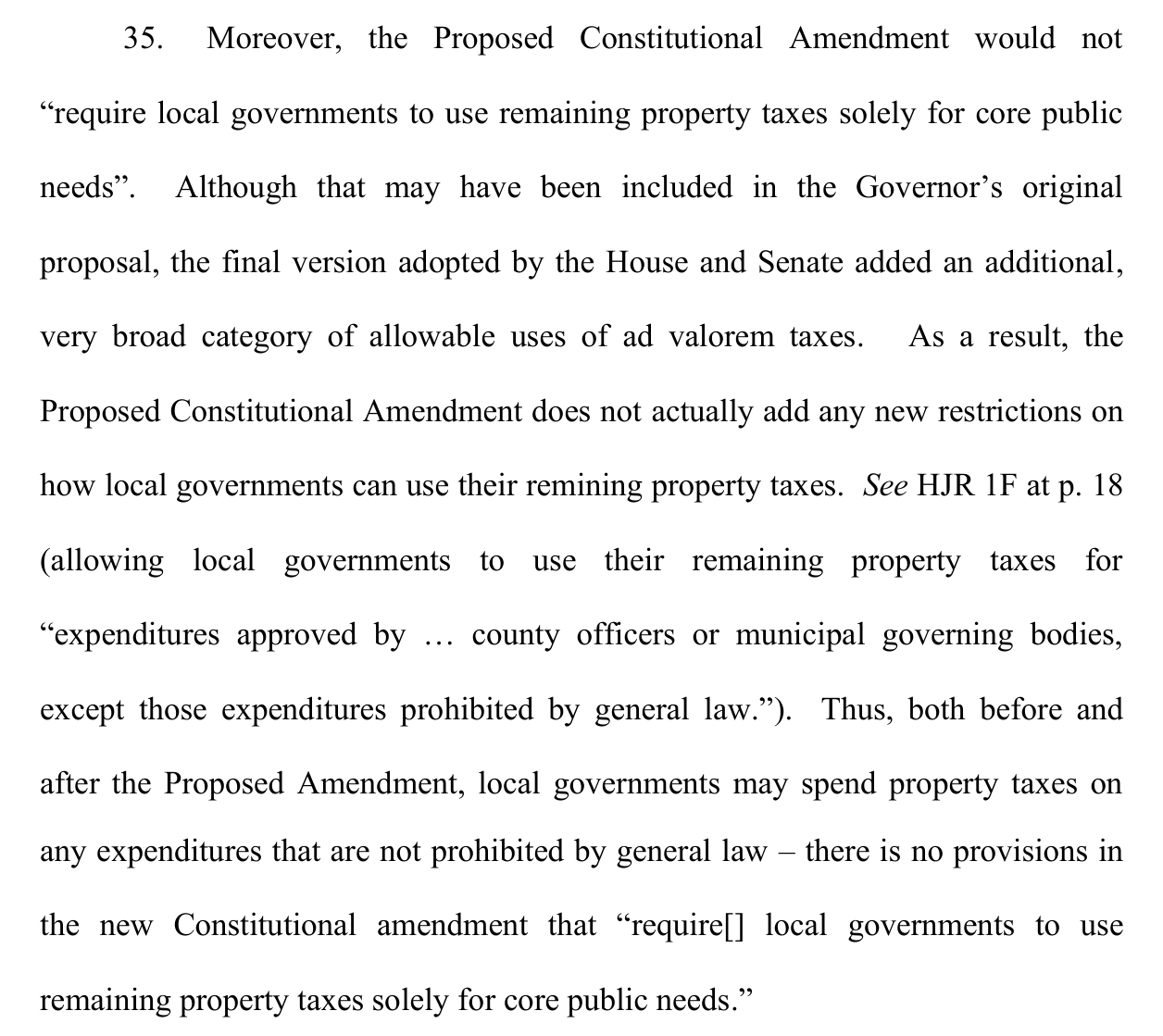
“Protecting small businesses.” Small businesses are never mentioned anywhere in the amendment text. The measure lowers the cap on annual assessment increases for all non-homesteaded property from 10 percent to 5 percent, a change that applies equally to office towers, industrial parks, and rental apartment complexes. The summary also fails to disclose that a 10 percent cap already exists, and the lawsuit notes that likely millage rate increases could wipe out any benefit entirely.
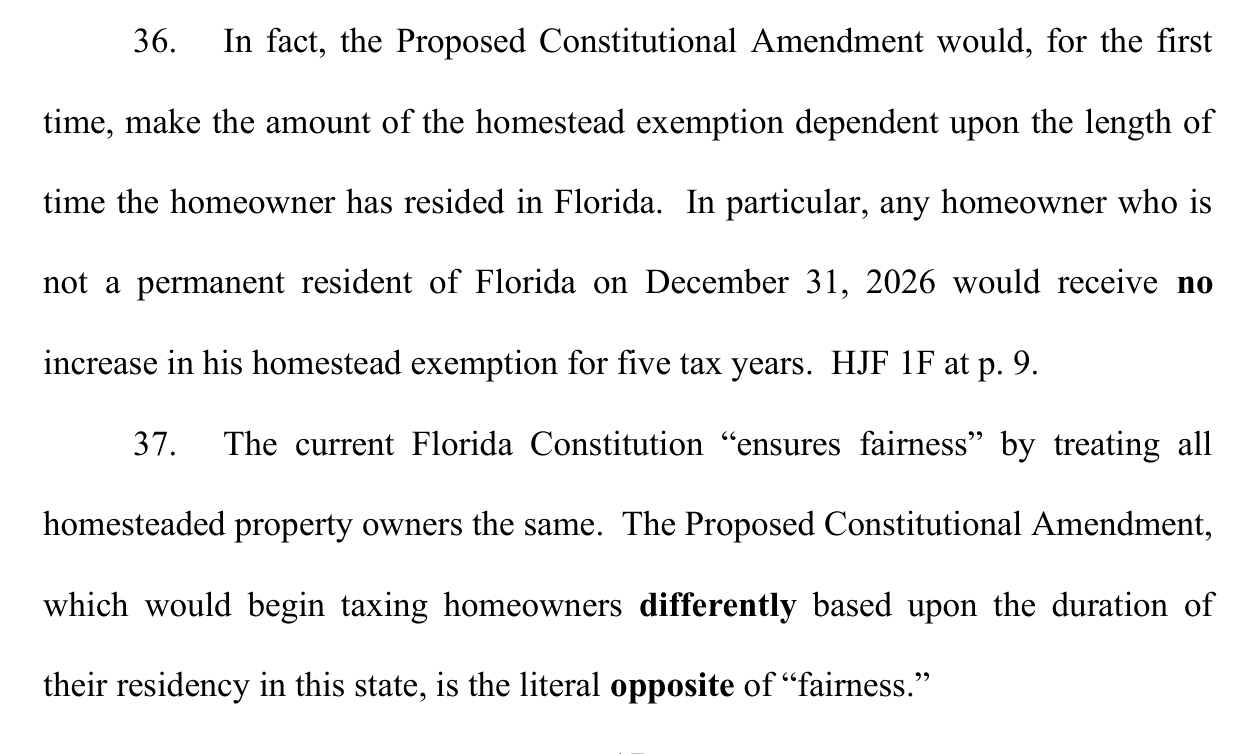
“Ensuring fairness for Florida residents.” The complaint calls this the literal opposite of what the amendment does. For the first time in state history, the size of a homestead exemption would depend on how long the owner has lived in Florida. Anyone establishing residency after December 31, 2026 would wait five years for the increased exemption. Renters get nothing, and would likely pay more as landlords pass along higher taxes driven by millage increases.
The Numbers Voters Will Not See
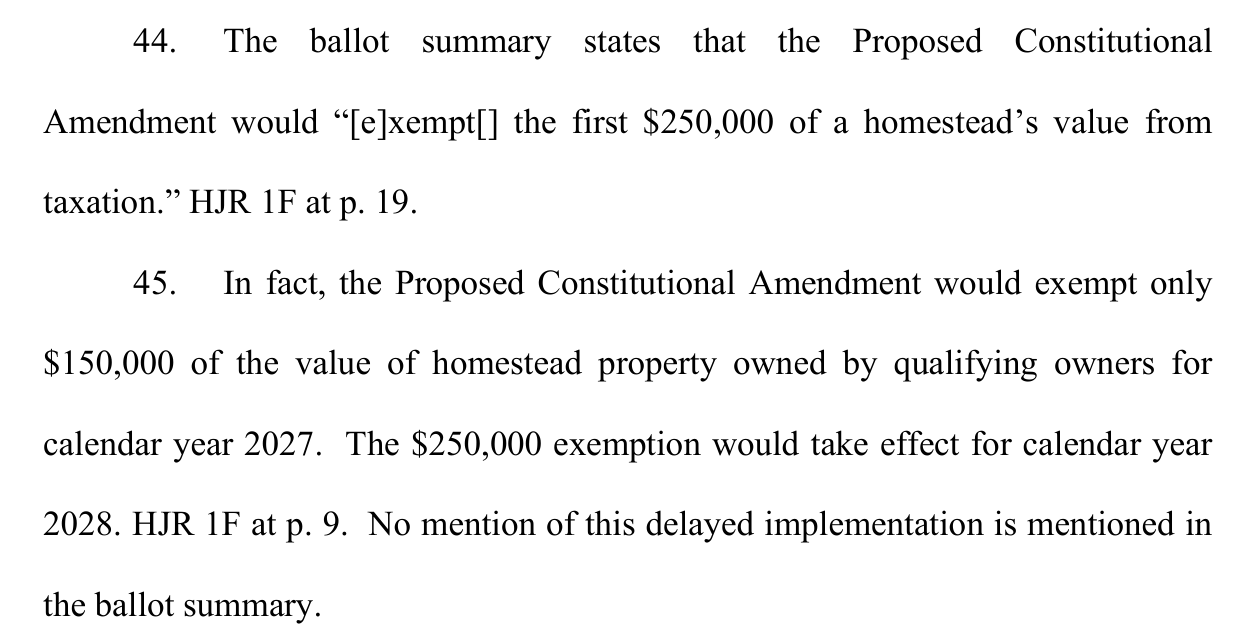
The summary tells voters the amendment exempts “the first $250,000 of a homestead’s value” and requires “a schedule for full elimination” of non-school homestead taxes.
Neither claim survives a reading of the actual amendment, according to the complaint. The exemption starts at $150,000 in 2027 and does not reach $250,000 until 2028, a delayed implementation the summary never mentions. And the amendment does not require full elimination of anything. It directs the Legislature to create a procedure through which counties and cities may, if they choose, increase exemptions “up to” the full assessed value. That is permission, not a mandate, and the lawsuit argues voters who want full elimination are being misled into believing this amendment guarantees it.
The plaintiffs cite a 2004 Florida Supreme Court case that struck a homestead exemption amendment from the ballot for promising “property tax relief” when local governments retained full power to raise millage rates and erase the benefit. The same logic, they argue, dooms the promise that this amendment will save anyone from “excessive” taxes.
What Happens Next
Even a win for the plaintiffs would not knock the amendment off the November ballot. Under Florida law, if a court finds the Legislature’s ballot summary defective, Attorney General Uthmeier would be required to rewrite it. The amendment still needs 60 percent voter approval to pass.
The stakes for local governments are enormous. A House staff analysis estimates the measure could cost local governments $8.4 billion per year. Here in Brevard County, that revenue funds the Sheriff’s Office, Brevard Public Schools’ non-operating levies, Palm Bay and Melbourne police and fire departments, and road and infrastructure budgets that are already stretched thin.
Attorney Jamie Cole, one of the lead lawyers on the case, summed up the plaintiffs’ position bluntly, saying the summary looks more like a campaign flyer than a ballot summary.
The plaintiffs acknowledge in the complaint that property tax reform is an important issue. Their argument is simpler than the politics surrounding it: whatever voters decide in November, they are entitled to a ballot that tells them the truth about what they are voting on.
The Space Coast Rocket will continue following this case as it moves through Leon County Circuit Court.
Criminal Defense
Bankruptcy · Evictions
WICKS LAW P.A.
Call or text for
free consult
321-733-2700
Eric Wicks, Esq.
1250 West Eau Gallie Blvd. G
Melbourne, FL 32935
Abogado Wicks habla español