

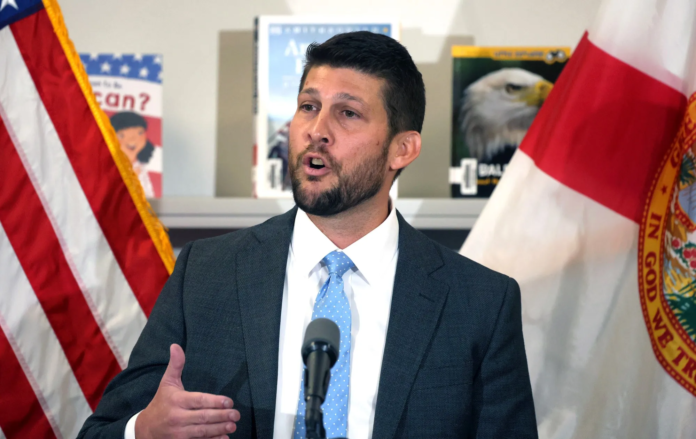
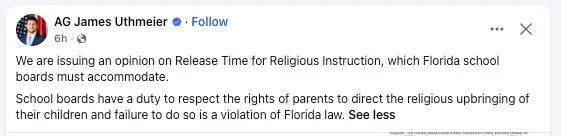
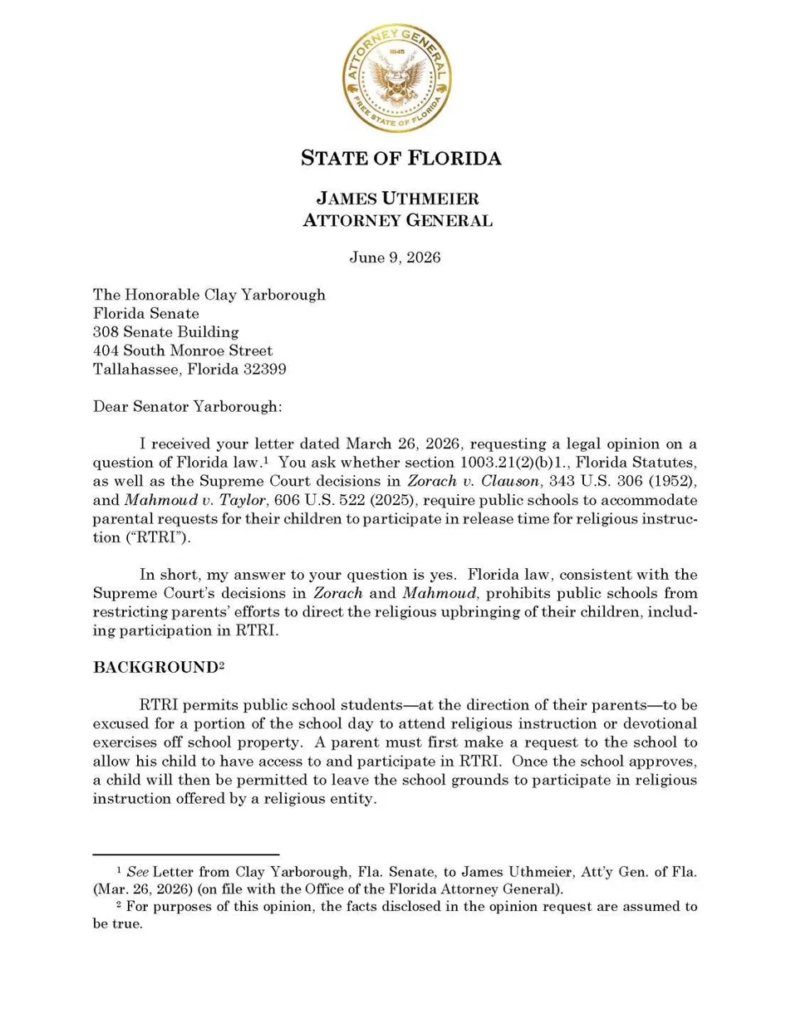
Florida Attorney General James Uthmeier issued a formal legal opinion on June 9 declaring that public school boards across the state are required to accommodate parents who want their children released from class during the school day to attend off-campus religious instruction. The practice is known as release time for religious instruction, or RTRI, and Uthmeier’s answer to whether districts must allow it was a single word: yes.

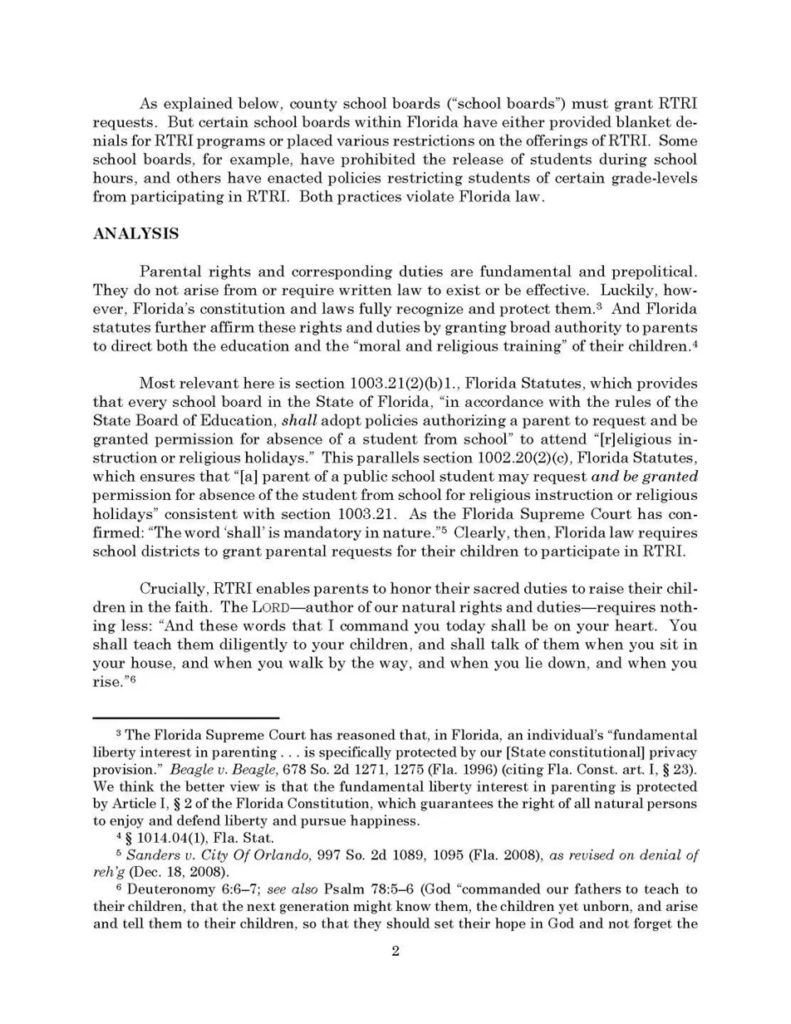
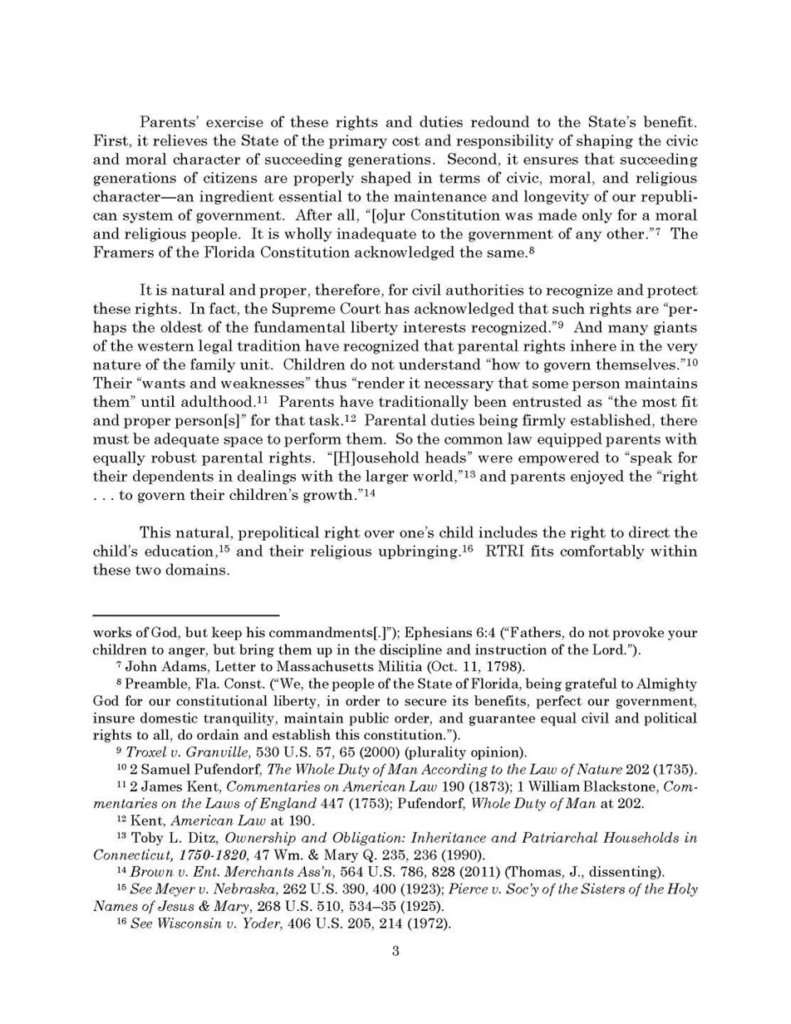
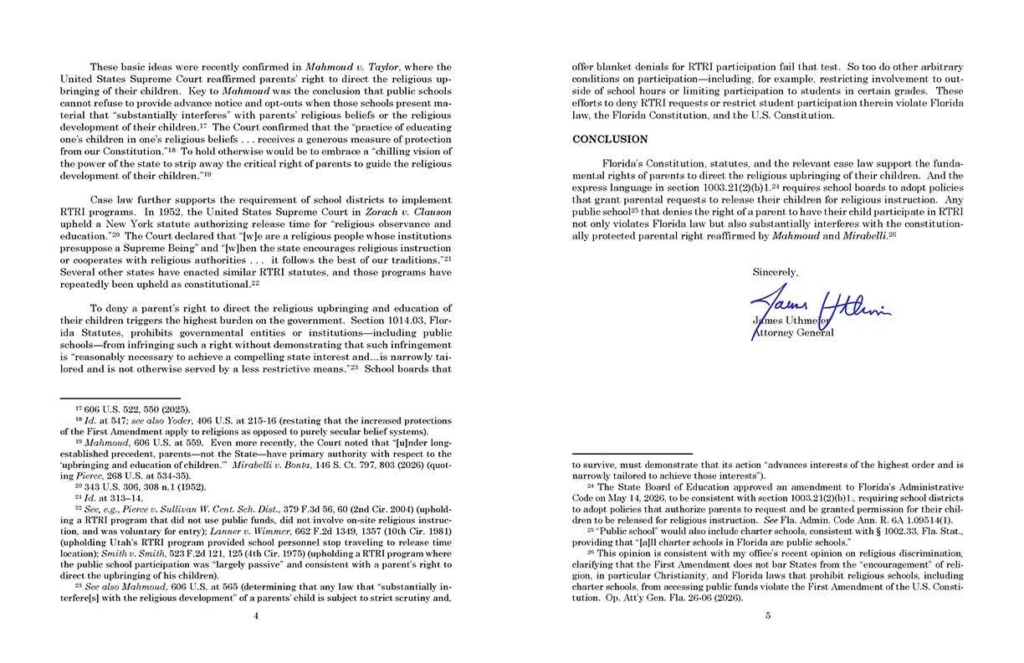
The opinion, addressed to state Senator Clay Yarborough of Jacksonville, leans on section 1003.21(2)(b)1 of the Florida Statutes, which says every school board “shall adopt policies authorizing a parent to request and be granted permission for absence of a student from school” for religious instruction or religious holidays. Uthmeier argues that the word “shall” makes approval mandatory rather than discretionary, and that boards which issue blanket denials, limit release time to certain grade levels, or bar it during school hours are violating Florida law.
An attorney general opinion is advisory. It guides state agencies and carries persuasive weight, but it does not bind courts, and a judge is free to disagree. What the opinion does is signal how Uthmeier’s office reads the law and how it intends to act, and it hands parents and religious organizations a ready-made legal argument to bring to local school boards.
Why this is surfacing now
The timing is not random. Release time has become one of the fastest-moving fronts in the national fight over religion in public schools, driven largely by LifeWise Academy, an Ohio-based nonprofit that provides Bible-based instruction to public school students during the school day. LifeWise now operates in more than 30 states and projected enrollment of close to 100,000 students for the 2025-26 school year. Its growth exploded in Ohio after that state changed its law in 2025 to require every district to adopt a release-time policy, flipping the framework from permissive to mandatory. Florida appears to be following the same path.
The movement has already reached Florida. In August 2025, LifeWise pushed to launch in Duval County Public Schools, drawing both support and pushback over lost instructional time and pressure on students who opt out. Duval sits inside Senator Yarborough’s district. Yarborough chairs the Senate Judiciary Committee, sits on the Pre-K-12 Education Committee, and has sponsored religious-expression legislation. His March 26 request for this opinion landed against that backdrop.

The opinion also follows two larger developments. In June 2025, the U.S. Supreme Court decided Mahmoud v. Taylor, which strengthened parents’ ability to claim that public schools cannot force religious families into instruction that conflicts with their beliefs. And in April 2026, Uthmeier issued a separate and far more controversial opinion declaring that Florida’s constitutional ban on public funding for religious institutions is unconstitutional, and arguing that the state is free to encourage religion, particularly Christianity. The release-time opinion explicitly cross-references that April opinion. The two are part of the same arc.
One more piece completes the timeline. The opinion states that the State Board of Education adopted an amendment to its administrative rule, Rule 6A-1.09514, on May 14, 2026, which it characterizes as requiring districts to adopt release-time policies. The publicly indexed version of that rule still reads “each school district which chooses to permit” release time, the older permissive language, so the exact text of the amendment was not yet reflected in public databases as of this writing.
An unusual legal opinion
The tone of the document sets it apart from a typical attorney general opinion. Most read like dry statutory analysis. This one quotes Deuteronomy and Psalms, cites John Adams and the 18th-century legal philosopher Samuel Pufendorf, and refers to “the LORD” as the “author of our natural rights and duties.” Uthmeier writes that parental rights are “fundamental and prepolitical” and do not depend on written law to exist. Supporters will read it as a robust defense of parental authority. Critics will read it as a religious argument dressed in legal citations.
What it means for Brevard
The honest answer is that Brevard Public Schools is not one of the districts Uthmeier is targeting. The district’s Board Policy 5200 (Attendance), last revised in March 2024, lists “religious instruction or religious holiday” as a recognized excused absence, and it cites the same statute and administrative rule the opinion is built on. There is no blanket denial in the policy, no grade-level restriction, and no language barring religious absences during school hours. On its face, Brevard already permits what the opinion says districts must permit.
That said, there are gaps worth watching. Brevard treats religious instruction as a category of excused absence, but it does not appear to maintain a full release-time framework of the kind the state rule contemplates for districts that allow students to leave during the school day. That framework includes procedures for a religious provider to report attendance back to the district, liability and insurance requirements, consideration of the district’s pupil-progression plan, and hearing rights for parents. An occasional excused absence is one thing. A recurring, structured program of the LifeWise variety is another.
There is also a discretion question. Policy 5200 states that the final authority for accepting the reason for an absence rests with the principal, and routes some absences through prior approval. Uthmeier’s entire argument is that approval of a bona fide religious-instruction request is mandatory, not subject to a principal’s judgment. If the May rule amendment did convert the framework from “districts that choose to permit” into “districts shall adopt a policy,” Brevard would have an affirmative obligation to adopt a dedicated release-time policy, and its current excused-absence approach may not be enough to satisfy it.
The other side
Release-time programs draw consistent objections, and they are worth stating plainly. Critics in Ohio and elsewhere have raised concerns about students missing core instructional time, about social pressure and bullying directed at children who do not participate, and about a private religious organization gaining a recurring presence in the rhythm of the public school day. Civil-liberties groups also question whether mandatory adoption blurs the constitutional line separating church and state, even when the instruction itself takes place off campus and is privately funded.
Supporters counter that the U.S. Supreme Court settled the basic question in 1952 in Zorach v. Clauson, which upheld release time so long as the instruction is off school property, privately funded, and chosen by the parent. They frame it as a matter of parental choice, not state endorsement.
What to watch
The questions for Brevard are concrete. Does the district intend to adopt a formal release-time policy in response to the opinion and the new state rule? Has any religious organization, LifeWise or otherwise, approached the district about launching a program? And how does the board’s general counsel read the May 14 rule amendment, as a mandate or as guidance?
Criminal Defense
Bankruptcy · Evictions
WICKS LAW P.A.
Call or text for
free consult
321-733-2700
Eric Wicks, Esq.
1250 West Eau Gallie Blvd. G
Melbourne, FL 32935
Abogado Wicks habla español