

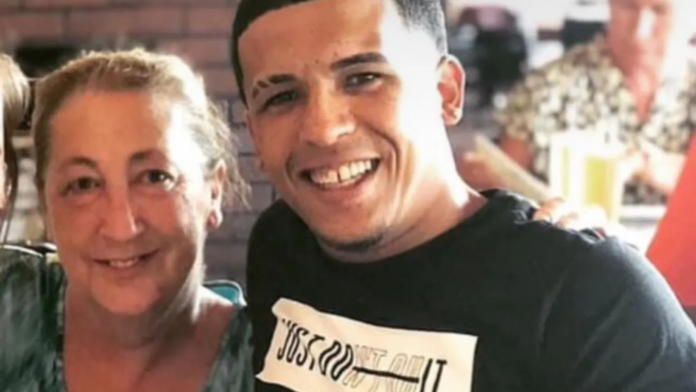
The estate of the 31-year-old Palm Bay man says officers tased him off the top of a six-foot fence, breaking his neck and leaving him a quadriplegic for nearly a year before he died. The city has previously called the tasing lawful.

PALM BAY, Fla. – The mother of Thomas Farley filed a federal civil rights and wrongful death lawsuit Monday against the City of Palm Bay and two Palm Bay Police Department officers, alleging that the officers used unconstitutional deadly force when they tased her son off the top of a six-foot wooden fence in June 2024, causing a fall that broke his neck and ultimately killed him.
The 52-page complaint was filed June 8 in the United States District Court for the Middle District of Florida, Orlando Division. The plaintiff is Pamela Farley, suing as executor of her son’s estate. The defendants are the City of Palm Bay, Officer Derrick Mitchell, and Sergeant Samantha Missale. The suit demands a jury trial and seeks compensatory and punitive damages.
Farley’s estate is represented by nationally known civil rights attorney Benjamin Crump and his firm, the Chicago trial firm Romanucci & Blandin, and Jacksonville’s Middleton Law Firm. The case carries echoes of high-profile police accountability suits the same lawyers have brought elsewhere in the country, but its central allegation is local and specific: that Palm Bay’s own written taser policy authorized exactly the kind of force that killed Thomas Farley.
The night at the Circle K
According to the complaint, on the night of June 28, 2024, Farley, a 31-year-old carpenter and construction worker, was standing in the parking lot of the Circle K at roughly 4950 Babcock Street NE with a group of friends, talking and shooting dice after making a purchase. A caller had reported a group of men outside the store. When Sergeant Missale’s patrol car pulled up shortly before midnight, the men ran.

The lawsuit alleges that Missale did not initially chase them, later stating that “they didn’t commit a crime at that point” and that she “wasn’t worried about them.” The complaint says she nonetheless searched the area, found Farley near a fence, and called Officer Mitchell over as Farley tried to climb it.
Over several seconds, the complaint alleges, Mitchell deployed his taser at Farley three times, firing six darts. As Farley reached the top of the roughly six-foot fence and was about to go over, the suit says, Missale shouted “Tase him!” Mitchell fired again while Farley was atop the fence. The electric shock incapacitated him, and he fell head-first to the ground, breaking the fence and his neck.
Body camera audio reported by FOX 35 Orlando captured Farley telling officers in the moments afterward, “I broke my neck, sir,” and “I can’t feel my lower body.” The same reporting noted that the officer who tased him was recorded telling another officer at the scene, “I got no crime.”
The complaint catalogs more than two dozen statements Farley made to officers as he lay face down, including that he could not move, could not feel his hands or feet, could not breathe, and believed he was going to die. It alleges that, knowing he had fallen head-first and was reporting paralysis, the officers rolled, dragged, and propped up his body to handcuff him without stabilizing his neck or spine.
A year as a quadriplegic, then death
Farley was taken to Holmes Regional Medical Center with a fractured cervical spine and was left a quadriplegic, paralyzed from the mid-chest down. He spent nearly a year bedbound, unable to breathe without assistance and unable to clear his own airway, the complaint states. He died on June 19, 2025. An autopsy concluded that the cause of death was the taser deployment associated with the fall and the resulting spinal injury, and that the manner of death was homicide, according to the suit. He is survived by his mother and a young son.
In the months Farley lay in the hospital, his mother spoke publicly about his condition. “It breaks my heart. He doesn’t even want to live,” Pamela Farley told reporters at an October 2024 press conference, as covered by WESH 2. In a statement released with this week’s lawsuit, she said, “My son Thomas was the protector, the rock, and the heart of our family. I am bringing this lawsuit so that Thomas’s name is remembered and so no other family has to live through what mine has.”
The legal theory: tasing at height as deadly force
The heart of the case is a 2021 federal appeals court decision. In Bradley v. Benton, the Eleventh Circuit Court of Appeals held that firing a taser at a person who is at an elevated height constitutes deadly force, because of the risk of a fall, and that using such force against an unarmed person not suspected of a violent crime violates the Fourth Amendment. The complaint argues that this ruling, issued three years before Farley’s tasing, made the officers’ conduct clearly unconstitutional.
The suit alleges the officers’ own paperwork undercuts any justification. On the department’s Response to Resistance form, the complaint says, both officers indicated that Farley posed no imminent threat, was not armed, had not attacked anyone, and was engaged only in passive resistance, and that the stated purpose of the force was to make an arrest and prevent escape.
Where the complaint moves beyond the two officers is its claim that the city itself is liable. It alleges that Palm Bay Police Department General Order 203, the taser policy in effect that night, permitted officers to tase a person where a fall could cause injury whenever “exigent circumstances” existed, a standard the suit says falls far below the constitutional requirement for deadly force. The policy, the complaint argues, never told officers that tasing someone at height is deadly force or that it may be used only when deadly force is justified.
A prior tasing, and a rejected firing recommendation
The complaint devotes significant attention to Mitchell’s history. It alleges that on August 23, 2023, less than a year before Farley’s death, Mitchell tased a man named Esteban Morris off a moving dirt bike, causing Morris to crash and suffer broken ribs and a broken clavicle. An internal investigation found Mitchell violated policy, the suit says, but he denied wrongdoing.
According to the complaint, it was recommended that Mitchell be fired, reasoning that an officer who would not recognize his own misconduct could not be trusted to avoid repeating it. The suit alleges that the department instead suspended Mitchell for 120 hours, ordered remedial taser training, and that Mitchell still received a satisfactory annual rating and a merit pay increase. Less than a year later, the suit notes, Mitchell tased Farley off the fence. We have not yet independently verified these allegations.
A pattern, and the city’s response
The lawsuit frames Farley’s death as the product of a broader culture, alleging that the department’s supervisory chain routinely approved, concealed, or rewarded excessive force rather than disciplining it. It cites department use-of-force data drawn from the national Police Scorecard project, which it says shows Palm Bay deployed less-lethal weapons per arrest more often than 74 percent of departments nationwide between 2013 and 2022, and that the department did not sustain a single civilian use-of-force complaint over that decade.
The complaint also points to other incidents involving the same night-shift squad and other officers, including the June 2025 arrest of a pregnant woman, Tamara Hatcher, by Officer Sean Rollins. That arrest, in which a former deputy chief told the city council the force was excessive, was reported by ClickOrlando. The suit alleges Rollins had been fired by the Columbia, South Carolina police department in 2021 before Palm Bay hired him in 2023.
The lawsuit alleges that the city’s top officials ratified the tasing. It says PBPD awarded the two officers a unit citation weeks after the incident, that the police chief publicly announced the officer “legally and justifiably used his Taser” and “followed departmental policy,” as reported by WESH 2 in October 2024, and that at a November 2024 council meeting Mayor Rob Medina rebuked former Deputy Chief Fisher’s whistleblower comments and praised the officers.
The charges against Farley
After the tasing, Palm Bay police charged Farley, not the officers. As reported by FOX 35 and others, Farley faced charges of resisting an officer without violence, loitering and prowling, and possession of a controlled substance. Crump and the family spent much of 2024 publicly demanding that those charges be dropped so Farley could get medical care, and calling instead for charges against the officer who tased him.
The counts, and what comes next
The complaint brings eight counts under 42 U.S.C. Section 1983 and Florida law: excessive force against Mitchell; supervisory excessive force against Missale; municipal (Monell) liability against the city for its taser policy, training, and discipline; failure to intervene against Missale and the city; post-tasing excessive force against both officers; deliberate indifference to serious medical needs under the Fourteenth Amendment, pleaded in the alternative; and wrongful death under Florida’s Wrongful Death Act against all defendants. The estate says it will seek a claims bill for damages above the statutory cap that limits recovery against Florida municipalities.
“This is not a case about one or two bad officers,” Romanucci & Blandin Senior Attorney Joshua M. Levin said in a statement. “The Palm Bay Police Department’s own written policy authorized the kind of unconstitutional, elevated-height tasing that killed Thomas Farley.”
The allegations in the complaint have not been tested in court, and the defendants have not yet filed a response. Palm Bay has consistently maintained that the tasing complied with department policy and Florida law, a position its police chief stated publicly in 2024. The Space Coast Rocket has reached out to the City of Palm Bay for comment and will update this story with any response.
Criminal Defense
Bankruptcy · Evictions
WICKS LAW P.A.
Call or text for
free consult
321-733-2700
Eric Wicks, Esq.
1250 West Eau Gallie Blvd. G
Melbourne, FL 32935
Abogado Wicks habla español