

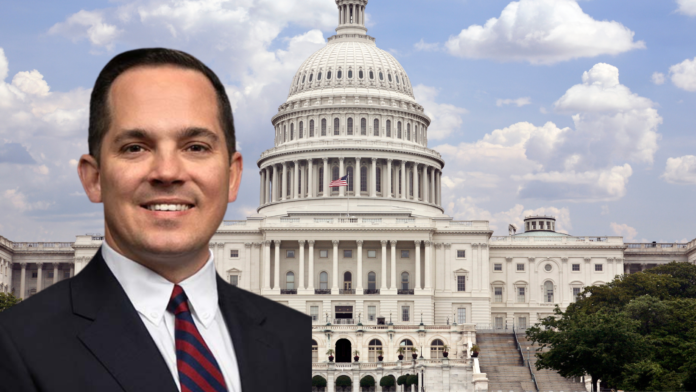
A Lake County Republican is asking a federal judge to dismantle one of Florida’s oldest election laws on the eve of the 2026 qualifying period, and so far the judge is not buying it. District 1 Lake County Commissioner Anthony Sabatini, a former state representative and a practicing attorney representing himself, has refused to resign his county seat in order to run for Congress and is suing the state to have the requirement declared unconstitutional.

The target is Florida’s resign-to-run statute, Section 99.012, which bars an officeholder from qualifying for another office if the terms overlap unless they first resign the seat they hold. Sabatini wants to keep his commission seat as a fallback while he runs for the open U.S. House District 11 seat being vacated by retiring Rep. Dan Webster. The lawsuit names Secretary of State Cord Byrd and Gov. Ron DeSantis, both Republicans, making this an intraparty fight over a law that has been on the books since 1970.
The procedural history
Sabatini filed his original federal complaint in May in the U.S. District Court for the Northern District of Florida, the case captioned Sabatini v. Byrd, No. 4:26-cv-00246-MW-MJF. He argues the law violates the Qualifications Clause and the Elections Clause of the U.S. Constitution by adding a requirement for congressional candidates that the Constitution does not allow, and that it separately violates the Florida Constitution.
Chief U.S. District Judge Mark Walker was not persuaded. Walker denied Sabatini’s request for an injunction, writing that he was not convinced the sole purpose of the resign-to-run law is to create an additional qualification to run for Congress, and that Sabatini had not shown he was substantially likely to win on the merits. In plain terms, the judge told him to follow the law like everyone else.
Rather than appeal, Sabatini amended and refiled. The Amended Verified Complaint, Document 23, was entered on June 3, and he has asked the court to move quickly. The timing is unforgiving. The 2026 qualifying period for congressional candidates opens at noon on Monday, June 8, and closes at noon on Friday, June 12. The ten-day statutory deadline to submit a resignation letter has already passed, and Sabatini did not submit one.

The precedent landscape
The centerpiece of Sabatini’s case is U.S. Term Limits, Inc. v. Thornton, the 1995 Supreme Court decision holding that states cannot add qualifications for Congress beyond the age, citizenship, and residency requirements set in Article I. He pairs it with Powell v. McCormack from 1969 for the same proposition. The trouble is that courts have repeatedly declined to treat resign-to-run laws as added qualifications.
The controlling distinction is between a rule that flatly bars a candidate based on something inherent to that person, which is forbidden, and a condition the candidate can simply choose to satisfy, which is allowed. Resign-to-run has landed on the permissible side of that line again and again. In Joyner v. Mofford, the Ninth Circuit upheld an Arizona resign-to-run law against the exact argument Sabatini makes, reasoning that the law does not stop a state officeholder from running for federal office but only requires resignation if they choose to. In Merle v. United States, the Third Circuit reached the same conclusion, holding that such a law imposes no additional qualification because it leaves the citizen a choice. Sabatini frames his predicament as an impossible choice, but a choice is precisely what the case law treats as constitutional.
His effort to distinguish Arizona, on the ground that Arizona’s rule is written into its constitution while Florida’s exists only in statute, does little for the federal claim. That distinction may matter to a state-law argument, but for the federal Qualifications Clause it is largely beside the point, since the Arizona law in Joyner was struck at and survived on the same theory.
Sabatini does hold one genuinely interesting card. In 1970, the same Northern District of Florida ruled that the resign-to-run law could not be applied to candidates for Congress. It is his strongest authority and it sits in his own courthouse. But it is an old, non-binding district decision that predates the modern framework courts now use to separate ballot-access rules from qualifications, and the statute has been amended since. Walker was plainly unmoved by it the first time around.
The complaint’s other half, that the law violates Article X, Section 3 of the Florida Constitution because that provision lists the only ways an office can become vacant and the Legislature cannot invent a new one by statute, is a cleaner argument on the text. But it faces a structural problem in federal court. A federal judge generally cannot order state officials to obey state law, which means the most novel part of Sabatini’s case may belong in a state courtroom, not before Judge Walker.
One practical point cuts against the urgency Sabatini describes. A candidate who files the resignation letter on time can set its effective date as late as the day the new term begins, so the immediate loss of office he warns about is triggered only because he declined to file. The real burden the law imposes is narrower and well understood: he cannot run for the higher office while keeping his current seat as a safety net if he loses. Courts have consistently called that a lawful burden rather than an unconstitutional barrier.
What happens to Sabatini’s commission seat
If he wins an injunction
He could qualify for Congress without resigning and keep his District 1 seat while he campaigns, at least while the order stands. This is the outcome Walker has already declined to grant once.
If he loses but files a resignation letter before qualifying closes
He can run for Congress and set his resignation to take effect when the congressional term would begin in January 2027. If he wins the seat, he moves to Washington. If he loses, the resignation is still irrevocable, so he gives up the commission seat anyway and it is filled under state law. No safety net.
If he loses and refuses to resign but qualifies anyway
The statute treats that as an automatic, irrevocable resignation effective immediately, costing him the commission seat now, and it could expose his candidacy to a challenge under Section 99.0211.
If he abandons the congressional run
He keeps his Lake County Commission seat through the end of his term in November 2028.
Why it matters beyond Lake County
Resign-to-run is a statewide law, and a ruling for Sabatini would ripple to every county commissioner, school board member, and city official in Florida who has eyed a congressional seat without wanting to risk the office they already hold. That includes officeholders here on the Space Coast. The case also lands in the middle of a broader season of litigation over how Florida administers its 2026 elections, the same arena that has produced fights over the state’s redistricting maps and the handling of judicial and legislative vacancies.
For now, the smart money tracks the judge’s own words. Sabatini calls the law illegal. The court calls his odds of proving it low. The qualifying window will likely force the issue before any of it is fully resolved.
Criminal Defense
Bankruptcy · Evictions
WICKS LAW P.A.
Call or text for
free consult
321-733-2700
Eric Wicks, Esq.
1250 West Eau Gallie Blvd. G
Melbourne, FL 32935
Abogado Wicks habla español