


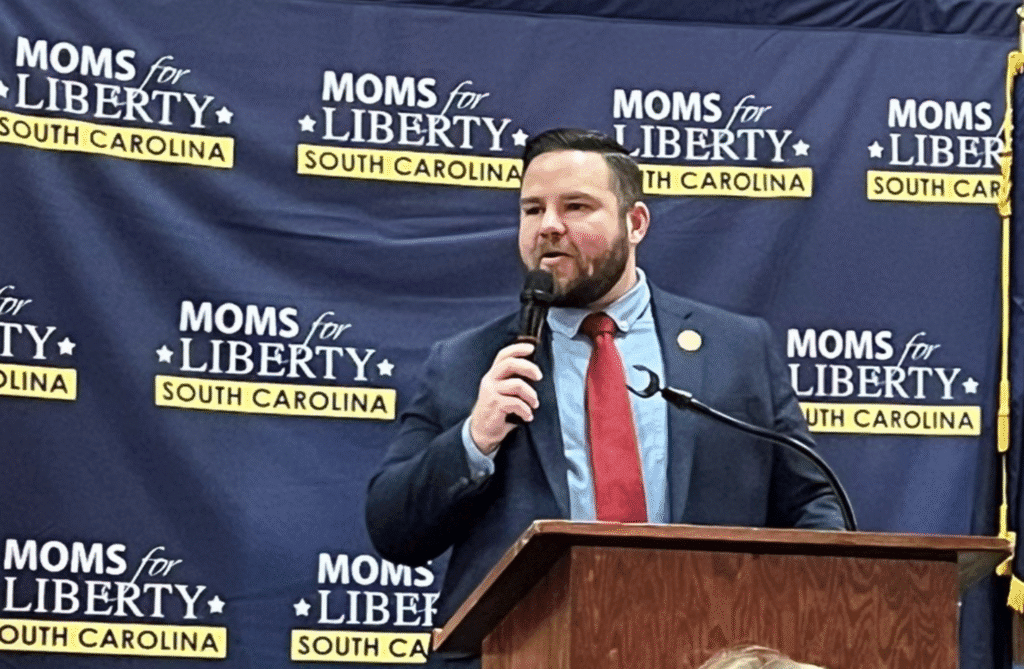
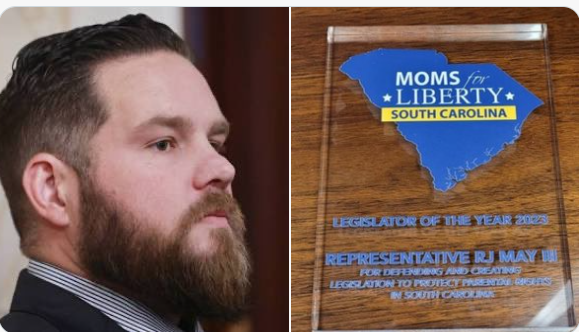
Former South Carolina state Rep. Robert John “RJ” May III, the Republican lawmaker once celebrated by Moms for Liberty as its 2023 “Legislator of the Year,” is now asking a federal judge to sentence him below the advisory guideline range after he pleaded guilty to distributing child sexual abuse material.

Prosecutors have asked the court to impose the maximum sentence allowed by law, 20 years in federal prison, in a case that has drawn national attention because of May’s political profile and the moral panic machine that helped elevate him.
Now, May’s attorneys have filed a formal sentencing memorandum and motion seeking a downward variance and or departure from the federal sentencing guidelines, arguing that the current guideline structure for non-production cases is overly punitive and does not reflect individualized culpability.
Defense asks court to go below the guideline range
In the filing, May’s lawyers note that the presentence investigation report places him in Criminal History Category I and calculates an advisory guideline range of 210 to 262 months. Because the statutory maximum is 20 years, the high end of that range is effectively capped.
The defense argues that a guideline sentence would be greater than necessary under federal law and urges the court to impose a lower sentence based on the factors judges must consider at sentencing.

May pleaded guilty Sept. 29, 2025 to five counts of distribution pursuant to a written plea agreement, according to the filing.
“Mechanical escalation” and “outdated enhancements”
The defense attempts to distinguish May’s conduct from cases involving production or direct contact with children, arguing the guidelines treat him as if he were among the most culpable offenders even without certain aggravating factors.
In one of the most pointed lines in the memo, the defense claims the guidelines “function less as a measure of just punishment and more as a mechanical escalation driven by outdated and harsh enhancements,” and asks the judge to limit reliance on the advisory range.
The filing does not specify how many years May believes he should receive, only that it should be below what prosecutors are seeking.
A post-release plan built around isolation
To support the request for leniency, May’s attorneys present a post-release plan they say reduces risk and provides structure.
According to the motion, May would reside on his parents’ family farm in rural Virginia, where the only other people living on the land are his parents. The defense claims the property has no internet access or cable television.
The filing also claims there are no schools, daycares, malls, parks, arcades, movie theaters, or playgrounds for miles.
May’s lawyers say he plans to build a small “tiny home” next to his parents’ dwelling and that he has already completed a design plan while incarcerated.
The memo further notes that the Virginia State Police regional headquarters is located close to the farm for sex offender registry reporting, and that mental health providers are about a 30-minute drive away so he can continue treatment after release.
Work plan and restitution
The defense also argues that a lower sentence would allow May to begin paying restitution and financially supporting his children sooner.
According to the filing, May plans to revive his father’s landscaping business and expand services into pressure washing, asphalt sealing, and line striping, which the defense says would allow him to earn income and begin making payments.
The hypocrisy issue remains
This latest filing is the next chapter in a case that has become a political Rorschach test.
Moms for Liberty and allied conservative activists have spent years accusing others of being threats to children, while pushing book bans and branding LGBTQ people and educators as “groomers.” May was not a fringe figure in that ecosystem. He was promoted, honored, and platformed.
Now his lawyers are asking the court to view him as less culpable than the harshest category of offenders and to sentence him below the guideline range.
May is scheduled to be sentenced this week. The judge will decide whether the defense’s argument for a reduced sentence and an isolated farm-based release plan outweighs the government’s push for the harshest punishment allowed.
Criminal Defense
Bankruptcy · Evictions
WICKS LAW P.A.
Call or text for
free consult
321-733-2700
Eric Wicks, Esq.
1250 West Eau Gallie Blvd. G
Melbourne, FL 32935
Abogado Wicks habla español