

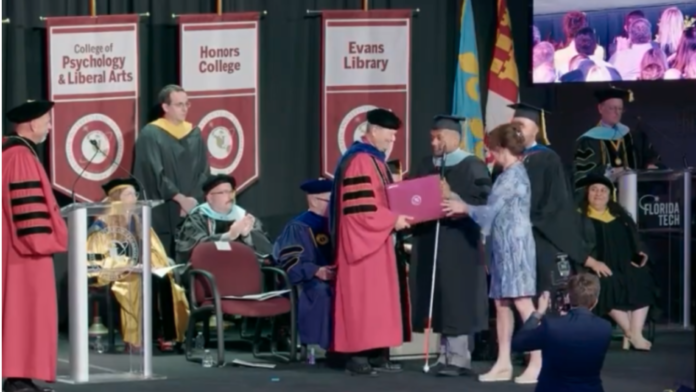
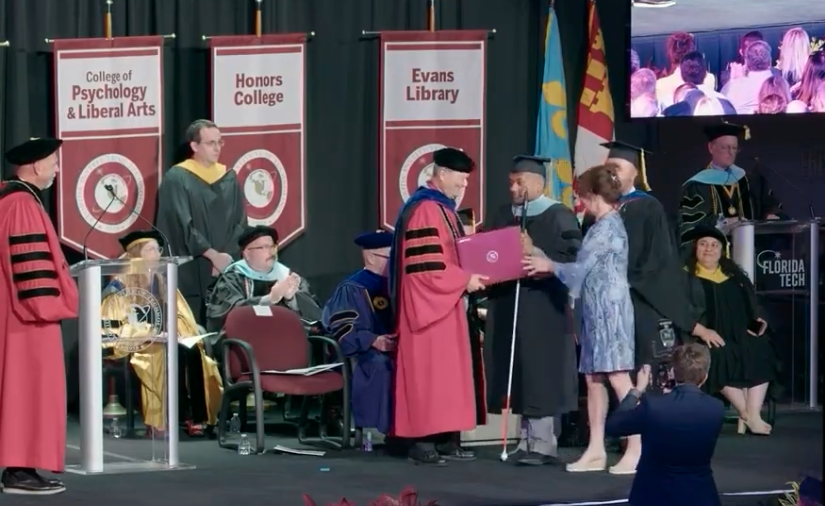
MELBOURNE, FL — Dr. Tanveer Mansur Syed, a legally blind doctoral candidate at the Florida Institute of Technology, has officially completed his PhD in Mathematics and Systems Engineering, capping a ten-year academic journey that he describes as a first for the Melbourne-based university.

Syed, who is known online as “The Bengal Dragon” and produces content under the channel “Blind Man Reviews,” announced the milestone in a YouTube video published this week titled “I FINALLY GOT MY PhD – Brief thoughts.” His dissertation, “Low-Vision Students’ Experiences with and Suggestions to Improve Desktop Virtual Reality Science Labs,” is archived in the Florida Tech institutional repository and is dated May 2026.
According to the repository listing, his doctoral committee was chaired by Dr. Thomas Marcinkowski and included Drs. Nezamoddin Nezamoddini-Kachouie, Khaled Ali Slhoub, and M. Toufiq Reza.
A Decade-Long Journey
Syed began his doctoral program in the fall of 2016. In his video remarks, he reflected on the length and difficulty of the road behind him, noting that he completed his degree just days before recording the announcement.
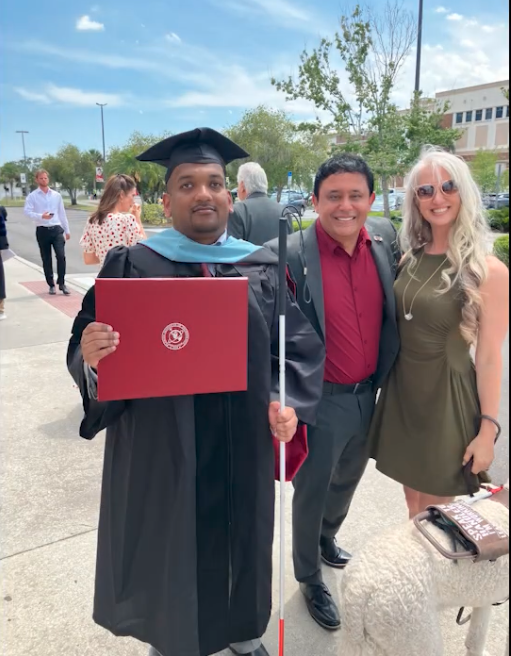
“Ten long, grueling years, ladies and gentlemen, for the most part,” Syed said in the video. He held his white cane next to his diploma in promotional photographs, a deliberate choice he said was meant to send a message rather than simply mark a personal achievement.

“A blind man has earned a PhD doing research that has never been done before,” he said.
Syed told viewers that based on his own inquiries, he believes he is the first legally blind person to earn a doctoral degree from Florida Institute of Technology. The Space Coast Rocket has not independently verified this claim with the university, and Florida Tech has not publicly confirmed or denied it.
Research Focus: Virtual Reality for Low-Vision Students
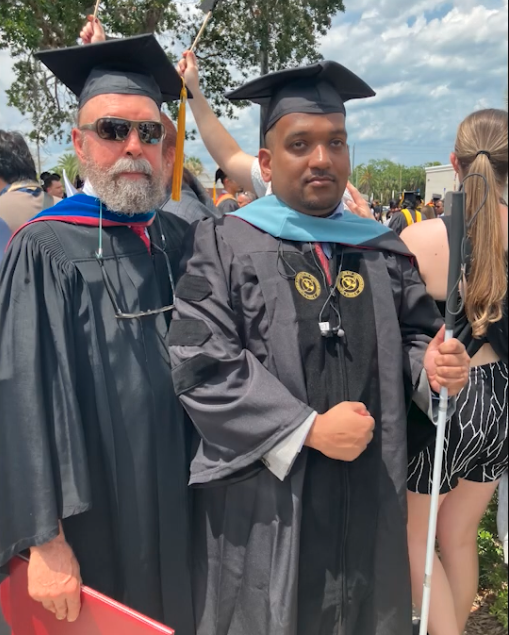
Syed’s dissertation investigated how virtual science labs can be improved for low-vision students and explored their perceptions of virtual reality and assistive technology. According to the repository abstract, the research notes that working-age visually impaired people continue to face an unemployment rate above 70 percent despite federal protections, and that VR science lab simulations have been presented as cost-effective alternatives to traditional science labs.
His original research plan called for high-immersion VR headsets, but Syed said in the video that software developers discontinued the high-immersion version during the COVID-19 pandemic, forcing him to pivot to low-immersion desktop VR. He described that shift as “a hint of serendipity,” noting that his subsequent literature review turned up no comparable English-language studies on low-immersion VR science labs for low-vision students.
An International Path to Melbourne
Syed’s path to Florida’s Space Coast has been documented previously by international outlets. The Business Standard reported in 2021 that Syed was born and raised in Abu Dhabi to Bangladeshi parents and was told by doctors he would lose his sight by age 15. He went on to play blind cricket for a Yorkshire County team, earn two master’s degrees, and learn multiple languages before being accepted into the Florida Tech doctoral program.
While at Florida Tech, Syed previously won both Student of the Year and Student-Employee of the Year awards, according to the same report.
A Message About Visibility
In his announcement video, Syed pushed back on what he described as a tendency to treat accomplishments by people with disabilities as a matter of good fortune rather than earned achievement.
“There is a difference between being humble and being invisible,” he said. “A lot of people conflate the two as one.”
He credited his doctoral advisor, his family, and his friends with providing financial, psychological, and institutional support throughout the program, and he singled out the bureaucratic hurdles involved in conducting qualitative education research with a low-incidence population in Florida.
The announcement was amplified locally by community advocate Jennifer Cleveland, who wrote on Facebook that watching Syed walk across the stage was “a surreal and heartfelt moment” and called him “an inspiration, a trailblazer, and a true superhero to the visually impaired community.”
What’s Next
Syed closed his video by recounting advice from his advisor delivered immediately after the commencement ceremony.
“Tanveer, this is just the beginning. You are going to achieve a lot more,” Syed recalled him saying.
Syed also invited others in academia or in any field, particularly people with disabilities, to reach out to him for guidance.
His full announcement video is available on the Blind Man Reviews YouTube channel.
Criminal Defense
Bankruptcy · Evictions
WICKS LAW P.A.
Call or text for
free consult
321-733-2700
Eric Wicks, Esq.
1250 West Eau Gallie Blvd. G
Melbourne, FL 32935
Abogado Wicks habla español