

Letter to the Editor

By H.E. Rektion
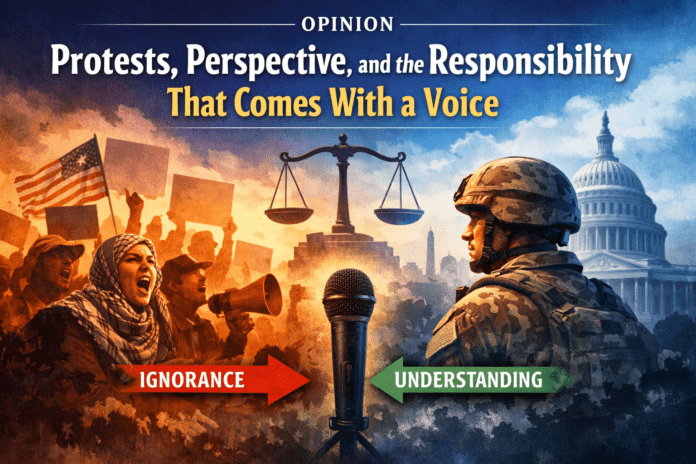
Across the country, protests and school walkouts have once again become part of the national conversation. Supporters view them as an important expression of civic engagement, while critics question their impact, timing, and depth of understanding behind them. The debate itself is not new, but it raises an enduring question: How do we balance the right to protest with the responsibility to understand what is being protested?
This question takes me back to 1990, during the first Gulf War, when I was a seventh grader at Central Junior High. One day, the entire school walked out to protest the war. I remember sitting in math class watching classmates leave, wondering how kids our age had suddenly become so passionately invested in a conflict most of us could not explain, did not understand, and likely could not even locate on a map. Iraq, Kuwait, annexation, geopolitics, none of it carried real meaning to us at that age.
Eventually, after the classroom emptied and the teacher left, I walked outside to find every student gathered together. What stayed with me was not the protest itself, but how it was handled. The principal at the time, Mr. Knowles, was not angry. Instead, he shared that he had protested during the Vietnam era and reminded us there is a time and a place for protest, and that peaceful action is what gives a voice credibility and staying power. That moment shaped how I have thought about protest ever since.

Years later, after joining the Army, my perspective deepened further. I was willing to give a blank check to my country so that others could freely exercise their rights, even when I personally disagreed with them. At the same time, military service teaches another difficult lesson: People can genuinely believe they are on the right side of history and later realize the truth was far more complicated. Some sacrifices are made in good faith only to be reevaluated years later when fuller information comes to light. That realization has a way of changing how one views certainty, activism, and moral confidence.
I strongly believe in the right to protest, in free speech, and in standing up for what one believes in. But I also believe those rights come with an obligation: Understanding matters. Not slogans. Not social media summaries. Not echo chambers. In an era where reliable information is widely accessible, ignorance is no longer an excuse we should casually accept.
Protest can be powerful when it is informed. When it is not, it risks becoming noise rather than conviction. The challenge is teaching the next generation that passion and preparation are not opposites, and that doing the work to understand an issue is what gives activism legitimacy.
For context, and perhaps contrary to how I sometimes present myself online, I consider myself a centrist. That middle ground often feels like it has disappeared in modern discourse, replaced by a demand to pick sides or be dismissed entirely. Centrism, at least as I see it, is not a lack of principles, but a refusal to abandon nuance.
I believe strongly in the First Amendment, the Second Amendment, and the right to privacy protected by the Fourth Amendment. I also believe immigration has historically made this country stronger. At the same time, I believe immigration should be legal, orderly, and vetted. Expressing concern about process and safety should not automatically invite accusations of racism or bigotry. Wanting a secure country and a lawful system does not negate compassion, nor does it undermine the value immigrants bring to this nation.
Like many Americans, I am a parent. I have five children. Even though they are grown, the instinct to care about the safety and stability of the country they live in does not disappear. Wanting a society that protects both liberty and security should not be viewed as extreme. It should be viewed as responsible.
What is troubling today is not any single protest, but the broader tone of public discourse. The inability to talk across differences, the rush to label rather than listen, and the growing sense that disagreement itself is intolerable are signs of a society under strain. These divisions feel less like healthy debate and more like a spiral that benefits no one.
The real challenge moving forward is not whether people should protest. They should. The challenge is whether we can create space for informed activism, respectful disagreement, and honest conversation. If we cannot slow down long enough to listen to one another, protect constitutional rights consistently, and value understanding over outrage, we risk losing far more than any argument we win.
That is a conversation worth having, and one that deserves thoughtful voices from all sides.
Editor’s note: This submission is published as a Letter to the Editor. The views expressed are the author’s own.
Criminal Defense
Bankruptcy · Evictions
WICKS LAW P.A.
Call or text for
free consult
321-733-2700
Eric Wicks, Esq.
1250 West Eau Gallie Blvd. G
Melbourne, FL 32935
Abogado Wicks habla español