


- Advertisement -

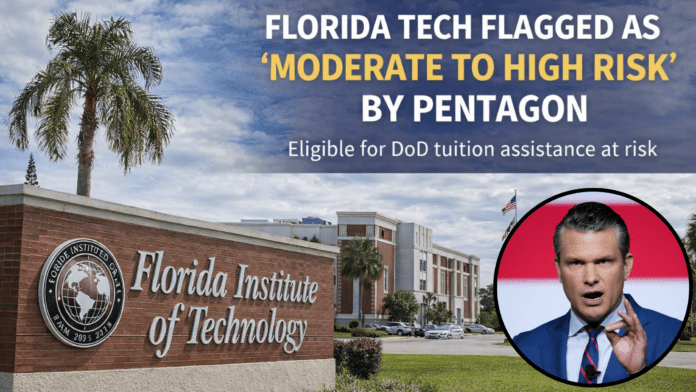
Local focus: Florida Institute of Technology in Melbourne and what this could mean for Space Coast service members, veterans, and the community.
- Advertisement -


Published on
Local focus: Florida Institute of Technology in Melbourne and what this could mean for Space Coast service members, veterans, and the community.
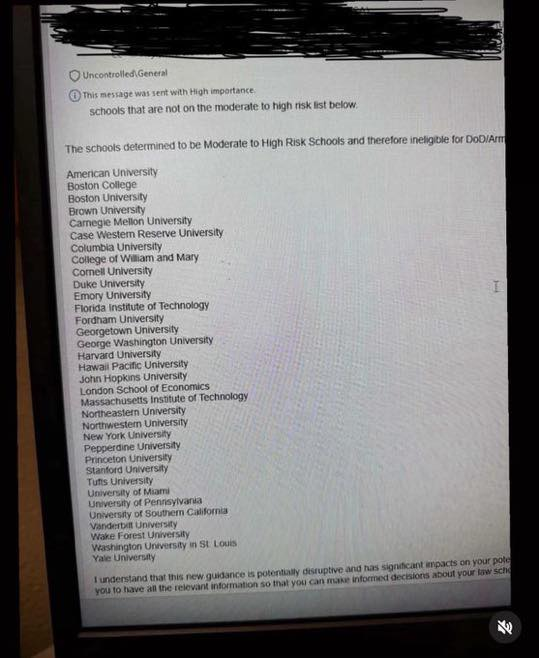
MELBOURNE, Fla. | An internal military message that has been widely circulated online lists Florida Institute of Technology (Florida Tech) among dozens of universities classified as “Moderate to High Risk Schools,” a label the message says would make those schools ineligible for certain Department of Defense and Army education funding. The list surfaced as the Trump administration’s Pentagon, led by Secretary Pete Hegseth, moves to cut and review academic partnerships it claims are ideologically hostile to the military.
The controversy accelerated after Hegseth announced the Pentagon would sever academic ties with Harvard University, beginning in the 2026 to 2027 school year, ending professional military education, fellowships, and certificate programs there. In the same announcement, he said the department would evaluate similar relationships with other universities.

According to national reporting, the list was compiled by the Army in the wake of new guidance and was described as affecting troops who plan to enroll in graduate programs, including law school pathways. The reporting notes that the terminology being used is broad and has created confusion about exactly which programs are covered and how the “risk” label is being applied.
The schools listed skew heavily toward elite private universities, including the Ivy League and other major institutions. Florida Tech’s inclusion stands out locally because it is one of the only two Florida school on the list, the other being University of Miami.

1) A potential hit to active duty education options in Brevard. Florida Tech actively recruits and serves military students, including those using DoD Tuition Assistance and service-specific systems such as ArmyIgnitED. Florida Tech’s own military education materials state that Tuition Assistance can pay up to a capped amount per credit hour, and the school outlines processes for active duty students to use those benefits. If Florida Tech were formally deemed ineligible for the relevant DoD or Army funding streams, that could mean some Space Coast service members would no longer be able to apply their Tuition Assistance benefits at Florida Tech for future terms.
2) This is not automatically about the GI Bill. Many veterans and families will immediately ask a blunt question: “Does this mess with the GI Bill?” The GI Bill is administered through the U.S. Department of Veterans Affairs, not the Pentagon. What is at issue here, based on current reporting, is primarily DoD-funded education programs and certain graduate partnerships. There is overlap in the real world, though. For example, the VA’s Tuition Assistance Top-Up benefit requires that a service member is first approved for Tuition Assistance through the DoD. If Tuition Assistance becomes unavailable at a specific school, Top-Up tied to that Tuition Assistance is not going to help for that school either.
3) Effects on Florida Tech and the Space Coast economy. Florida Tech is a private university with deep connections to aerospace, engineering, and defense-adjacent fields, and it is located in a region with a dense military and contractor population. Any policy that reduces the flow of military-funded students into Florida Tech, even if only for certain programs, could ripple into enrollment, program demand, and local spending. The bigger impact may be uncertainty: service members planning their degrees months or years out may choose a different school simply to avoid the risk.
Here is what can be said, and what cannot, based on what is public right now.
What is public: Hegseth has used explicitly political language in describing Harvard and elite universities, arguing they push ideologies that “do not improve our fighting ranks,” and he has said the department will review other schools for whether they deliver cost-effective strategic education and whether they align with military needs.
What is not public: The Pentagon has not, at least in the reporting tied to this list, issued a school-by-school explanation for why Florida Tech appears on it. So while political commentators may frame the list as a “woke school” list, the inclusion of Florida Tech does not come with a publicly stated justification specific to Florida Tech.
That matters because Florida Tech is not typically discussed in the same cultural bucket as Ivy League schools. It is known primarily as a STEM-focused institution, and it has long-running relationships with defense entities in Brevard. For example, Air Force Technical Applications Center (AFTAC), based at Patrick Space Force Base, has publicly described research agreements with Florida Tech.
The Florida Tech angle is not happening in a vacuum. Last year, Florida Tech became the target of controversy after a secretly recorded video involving university President John Nicklow was released online. In coverage of that incident, Florida Tech stated that the recording was illegal and that the video was heavily edited. Local reporting summarized the claims in the leaked footage as involving discussion of DEI-related funding and how language and programs might be structured in response to political constraints.
That episode is relevant now for one reason: it created an existing narrative that opponents can easily attach to Florida Tech if the school is portrayed, fairly or unfairly, as part of a broader ideological crackdown. Even if Florida Tech’s appearance on the list has nothing to do with the prior DEI controversy, the optics are obvious, and that is why the community is already asking whether Florida Tech is being “branded” the same way as Harvard.
On a national scale, the list signals an escalation in a long-running fight between parts of the federal government and elite higher education, now aimed directly at military education pipelines. If the Pentagon or the services restrict where service members can use certain funding for graduate programs, the impact will not be limited to the schools. It will land on the people trying to become military lawyers, engineers, medical professionals, analysts, and future senior leaders.
Supporters of the crackdown argue the Pentagon should stop sending personnel, and their tuition dollars, to institutions they view as hostile to military culture or national interests. Critics argue the policy is politically punitive and risks harming readiness and talent development by limiting access to top-tier programs and specialized education.
I am not writing about this as a detached observer.
Before retiring from the Army, I was afforded the opportunity to attend Harvard Business School programming and earned seven certificates at no cost to me through military education opportunities. That kind of access is a tremendous benefit to service members transitioning out of uniform and to the military itself, which needs educated leaders who can operate in complex environments.
So when I see Florida Tech, a Space Coast institution with deep roots in aerospace and defense-adjacent education, suddenly appearing on a “high risk” list, I have a basic question: How does cutting off education options for troops and veterans make the United States military stronger? If the real purpose is to punish universities over politics, then the people paying the price are not administrators in Cambridge or Melbourne. The people paying the price are the service members trying to build a future.
This story will be updated as Florida Tech and the Department of Defense provide clearer answers on what programs are actually affected and when changes would take effect.
Author disclosure: I’m Robert Burns, founder of The Space Coast Rocket. Before retiring from the U.S. Army, I completed Harvard Business School programs and earned seven certificates through military education opportunities that were provided at no cost to me.