

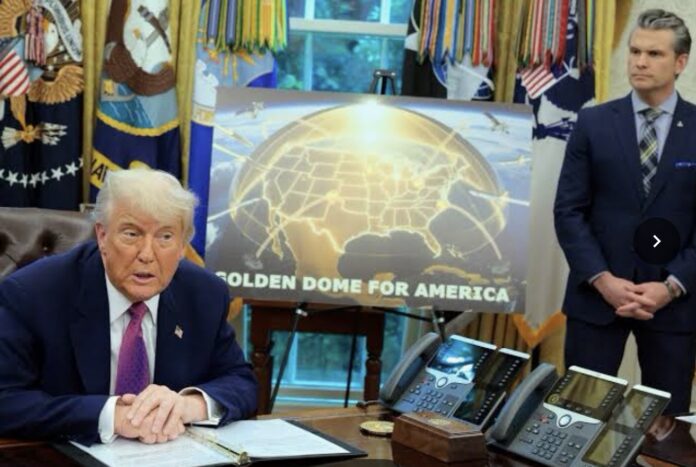
BREVARD COUNTY, Fla. — The Pentagon’s $185 billion Golden Dome missile defense program cleared its first competitive hurdle this week, with SpaceX, Northrop Grumman and 10 other companies passing the opening round of testing for space-based interceptors. But the general running the program delivered the news alongside a blunt warning: without new funding from Congress, Golden Dome stops in October.

Both announcements came Tuesday at the annual Space and Missile Defense Symposium in Huntsville, Alabama, and both carry direct consequences for Florida’s Space Coast, where the program’s satellites are being integrated and its hardware will eventually launch.
What the companies actually proved
Gen. Michael Guetlein, the Space Force officer directing Golden Dome for America, told reporters that all of the companies competing in the space-based interceptor effort had passed the first of four sequential “gates,” according to Breaking Defense. Guetlein said he had not personally reviewed the Gate 1 results but that Space Systems Command reported every provider looked positive and would continue into Gate 2.
Bloomberg first reported the milestone, noting that the early work included design and component-level testing, transferring data from sensors to an interceptor, and demonstrating spacecraft propulsion systems. The next phase requires the companies to show the technology can operate in space.
The Space Force awarded up to $3.2 billion in agreements to 12 companies in April, spanning boost-phase, midcourse and glide-phase interception. The structure is unusual for defense procurement: a prize-based competition designed to keep both traditional contractors and newer commercial space firms in the running until a production decision is made.

Timelines remain long. Flight demonstrations are slated for 2027, an initial operational capability is targeted for 2028, and the program blueprint does not schedule actual intercept demonstrations until June 2029.
The Brevard connection
National coverage of the milestone has focused on SpaceX and Elon Musk. The larger local story is L3Harris Technologies, headquartered in Melbourne with major operations in Palm Bay.
On July 13, the Space Development Agency awarded L3Harris a contract worth up to $955 million to build 18 Accelerated Missile Defense Tranche 3 satellites supporting Golden Dome, the company announced. Sierra Space received a companion award of up to $798 million for 18 more spacecraft, bringing the combined package to $1.75 billion, DefenseScoop reported.
The satellites carry medium-field-of-view infrared payloads intended to generate fire-control-quality tracking data on ballistic and hypersonic threats. Manufacturing happens at an expanded L3Harris facility in Fort Wayne, Indiana, but final satellite integration and testing is being performed in Florida. The spacecraft are expected to be ready for launch by the end of 2028.
The work builds on hardware Brevard residents have already watched leave the ground. Two Hypersonic and Ballistic Tracking Space Sensor demonstration satellites, one from L3Harris and one from Northrop Grumman, launched on a SpaceX Falcon 9 from Cape Canaveral Space Force Station in February 2024.
SpaceX, meanwhile, has secured roughly $6.45 billion in Golden Dome contracts for sensing and data relay satellites, including a $2.29 billion award to build the Space Data Network Backbone. The company’s launch cadence out of Cape Canaveral and Kennedy Space Center makes the Space Coast the most likely departure point for much of the constellation.
The October cliff
The same day he announced the testing milestone, Guetlein told the Huntsville audience that Golden Dome’s funding structure has left it exposed.
The program was financed almost entirely through budget reconciliation rather than the normal defense appropriations process. Congress provided roughly $24 billion to $25 billion through the One Big Beautiful Bill Act in 2025, and Guetlein said about 90 percent of that has already been obligated, with 95 percent committed to specific work.
For fiscal 2027, the Pentagon requested $17.5 billion for Golden Dome. Only about $400 million of that sits in the base defense budget, SpaceNews reported. The remainder depends on a separate $350 billion reconciliation request that has met resistance on Capitol Hill from both parties.
A continuing resolution would not solve the problem. Because Golden Dome has no base-budget line to fall back on, a CR would hold it at a prior-year rate that effectively does not exist.
Guetlein was direct about the stakes, telling the symposium that if lawmakers do not resolve the funding question, “there is no Golden Dome because there is no funding.” He added that he believes the nation will find a way given the urgency, but called it a challenging budget environment.
Speaking to reporters afterward, he said that without continued investment, the program would stop with what has already been built and delivered, according to Defense Daily.
What it means here
For Brevard County, the calculus is straightforward. Contracts already signed and funded continue to execute. That covers the L3Harris tracking satellites, the SpaceX communications and sensing work, and the interceptor prototypes now heading into Gate 2.
What is at risk is everything after that: the follow-on production awards, the 2028 operational capability, and the sustained industrial expansion that programs of this scale bring to a region that already builds, integrates and launches a substantial share of the nation’s national security space hardware.
Fiscal year 2027 begins October 1.
Neither SpaceX nor Elon Musk has publicly confirmed the company’s Gate 1 results. The Space Coast Rocket will continue following this story.
Criminal Defense
Bankruptcy · Evictions
WICKS LAW P.A.
Call or text for
free consult
321-733-2700
Eric Wicks, Esq.
1250 West Eau Gallie Blvd. G
Melbourne, FL 32935
Abogado Wicks habla español