


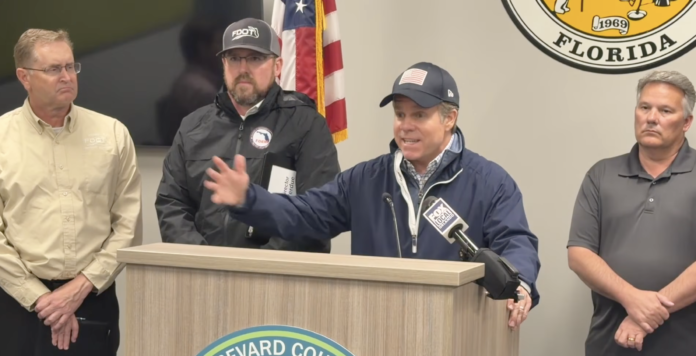
As Brevard County residents wait on a federal decision about flood aid, U.S. Rep. Mike Haridopolos has been telling them what to expect from the Federal Emergency Management Agency and what they should do in the meantime. Some of what the Indian Harbour Beach Republican has said is inaccurate or incomplete, and it could affect whether families get the help they are eligible for.

The Space Coast Rocket compared his public statements over the past week with Gov. Ron DeSantis’ Nov. 9 request for a major disaster declaration, Brevard County Emergency Management’s own guidance and federal rules for FEMA’s individual assistance program.
What Haridopolos said
In a press conference Thursday evening, Haridopolos described the state’s request and urged residents to document their losses.
“Historically, it’s taken 30 to 60 days to get some of the FEMA dollars in to give some individual relief. We’re hoping it’ll be an expedited time frame,” he said. “That’s why we turned it on the 9th. I’ve had extensive conversations with Administrator Hamilton.”
Asked how much money was being sought, Haridopolos did not give a figure. Instead, he compared FEMA to an insurance company.

“They want to make sure how much damage was done so they compensate the correct amount,” he said.
He then gave residents this advice: “Fill out that FEMA form. Make sure you have that form accurately done. Take the pictures. Fill out the form. That’s the best way to get the most accurate dollar amount for reimbursement.”
He gave similar advice the same day at a press conference at the Brevard County Emergency Operations Center with Sheriff Wayne Ivey and Emergency Management Director John Scott.
“Continue to fill out those forms, document the FEMA situation, because their job is to come in after the storm and try to make whole some of the losses you’ve incurred,” Haridopolos said. He closed the briefing with the same message: “Make sure you fill out that FEMA form as well. Very important. And document with pictures and so you all can get some restitution once this storm concludes.”
The form is not a FEMA form
The form Haridopolos has been pointing residents to is Brevard County Emergency Management’s online damage report, which runs on a platform called CrisisTrack. It is not run by FEMA, and the county says plainly that it is not an application for aid.
“This form is not an application for assistance,” Brevard County Emergency Management wrote when it shared the form on Facebook on Nov. 19. The county said the reports help it “assess community impacts and guide recovery efforts.”
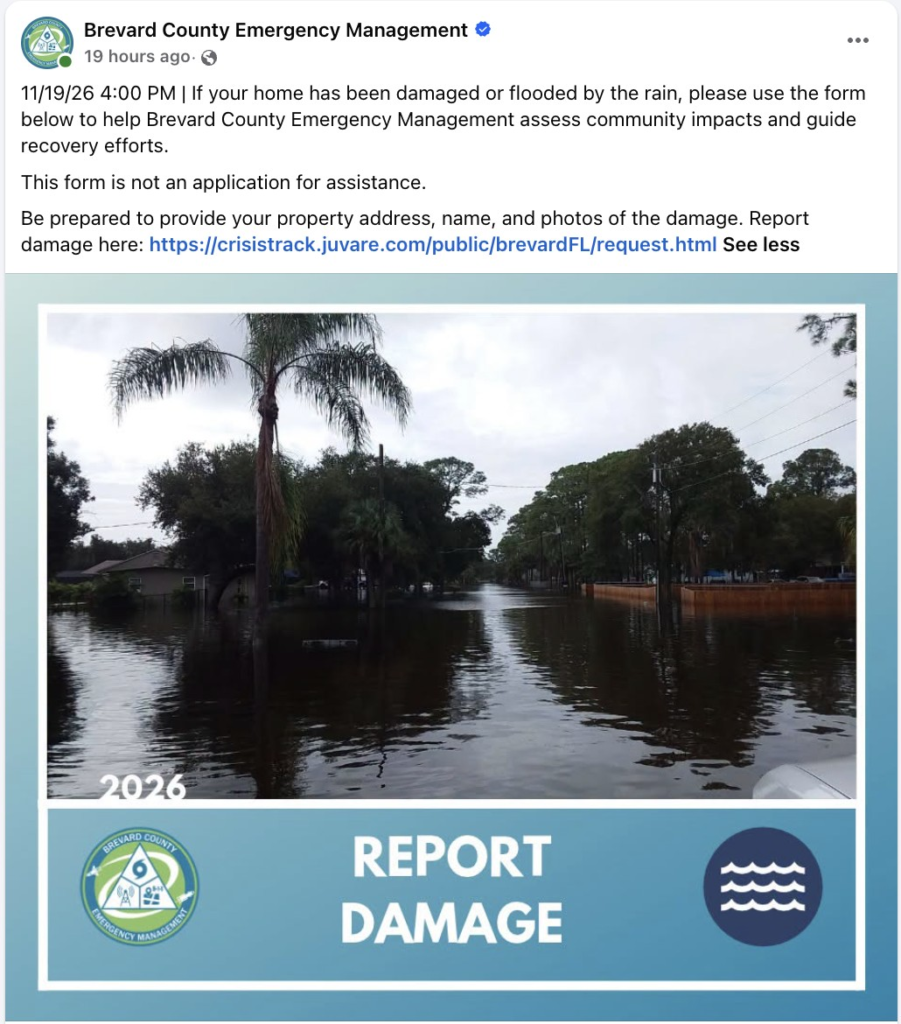
The county form asks for a property address, a description of the damage, photos, insurance coverage, household size and whether residents have been displaced. It is a damage survey for the county, and submitting it does not register anyone with FEMA.
Residents should still fill out the county form. Those reports help the county document the damage that supports the state’s request. But submitting it does not put anyone in line for FEMA money.
If FEMA opens individual assistance for Brevard County for this flooding, residents will have to register with FEMA separately at DisasterAssistance.gov or by calling 1-800-621-3362. Registration cannot begin until a declaration is approved, and a declaration can authorize different types of aid in different counties.
What the governor actually asked for
DeSantis’ request to the president is dated Nov. 9 and was sent through FEMA’s regional office in Atlanta. It seeks a major disaster declaration for nine counties: Brevard, DeSoto, Hardee, Highlands, Indian River, Martin, Okeechobee, Palm Beach and St. Lucie.
The governor asked the president to make available “all programs under Individual Assistance,” along with federal money for debris removal, emergency protective measures, direct federal assistance and hazard mitigation grants. He asked for an incident period beginning Oct. 31.
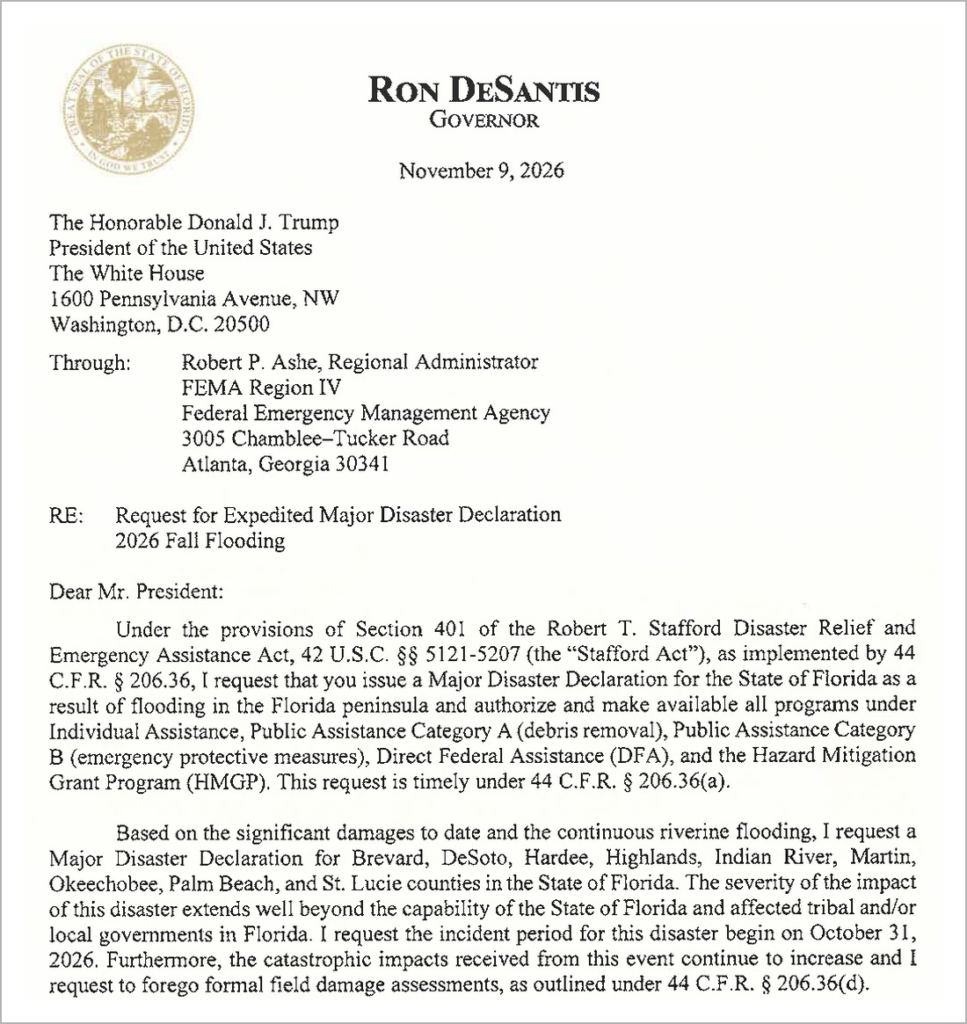
The request does not seek a higher federal cost share or any increase in the published limits on individual grants. If it is approved as written, residents would be eligible for FEMA’s standard individual assistance programs under those limits.
On the public assistance side, which reimburses local governments, the request covers only debris removal and emergency protective measures for now. Permanent repairs to roads, drainage and utilities are not included, though the letter says the state expects to seek “additional counties, categories of work, and program areas.”
Expedited request, joint assessments
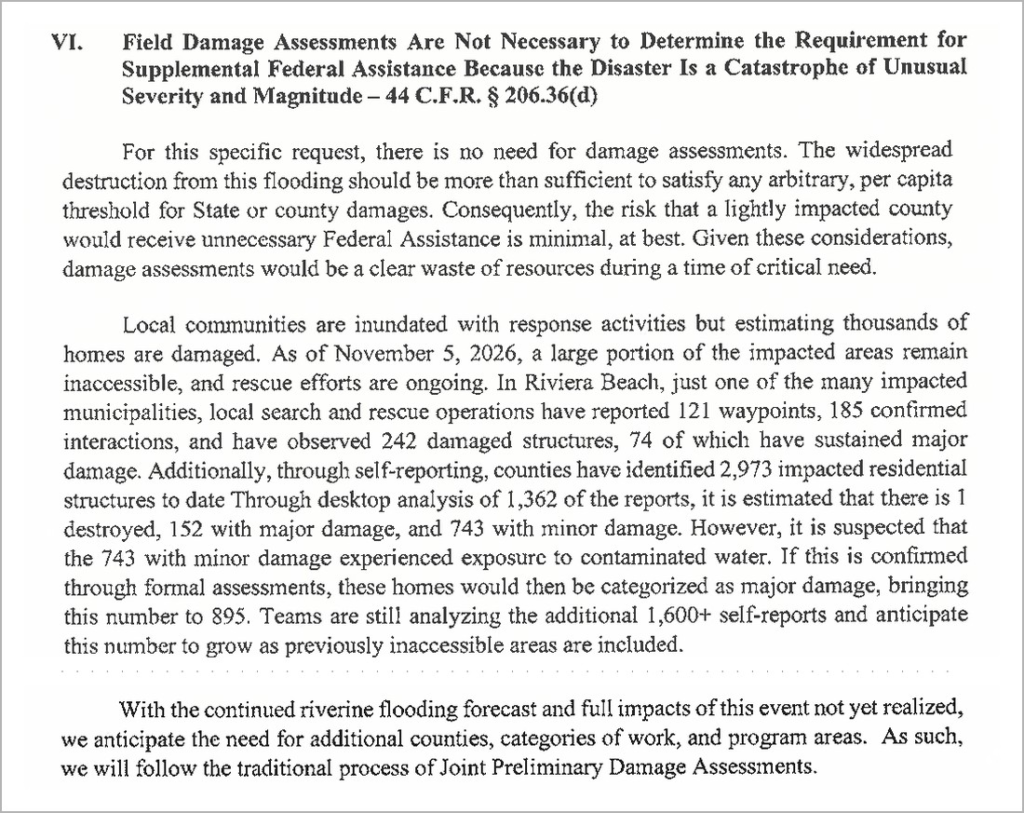
The governor’s letter is titled a “Request for Expedited Major Disaster Declaration,” and it asks FEMA to skip formal field damage assessments because the flooding was “a catastrophe of unusual severity and magnitude.”
The same section of the letter also says the state will pursue joint damage assessments with FEMA, because more counties and types of aid may need to be added as flooding continues.
“With the continued riverine flooding forecast and full impacts of this event not yet realized, we anticipate the need for additional counties, categories of work, and program areas,” the letter reads. “As such, we will follow the traditional process of Joint Preliminary Damage Assessments.”
Haridopolos said this week that FEMA is still reviewing the damage. “FEMA is assessing the damage and makes the recommendation to the president for approval,” he said at a Nov. 19 press conference at the Brevard County Emergency Operations Center, according to Florida Today. Neither the letter nor his comments show whether federal officials agreed to handle the request on an expedited basis.
His estimates of how long that will take have also changed. On Nov. 16, at the reopening of Port Malabar Road in Palm Bay, he told reporters FEMA officials expected a few weeks before people “can be compensated for some of their losses,” WESH reported. In Thursday’s interview, he cited a historical range of 30 to 60 days.
The letter also shows that most of the damage counted so far falls short of a total loss. Brevard and the other counties had identified 2,973 damaged homes through self-reporting as of Nov. 5. The state’s desktop review of 1,362 of those reports estimated one home destroyed, 152 with major damage and 743 with minor damage. The state said the minor-damage homes could be reclassified as major if inspectors confirm they were exposed to contaminated water.
FEMA does not “compensate” losses like an insurer
At the press conference, Haridopolos said that once the storm is over, “FEMA can come in a lot like your insurance company and try to make things whole.” FEMA’s Individuals and Households Program does not work that way.
The program is designed to make a home safe, sanitary and functional, not to restore it to its condition before the flood. It can help with essential repairs, temporary rental assistance and certain other disaster-related needs, such as replacing essential personal property.
For disasters declared on or after Oct. 1, 2026, the maximum award is $46,400 for housing assistance and $46,400 for other needs, according to a FEMA notice in the Federal Register. Some types of help do not count against those limits. Historically, few households have received anywhere near the maximum. A Congressional Research Service analysis of FEMA’s historical data found the average total award per recipient was $3,446.
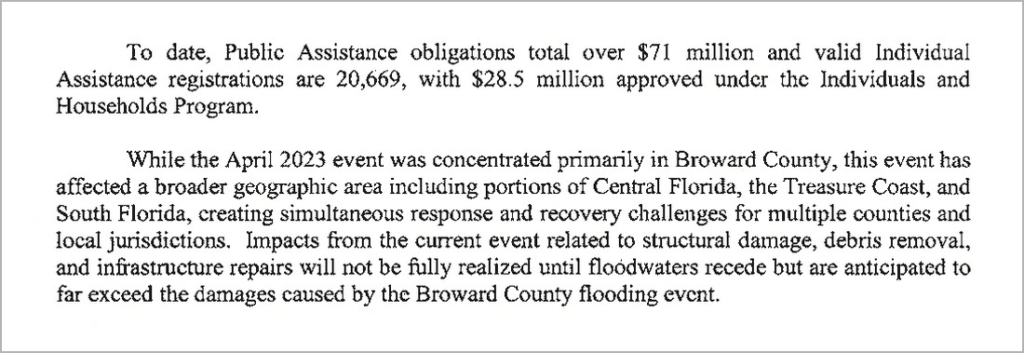
The governor’s own request points to a recent flood that qualified for this kind of help. To show the scale of this disaster, the letter cites the April 2023 Fort Lauderdale flood, which produced 20,669 valid individual assistance registrations and $28.5 million approved under the household program.
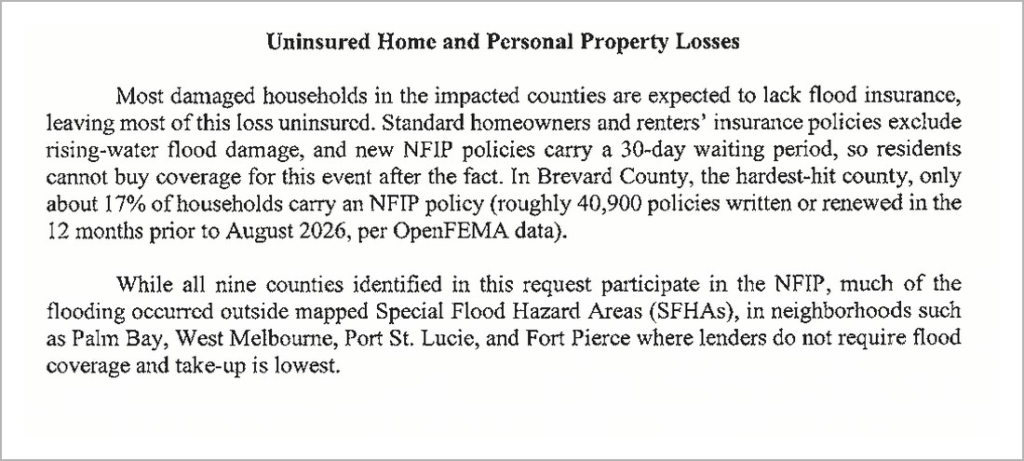
FEMA also cannot pay for the same loss that insurance covers. Residents with coverage should file their insurance claim promptly, but they do not have to wait for it to be settled before applying to FEMA once individual assistance opens. The state’s letter notes that most flooded households have no flood coverage. Only about 17% of Brevard households carry a National Flood Insurance Program policy, and the letter says much of the flooding happened outside mapped flood zones in neighborhoods such as Palm Bay and West Melbourne, where lenders do not require flood insurance.
That gap is why individual assistance matters for these neighborhoods. It does not mean those losses will be covered in full. Homeowners and renters may also qualify for low-interest disaster loans from the U.S. Small Business Administration if a declaration is approved, but those loans must be repaid.
The “named storm” claim
At the Port Malabar Road reopening, Haridopolos said the process would have been different if the flooding had come from a hurricane.
“Had this been a named storm, you all know these from, of course, our hurricanes, that’d be a totally different measure,” he said, according to WESH. “Because it was an unnamed storm, meaning a freak accident, literally a flood we’ve never seen before, we had to go through different channels.”
That is not accurate. Every major disaster declaration, whether for a hurricane, a tornado or a flood, goes through the same process under the federal Stafford Act. A governor submits a request, FEMA reviews the damage and makes a recommendation, and the president decides. The governor’s letter cites that same law and regulation, 44 C.F.R. § 206.36.
Whether a storm has a name has no bearing on eligibility under the Stafford Act. Federal rules allow any request to be expedited based on the severity and scale of the disaster, which is what the governor asked for here. The 2023 Fort Lauderdale flood that the state uses as its comparison was an unnamed rain event, and it received a major disaster declaration with individual assistance.
Where things stand
Haridopolos was among the members of Florida’s congressional delegation who signed a Nov. 9 letter urging President Trump to approve the governor’s request, a bipartisan effort WFTV reported included 27 members of Congress. The letter acknowledged that “damage assessments are still underway” and asked the president to approve the request “assuming the damages meet federal assistance requirements.”
Haridopolos has since said he spoke with the president about the request and that the president is waiting on FEMA’s recommendation.
The request remains pending 11 days after it was submitted. Brevard County was hit by more flooding on Nov. 19, when first responders rescued more than 100 people, WFIT reported. It is not yet clear whether the state will amend its request to include this week’s flooding or submit a new one.
The county’s damage form now lists a “2026 Mid-November Flooding Event.” Residents who were flooded in the Nov. 1 to Nov. 3 storm should make sure their damage is reported under the correct event.
What residents should do now
- Report your damage to the county using the Brevard County damage report form. It helps document the disaster, but it is not a FEMA application.
- Document everything. Take photos and video of damaged rooms, belongings and vehicles before you throw anything out.
- Keep every receipt for repairs, cleanup supplies, hotel stays and rental costs.
- File an insurance claim now if you have homeowners, renters, flood or auto coverage. You can still apply to FEMA while your claim is pending, but FEMA cannot pay for the same loss twice.
- Register directly with FEMA at DisasterAssistance.gov or 1-800-621-3362 if FEMA opens individual assistance for Brevard County for this flooding. Do not assume the county form counts as an application.
Criminal Defense
Bankruptcy · Evictions
WICKS LAW P.A.
Call or text for
free consult
321-733-2700
Eric Wicks, Esq.
1250 West Eau Gallie Blvd. G
Melbourne, FL 32935
Abogado Wicks habla español