
A Brevard County judicial candidate and a local voter have filed an emergency petition directly with the Florida Supreme Court, asking the justices to block Governor Ron DeSantis from cancelling a county court election and replacing it with a political appointment.

The petition, filed Thursday evening by Melbourne attorney Jessica J. Travis on behalf of candidate Margaret “Maggie” Wagner and voter Marcelle “Marcie” Adkins, challenges the Governor’s decision to “accept” a judge’s retirement letter as a resignation, a move that wiped a scheduled election off the ballot and stripped voters of their right to choose their own judge.
The case, Wagner and Adkins v. DeSantis, has been docketed with the Court and is already drawing attention from national legal media. Law360, a major legal news outlet, contacted Travis within hours of the filing.
What Happened
Here is what happened, stripped down to the basics.
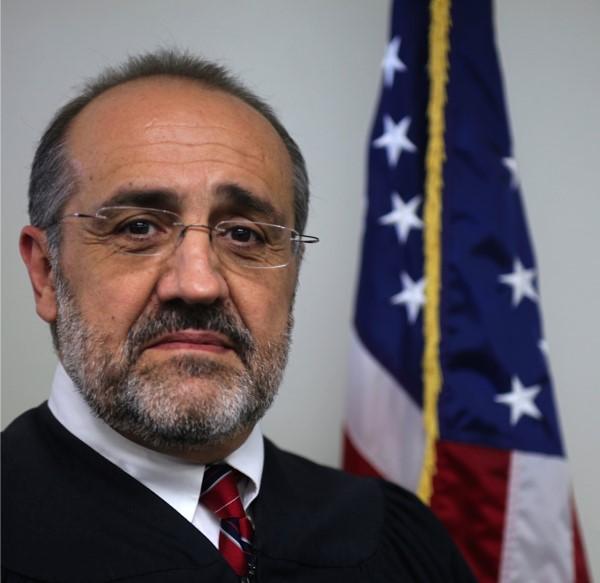
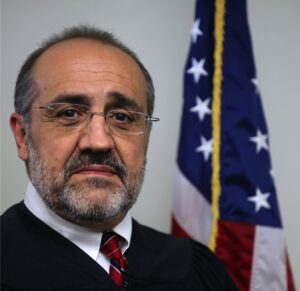
Judge Benjamin Garagozlo has served as a Brevard County Court Judge for nearly 20 years. His term expires January 5, 2027. Under Florida’s Constitution, voters were supposed to elect his replacement this year. Wagner had been campaigning for that seat for about a year, collecting nearly 2,000 petition signatures and filing all necessary paperwork with the Brevard County Supervisor of Elections.


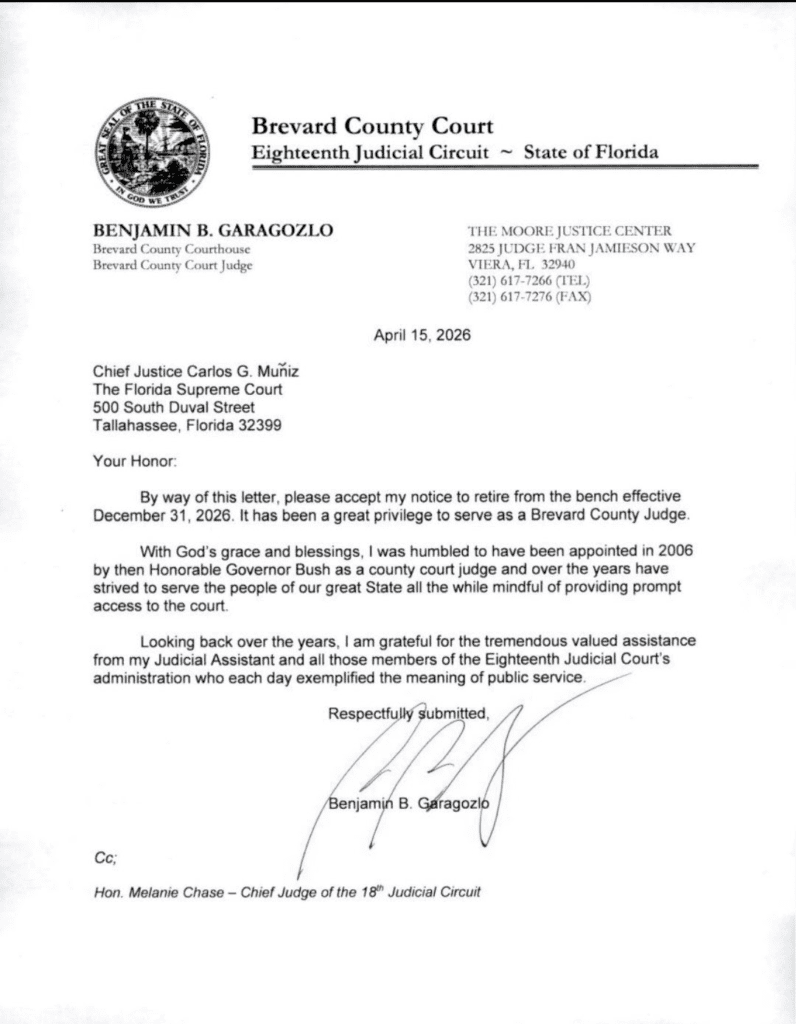
On April 15, Judge Garagozlo wrote a letter to Chief Justice Carlos Muniz of the Florida Supreme Court saying he planned to “retire from the bench effective December 31, 2026.” The letter never used the word “resign.” It was addressed to the Chief Justice, not to the Governor. The judge picked December 31 because retiring even one day into January would have delayed his retirement and Social Security benefits by an entire month. It left only one working day between his retirement and the end of his term.
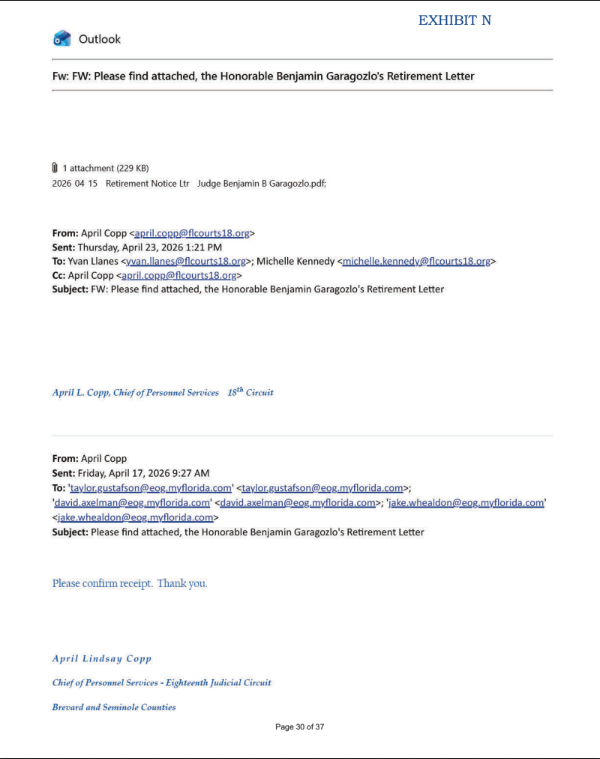
Two days later, on April 17, a personnel administrator in the court system emailed the judge’s retirement letter to the Governor’s office. The subject line of that email read: “Please find attached, the Honorable Benjamin Garagozlo’s Retirement Letter.” Judge Garagozlo was not copied on the email. According to the petition, he did not know his letter was being sent to the Governor.
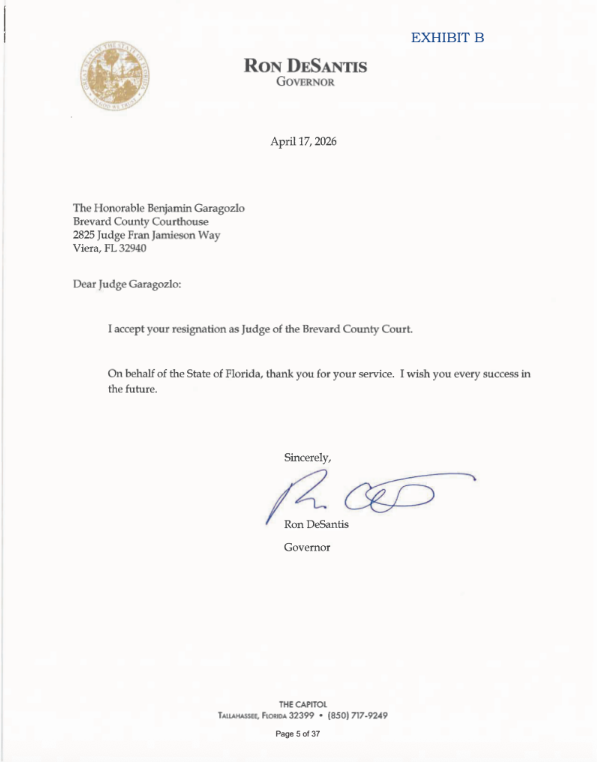
That same day, Governor DeSantis sent Judge Garagozlo a letter stating: “I accept your resignation as Judge of the Brevard County Court.”
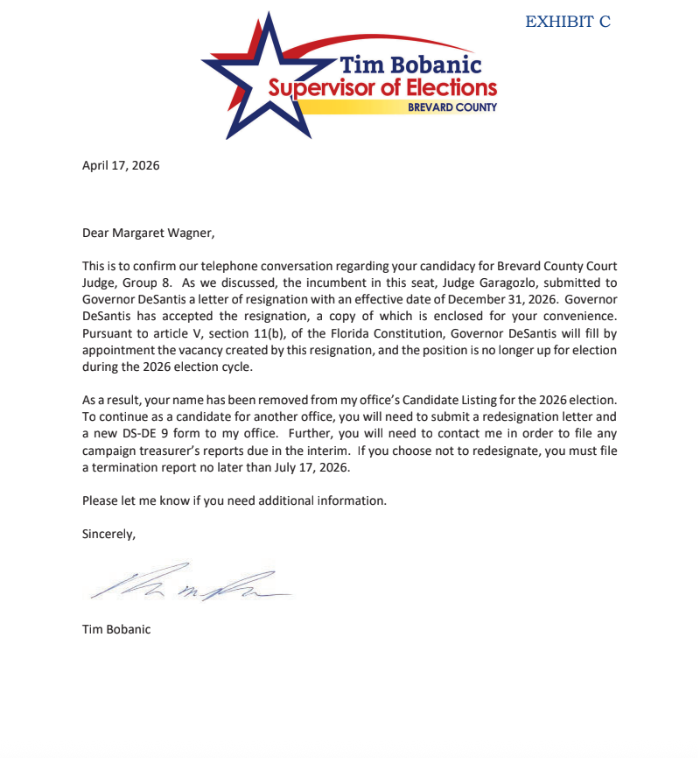
That same afternoon, at approximately 4:00 p.m. on a Friday, Supervisor of Elections Tim Bobanic called Wagner to tell her the election was cancelled and her name had been removed from the candidate listing. The Governor would appoint someone to the seat instead.
How Did This Happen?
The petition reveals a paper trail that shows how this played out behind the scenes.
In August 2025, the Office of the State Courts Administrator, known as OSCA, sent a directive to all chief judges across Florida instructing them to email copies of any judicial retirement or resignation letters directly to the Governor’s Office of Judicial Appointments. The directive explained that the Governor’s office wanted to “streamline the appointment process and increase efficiency.”
On April 6, 2026, the same day the prequalifying period opened for the 2026 judicial elections, OSCA sent an updated version of that directive with new contact information for the Governor’s staff. Within hours, the directive cascaded down through the 18th Judicial Circuit: from OSCA to Chief Judge Melanie Chase, from Chase to her personnel staff, and from personnel staff directly to retiring judges, including Judge Garagozlo, asking for copies of their retirement letters.
Nine days later, Judge Garagozlo submitted his retirement letter. On April 17, the circuit’s Chief of Personnel Services, April Copp, emailed it to three people in the Governor’s office: Taylor Gustafson, Director of Judicial Appointments; David Axelman, General Counsel; and Jake Whealdon, Deputy General Counsel. The subject line said “Retirement Letter.” Hours later, the Governor called it a resignation, accepted it, and the election was dead.
Michelle Kennedy, the official spokesperson for the 18th Judicial Circuit, sent an email to Wagner on April 23 stating that she had personally spoken to Judge Garagozlo and that “he was shocked to learn that his letter somehow initiated the judicial appointment process. He assured me that this was never his intention.”
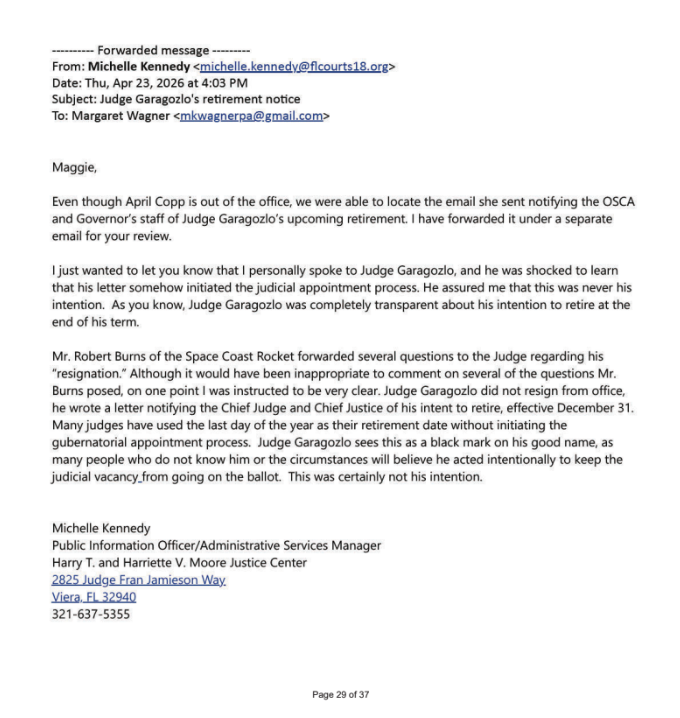
Kennedy added: “Judge Garagozlo did not resign from office, he wrote a letter notifying the Chief Judge and Chief Justice of his intent to retire, effective December 31. Many judges have used the last day of the year as their retirement date without initiating the gubernatorial appointment process.”
Kennedy said Judge Garagozlo “sees this as a black mark on his good name, as many people who do not know him or the circumstances will believe he acted intentionally to keep the judicial vacancy from going on the ballot. This was certainly not his intention.”
What the Lawsuit Argues
The petition makes several arguments, but the core claim is straightforward: the Governor received a retirement letter, relabeled it a resignation, and used it to cancel an election, all without ever asking the judge what he actually intended. (the entire petition is embedded at the end of this article)
The petition argues that “retirement” and “resignation” are legally different under Florida’s Constitution. Article X, Section 3 lists “resignation” as one of the events that creates a vacancy in public office. It does not list “retirement.” The petition argues that the Governor cannot simply treat a retirement letter as a resignation when the judge himself says that is not what he meant.
It also argues that even if the two words were legally identical, no valid “resignation” was ever delivered to the Governor. In every prior Florida case involving a judicial vacancy created by resignation, the judge submitted the letter directly to the Governor. Here, Judge Garagozlo sent his letter to the Chief Justice. It reached the Governor’s office only because an HR employee forwarded it through an administrative pipeline, and even she called it a “Retirement Letter” in the subject line.
The petition also raises constitutional arguments about voters’ rights and candidates’ rights, citing the Florida Constitution’s guarantee that county court judges “shall be elected” and the 2000 referendum in which every county in Florida, including Brevard, voted to keep electing their judges rather than switching to an appointment system.
What the Supreme Court Can Do
The petition asks the Court for three things.
First, it asks for an emergency stay, essentially a freeze on the entire process. Wagner’s qualifying period closed at noon today, April 24. If the Court issues a stay, it would toll or extend that deadline and block the Governor from appointing anyone to the seat while the case is decided.
Second, it asks the Court to issue what is called a writ of quo warranto. In plain English, this is the Court telling the Governor: “Show us your authority to do what you did.” If the Court finds the Governor did not have the authority to treat the letter as a resignation and cancel the election, the Court can declare that no valid vacancy exists and order the election reinstated.
Third, if the election is reinstated, the petition asks the Court to issue a writ of mandamus, which is a court order compelling a government official to perform a duty they are required to perform. In this case, it would order the Supervisor of Elections to accept Wagner’s qualifying paperwork and put her name back on the ballot.
The Court also has the option of issuing a declaratory judgment, which is a formal legal ruling that establishes the rights of the parties. The petition asks, in the alternative, for the Court to declare that the process used here violates the Florida and U.S. Constitutions.
Why This Matters Beyond Brevard County
This case is not just about one judicial seat in Brevard County. It has the potential to reshape how judicial vacancies work across the entire state of Florida.
For years, Florida governors have used a strategy where a departing judge submits a resignation timed to fall before the qualifying period, which cancels the scheduled election and allows the Governor to handpick a replacement. Three Florida Supreme Court justices have previously called this practice a “travesty” and a “mockery” of the Constitution, but the Court has never directly ruled on the merits of the constitutional question.
Justice Barbara Pariente wrote in a 2016 case called Pincket v. Detzner that if the constitutional question were properly before the Court on its merits, she would rule that the election should prevail over the appointment. But in that case, the procedural vehicle, a mandamus petition, was too narrow to reach the question.
The Wagner petition is specifically designed to give the Court the vehicle it has lacked. It is filed as a quo warranto proceeding, which directly challenges the Governor’s authority, and it is accompanied by a request for declaratory judgment, giving the Court the broadest possible platform to address the constitutional question.
If the Court rules in Wagner’s favor, it would establish that governors cannot convert retirement letters into resignations, that judges must actually intend to resign and submit that resignation to the Governor for a vacancy to be valid, and that the constitutional preference for elected judges cannot be circumvented through administrative maneuvering. It would effectively close the loophole that governors of both parties have used for decades to bypass the voters and install their own picks on the bench.
If the Court declines to act or rules against Wagner, it would confirm that any judge who submits routine retirement paperwork selecting an end-of-month date has effectively handed the Governor the power to cancel the election for that seat, regardless of the judge’s intent, the language of the letter, or the fact that voters were already preparing to vote.
Adkins told us in an email, “Voters rights are very important to me. I was raised by parents and in a time where we all considered voting to be sacrosanct. I have voted in every single election since I was 18 years of age. That has been 48 years. I take the right and responsibility of voting seriously and would have certainly voted in this county judge race. To be robbed of my vote feels un-American to me.”
Wagner Tried to Qualify Anyway
On April 23, during the open qualifying period, Wagner went to the Supervisor of Elections office in person and attempted to submit her qualifying fee of $7,590.20 and her remaining paperwork. She was accompanied by a witness, Amanda Farabee, who provided a sworn affidavit about what happened.
Wagner met with Debra Strasser, the Candidate Coordinator for the Supervisor of Elections, who told her that the office had received an email from Erica Reeve of the Florida Division of Elections stating that the Supervisor could accept Wagner’s documents but that “the seat is no longer up for election.” Strasser said she would hold Wagner’s paperwork until the qualifying period closed at noon on April 24.
Wagner’s qualifying check, made payable to the Brevard County Supervisor of Elections for $7,590.20, is included in the appendix filed with the Court.
Wagner told The Space Coast Rocket, “I have been an attorney in this community for 20 years and spent my entire career dedicated to defending the Constitution. It was always known and understood that Judge Garagozlo was going to retire and leave his seat up for the voters to choose his replacement. My campaign team and I have been working diligently for almost a year getting out to the voters. I got thousands of petitions signed. The record shows Judge Garagozlo intended to retire and give the election to the voters, and the Governor is taking that away. This is an election that has essentially been stolen from the voters. I’ve been denied my right to run and they have been denied the right to choose.”
The Judge Speaks Through His Spokesperson
Judge Garagozlo has not submitted a sworn affidavit in the case. The petition explains that as a sitting judge, providing testimony in a matter that directly affects whether his seat is filled by election or appointment could violate Canon 7 of the Florida Code of Judicial Conduct, which restricts judges from engaging in political activity.
Instead, the Court has the email from Michelle Kennedy, the official spokesperson for the 18th Judicial Circuit, who confirmed that the judge never intended to resign, was shocked to learn his letter had been used to trigger an appointment, and views the situation as a stain on his reputation.
Jessica Travis, a Florida elections lawyer at DefendBrevard.com who filed the lawsuit on behalf of Wagner and Adkins, said: ‘The issues we raised in this emergency petition for writ of quo warranto are critical for the rights of judicial candidates and voters in Florida. I hope that this becomes a bellwether case and effects change that we have sorely needed for many years.'”
What Happens Next
The petition is now docketed with the Florida Supreme Court. The Court can act on the emergency stay request at any time. Respondents in the case include Governor DeSantis, Secretary of State Cord Byrd, Division of Elections Director Maria Matthews, and Supervisor of Elections Tim Bobanic.
The Governor’s office is represented by General Counsel David Axelman and Deputy General Counsel Jake Whealdon. The Secretary of State and Division of Elections are represented by Mohammad Jazil of Holtzman Vogel. Bobanic is represented by Frank Mari of Tessitore Mari, PLLC.
We have reached out to the Governor’s Office for comment. This article will be updated when it is received. The Space Coast Rocket will continue to follow this case as it develops. Readers can view the full petition and appendix through the Florida Supreme Court’s case management system.
Robert Burns is the editor and publisher of The Space Coast Rocket, covering Brevard County government, courts, and elections.
Criminal Defense
Bankruptcy · Evictions
WICKS LAW P.A.
Call or text for
free consult
321-733-2700
Eric Wicks, Esq.
1250 West Eau Gallie Blvd. G
Melbourne, FL 32935
Abogado Wicks habla español