


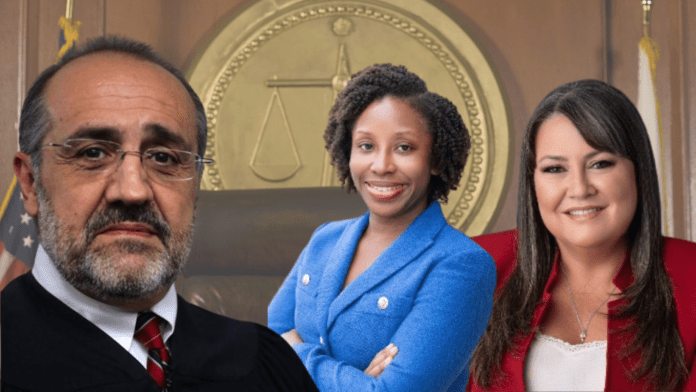
BREVARD COUNTY, Fla. — Two candidates who spent about a year campaigning for a Brevard County judgeship learned Friday that their race has been cancelled, not because of anything they did wrong, but because the sitting judge quietly submitted a resignation letter to
Chief Justice Carlos G. Muniz, timed with surgical precision to hand his seat to Governor Ron DeSantis rather than the voters of Brevard County.

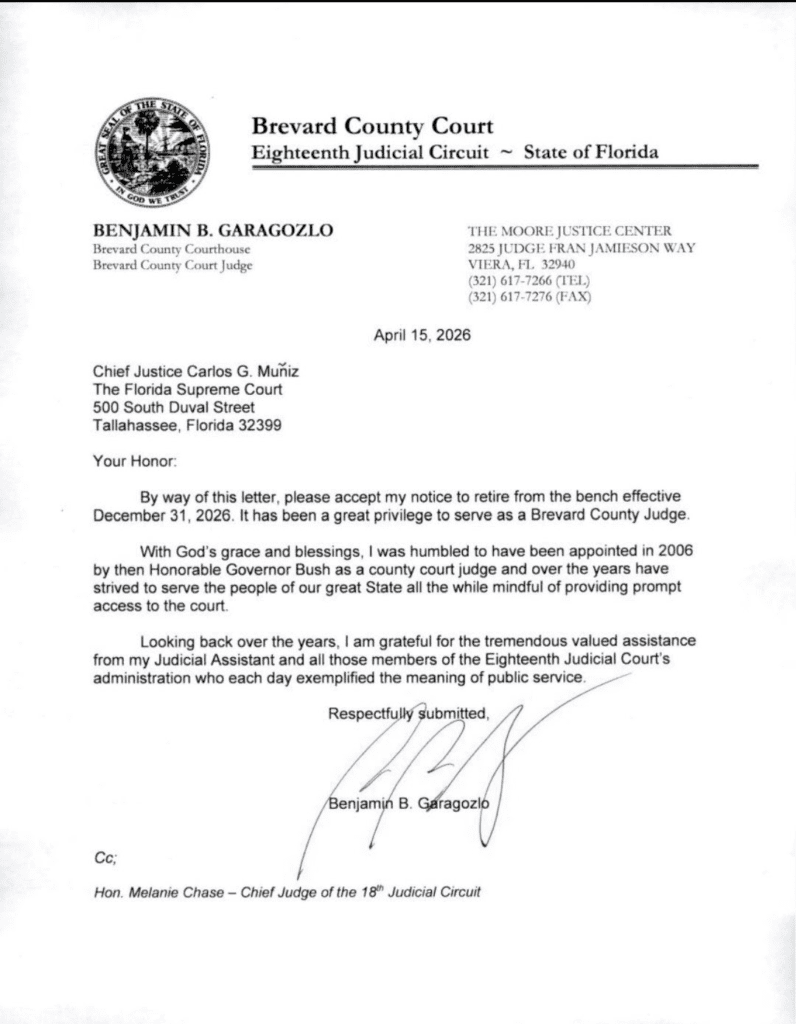
The Brevard County Supervisor of Elections confirmed Friday that Judge Benjamin B. Garagozlo of the 18th Judicial Circuit, Group 8, submitted his resignation letter on April 15, 2026, effective December 31, 2026, just five days before the end of his term on January 5, 2027. Governor DeSantis has already accepted the resignation. As a result, the SOE announced, the position “is no longer up for election during the 2026 election cycle,” and the two announced candidates — Andrea Fant and Margaret “Maggie” Wagner — have been removed from the candidate listing entirely.
The announcement came Friday around 4:30pm, the business day before the qualifying period for judicial races was set to open Monday morning. Both candidates had already submitted their qualifying paperwork to the Supervisor of Election’s Office for pre-qualifying.
A Year of Campaigning, Erased Overnight
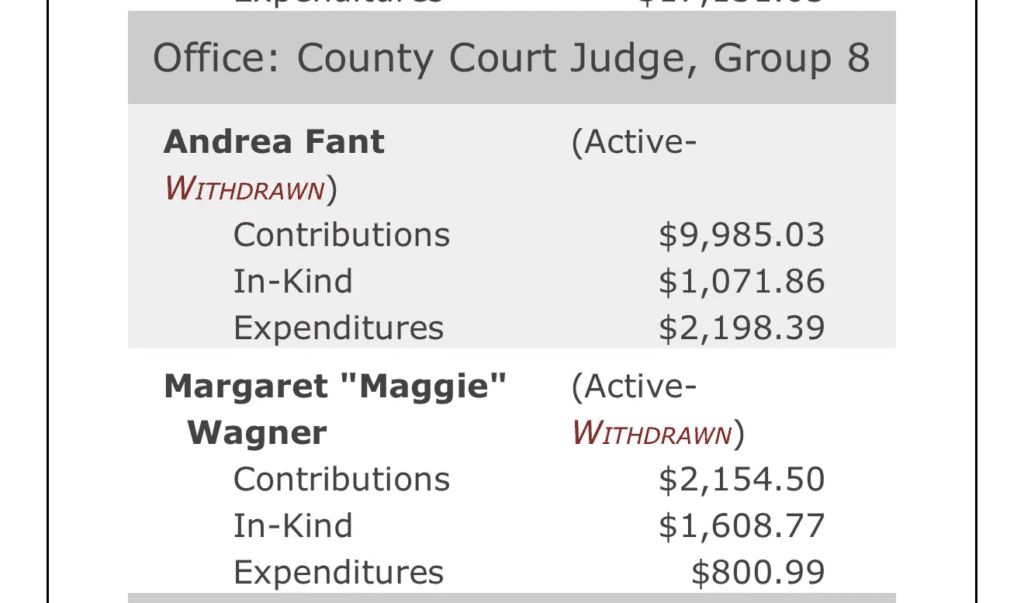
According to the last available campaign finance reports, Fant had raised $9,985.03 in contributions and spent $2,198.39 on her campaign. Wagner had raised $2,154.50 and spent $800.99. Both are now listed as “Active-Withdrawn” in state campaign finance records — though neither candidate withdrew voluntarily. They were administratively removed by the SOE based solely on the judge’s resignation and the Governor’s acceptance of it.
Neither candidate had done anything to disqualify herself. The official qualifying period had not yet opened. No legal process had adjudicated the question of whether the election should proceed. On Friday however, the SOE’s website had already deleted the race from the upcoming elections for 2026.

Unfortunately, the timing is not accidental. It is the mechanism.
How a Judicial Election Gets Stolen — Legally
Under Florida’s Constitution, Article V, Section 11(b), when a vacancy occurs on a county or circuit court before the statutory candidate qualifying period begins, the Governor fills the seat by appointment rather than election. The appointed judge then serves until the first Tuesday after the first Monday in January of the year following the next primary and general election occurring at least one year after the date of appointment, meaning the earliest the voters could choose a successor would be 2028, not 2026.
The critical legal trigger is not when the judge actually leaves the bench. It is when the Governor accepts the resignation letter. Under a line of Florida cases beginning with Trotti v. Detzner, 147 So. 3d 641 (Fla. 1st DCA 2014), a constitutional vacancy is created at the moment the Governor accepts a resignation, even when the effective date is months in the future. Because Garagozlo submitted his letter on April 15 and DeSantis accepted it before the qualifying period opened April 20, the First District’s bright-line rule dictates that the seat goes to appointment.
The five-day gap between his resignation’s effective date and his natural term expiration is not incidental. It is the entire point. Had Garagozlo simply announced he would not seek re-election (which he already had) and allowed his term to expire naturally on January 5, 2027, his successor would have been chosen by Brevard County voters in November 2026. No vacancy would ever have existed. The election would have proceeded. Fant and Wagner would still be candidates.
Instead, by filing a resignation effective December 31, five days early, Garagozlo manufactured a brief technical vacancy, triggered the Governor’s appointment power, and cancelled the election. The voters of Brevard County have no vote in who replaces him. DeSantis alone decides.
This Is Not New — And Florida’s Own Supreme Court Has Called It a Sham
What happened to Brevard County voters Friday is not an isolated incident. It is a documented, recurring, statewide pattern that Florida’s own Supreme Court justices have described in unusually blunt terms.
In Pincket v. Detzner (2016), four Florida Supreme Court justices wrote separately to condemn the practice, even while acknowledging they lacked the procedural vehicle to stop it. Justice Barbara Pariente wrote that “no individual judge should be able to circumvent the intent of the provisions of the Florida Constitution that state the election of county and circuit judges ‘shall be preserved.'” Justice R. Fred Lewis was more direct, calling the practice “clever albeit disgraceful” and writing that “it is truly a sad day for Floridians when their trial court judges may manipulate the electoral process and prioritize their personal preferences over those espoused in the very Constitution they swore to defend.”
When the Florida Supreme Court later discharged jurisdiction in Trotti v. Scott (2018) without resolving the constitutional question, Justice Lewis dissented in terms that apply directly to what happened in Brevard County Friday. He called the practice “a brazen attempt to accomplish that which is otherwise prohibited” and wrote that “there is absolutely nothing in the Constitution, Florida Statutes, or the decisional law of this State that grants trial court judges the right to delay their resignation by eight months.” He called the manufactured vacancy “fake, false, and otherwise hollow” and said that allowing judges to remain on the bench while using a prospective resignation to foreclose an election meant the court was “giving them paychecks for the trouble.”
Justice Quince, also dissenting in Trotti v. Scott, noted that the practice “could serve to undermine the voters’ respect for the courts” and that “a judgeship is not an office that may be capriciously forsaken at will for personal benefit.”
Despite four Supreme Court justices calling this an abuse and a sham in 2016, the practice has continued through every election cycle since — including, as reported Friday, in both Brevard County and Leon County simultaneously in the 2026 cycle.
Brevard attorney Jessica Travis of DefendBrevard.com, who represented a client in a Florida Supreme Court elections case last year, said the practice on display in is indefensible under the state’s own constitution. “This is not a practice that should be condoned,” Travis said. “When judges announce their resignation before the start of the qualifying period but delay the effective date until the final days of their term, it undermines the integrity of the electoral process. No individual judge should be permitted to circumvent the clear intent of the Florida Constitution, which mandates that the election of county and circuit judges ‘shall be preserved.'” Travis cited Article V, Sections 10(b)(1) and (2) of the Florida Constitution directly, the same provision four Florida Supreme Court justices relied on in condemning the practice in prior cases. “As the Court made clear in Spector, if the elective process is available — and not expressly precluded — it must be used to fill judicial offices by a vote of the people at the earliest possible opportunity,” Travis said. “The elective process is not secondary. It retains primacy, consistent with the fundamental principle that all political power resides in the people, exercised either directly or through their elected representatives.”
The Leon County Mirror Image
On the same day Brevard County voters learned their judicial election had been cancelled, news reports surfaced that Leon County Circuit Judge Angela Dempsey submitted her own resignation letter to the Governor’s office under nearly identical circumstances — the day after a Tallahassee attorney named Talley Kaleko, who had filed to challenge her, reported raising approximately $120,000 for his campaign compared to Dempsey’s $25,000. Like Garagozlo’s resignation, Dempsey’s came just before the weeklong qualifying period opened April 20, with an effective date in December — ensuring DeSantis could make an appointment rather than allowing voters to choose.
Two judicial elections. Two resignations. Both submitted just before qualifying opened. Both effective days before term expiration. Both resulting in DeSantis appointments rather than voter elections. In the same cycle.
A Question of Ethics, Legacy, and Outside Influence
Beyond the legal mechanics, what happened in Brevard County Friday raises questions that go to the heart of judicial ethics and the integrity of every ruling Judge Garagozlo has issued from the bench. Florida judges are bound by the Florida Code of Judicial Conduct, which under Canon 1 requires judges to “uphold the integrity and independence of the judiciary” and under Canon 2 requires them to “avoid impropriety and the appearance of impropriety in all of the judge’s activities.” Canon 2A is explicit: a judge “shall act at all times in a manner that promotes public confidence in the integrity and impartiality of the judiciary.” A judge who publicly announces retirement, allows two candidates to spend nearly a year campaigning in reliance on that announcement, then suddenly files a resignation timed to a five-day window that cancels the election and delivers his seat to a sitting governor’s appointment power has engaged in conduct that, at minimum, raises serious questions about whether those standards were met.
The language used by sitting Florida Supreme Court justices in reviewing this exact practice leaves little room for ambiguity. Justice R. Fred Lewis, writing in Trotti v. Scott (2018), stated that judges who engage in this conduct are violating their oath to “support, protect, and defend the Constitution,” citing Article II, Section 5(b) of the Florida Constitution directly. He called the practice “a brazen attempt to accomplish that which is otherwise prohibited” and wrote that judges who manufacture resignations to foreclose elections “should not be permitted to retain the benefits of office while at the same time creating a constitutional vacancy.” Justice Barbara Pariente wrote that “no individual judge should be able to circumvent the intent of the provisions of the Florida Constitution” protecting judicial elections, and that “the personal preferences of individual judges should not be the basis for determining whether a vacancy exists that can either be filled by election or appointment.” These are not the words of outside critics. They are the words of Florida Supreme Court justices describing conduct they characterized as a betrayal of the constitutional oath every judge takes.
The more serious question is whether Garagozlo acted alone. Canon 2B of the Florida Code of Judicial Conduct prohibits judges from allowing “family, social, political or other relationships to influence the judge’s judicial conduct or judgment.” If anyone in the DeSantis administration, the Governor’s office, or any political organization contacted Garagozlo about the timing or form of his resignation before April 15, if his decision to change a public retirement announcement into a strategically timed resignation was shaped by any promise, expectation, or communication from outside the bench, then the ethical question is no longer limited to how he chose to leave. It extends to every case he decided while that relationship existed. Litigants who appeared before Judge Garagozlo have a legitimate and unanswered question: was the judge who decided their case operating with the independence the Constitution requires, or under the influence of political relationships that the canons of judicial conduct explicitly prohibit?
That question, once raised, does not resolve itself with silence. The Florida Judicial Qualifications Commission is the body charged with investigating judicial misconduct and has authority to examine whether a judge’s conduct, (including the circumstances surrounding a resignation) is consistent with the ethical obligations of the office. The Space Coast Rocket is submitting an inquiry to the JQC asking whether the practice of strategic pre-term resignations coordinated with gubernatorial appointment cycles falls within the scope of their jurisdiction to review. Whether Garagozlo’s specific conduct warrants a formal inquiry is a question only the JQC can answer. But the conduct of a judge who announces retirement, watches two candidates campaign for a year, then reverses course five days before his term ends in a move that delivers his seat to a political ally of his choosing, without public explanation, without transparency, and on a Friday afternoon before qualifying opened on Monday, is precisely the kind of conduct the canons of judicial ethics were written to address. We reached out to Garagozlo’s office for explanation or comment and have not yet received a response.
The Bait and Switch
What makes the Garagozlo situation particularly egregious is the sequence of events. He did not quietly leave the bench. He publicly announced his retirement. Two candidates took him at his word, announced their own campaigns, and spent a year running — raising money, gathering petition signatures, attending events, building name recognition, and making commitments to supporters across Brevard County. They sacrificed their own family events in their commitment and dedication to the democratic process and the voters.
Then, on April 15, five days before qualifying opened, he changed his announced retirement into a formal resignation with a pre-term effective date, submitted it to the Governor, and DeSantis accepted it before the public, the candidates, or the courts had any opportunity to respond.
A retirement announcement is not legally binding. A judge can change his mind. But the candidates who built campaigns in reliance on that announcement had every reasonable expectation that the seat would go to an election. The switch from retirement to strategic resignation, executed in secret, communicated to nobody, and timed to land on a Friday before a Monday qualifying period, was not a passive decision to leave the bench. It was an active choice to cancel an election.
What the Law Says — And What It Doesn’t
The controlling precedent under current Florida law is the First District’s decision in Trotti v. Detzner, subsequently affirmed in Scott v. Trotti (2018). The bright-line rule those cases establish is straightforward: if the Governor accepts a resignation before the statutory qualifying period opens, the vacancy goes to appointment, period. The length of the remaining vacancy, the judge’s motive, the timing relative to a candidate’s announcement — none of it matters under the current rule.
Four Florida Supreme Court justices have publicly stated that rule is wrong, unconstitutional, and inconsistent with Spector v. Glisson, 305 So. 2d 777 (Fla. 1974), in which the Florida Supreme Court held that “if the elective process is available, and if it is not expressly precluded by the applicable language, it should be utilized to fill any available office by vote of the people at the earliest possible date.” The Spector court called gubernatorial appointments “stop gap measures” and said “interim appointments need only be made when there is no earlier, reasonably intervening elective process available.”
An election was available here. November 2026 was available. Garagozlo will remain on the bench through that election, through the primary, through the general — and five days before his term ends, a DeSantis-appointed replacement will take over. The voters will never weigh in.
The Spector court also addressed something directly applicable to this situation: a judge who engineers a resignation specifically to determine how his successor is chosen. The court noted that the appointment mechanism “was not provided to replace the elective process” and that its purpose was never “to remove from the people their traditional right to elect their judges.”
What Options Do the Candidates Have?
The legal path for Fant and Wagner is narrow but not nonexistent. The strongest available argument is a declaratory judgment action in circuit court, precisely the remedy recommended by Justice Pariente in her Pincket concurrence, asking a court to declare that the election must proceed. An emergency motion for injunctive relief filed immediately, before DeSantis makes an appointment, is the only realistic window to halt the process.
The argument would rest on several foundations. First, the Florida Supreme Court’s own language in Spector that elections are the preferred constitutional mechanism and that appointment is a stop-gap only when elections are unavailable. Second, the publicly stated views of four Supreme Court justices that the Trotti bright-line rule is inconsistent with the constitution. Third, the manufactured nature of this particular vacancy — five days before term expiration, announced on a Friday before a Monday qualifying period, by a judge who had publicly announced retirement and allowed candidates to campaign for nearly a year.
The argument’s weakness is binding precedent. The First District’s decisions in Trotti I and Trotti II are controlling on circuit courts and on First District panels unless overruled en banc or by the Florida Supreme Court. A circuit court that follows those cases would be legally correct in denying relief even if the result offends every principle of democratic accountability.
The candidates need an election law attorney today. Emergency relief over a shot time period before an appointment is made is difficult but not impossible when constitutional rights are at stake.
Additionally, the candidates and their supporters should contact their state legislators immediately. The Trotti line of cases has created a loophole the Florida Legislature could close tomorrow if it chose to — by statute or by referring a constitutional amendment to voters. Justice Pariente in 2016 and again in 2018 called for precisely that remedy. Nearly a decade later, the Legislature has done nothing, and the practice has continued every election cycle.
Another option the candidates may consider is jumping into the recently opened race for Circuit Judge, but again, time is short to make such a big decision for a much larger race that includes both Brevard and Seminole Counties.
The Bigger Picture
DeSantis has made no secret of his intention to reshape Florida’s judiciary through appointments. Multiple Supreme Court justices have resigned early under his tenure, including at least two who did so after winning merit retention elections that entitled them to serve additional six-year terms. The result is a Florida Supreme Court on which, as of 2023, every justice was appointed by a Republican governor. The same reshaping is proceeding at the trial court level, one strategic resignation at a time.
Every county court judge who submits a timed resignation converts a seat that belongs to the voters into a seat that belongs to the Governor. The voters of Brevard County voted against merit selection and retention in the year 2000 referendum — as did voters in every single Florida jurisdiction where the question was put to them. They chose elections. They chose the right to pick their own judges.
That choice was taken from them Friday afternoon, on a five-day technicality, by a judge who announced retirement, watched two candidates build campaigns for a year, and then changed his mind.
The Space Coast Rocket is an independent digital news publication serving Brevard County and Florida’s Space Coast. If you have information related to this story, contact Robert Burns at editor@thespacecoastrocket.com.
Criminal Defense
Bankruptcy · Evictions
WICKS LAW P.A.
Call or text for
free consult
321-733-2700
Eric Wicks, Esq.
1250 West Eau Gallie Blvd. G
Melbourne, FL 32935
Abogado Wicks habla español