

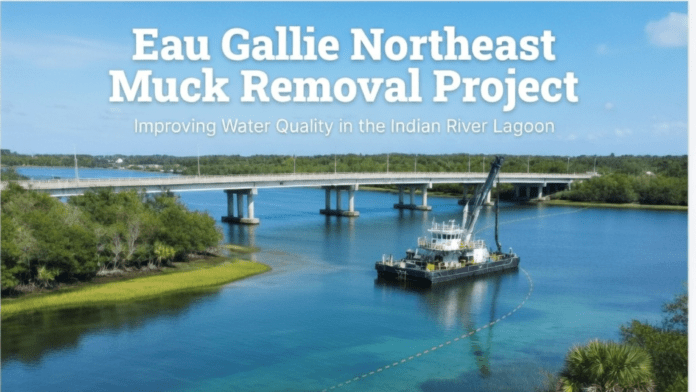
Brevard County is preparing to break ground on a significant water quality restoration effort in the Indian River Lagoon, with dredging operations set to begin near the Eau Gallie Causeway as soon as mid-April — and boaters in the area need to be paying attention.

The Eau Gallie Northeast Muck Removal Project targets a muck pit located just northeast of the Eau Gallie Causeway, where decades of nutrient loading and organic matter runoff have built up into what scientists sometimes call “black mayonnaise” — a thick, oxygen-depleting layer of sediment that smothers seagrass, fuels algal blooms, and degrades fish habitat. The project is funded through the voter-approved Brevard County Save Our Indian River Lagoon (SOIRL) Program and Florida Department of Environmental Protection grants.
What’s Being Removed — and Why It Matters
The problem of muck accumulation in the Indian River Lagoon is not new, but its scale is staggering. Remediation projects in Brevard County alone aim to remove roughly 6 million cubic yards of sediments that have accumulated over decades. Irlspecies Muck chokes out the lagoon’s natural sandy bottom, blocks sunlight from reaching seagrass beds, and releases massive amounts of nitrogen and phosphorus as it decays — directly feeding the toxic algal blooms that have plagued the lagoon for years.
According to state legislative documents, the Eau Gallie Northeast project will remove built-up organic muck from 73 acres of the lagoon, with the project area containing approximately 376,600 cubic yards of decaying muck.
The results of previous dredging nearby offer a compelling preview of what this project could accomplish. A prior dredging project in the Eau Gallie River reduced algal bloom intensity in the surrounding Indian River waters by nearly 75%, while oxygen levels and water clarity improved significantly — with boaters and fishermen reporting more frequent sightings of dolphins and shorebirds.

How the Project Works
Dredged material will be hydraulically pumped through an approximately 7-mile pipeline from the work area near the Eau Gallie Causeway to a dredge material management area near Robert J. Conlan Boulevard in Palm Bay, where it will be dewatered and processed. Work is expected to begin in mid-April 2026 and run through mid-2027.
The contractor awarded the project is Gator Dredging, which was previously identified as the sole bidder during the county’s procurement process earlier this year.
What Boaters Need to Know
Brevard County is urging mariners traveling near the Eau Gallie Causeway to use extreme caution throughout the duration of the project. Active dredging operations will be ongoing just northeast of the causeway, and both floating and submerged pipeline — including high-density plastic and steel piping — will be present in the water and may not always be fully visible.
County officials are advising boaters to:
- Use extreme caution when navigating near the project and dredge material management areas
- Travel at their slowest safe speed to minimize wake
- Be alert and follow directions from on-site crews
- Proceed carefully after passing arrangements have been made
Broader Lagoon Restoration Effort
The Eau Gallie Northeast project is one piece of a massive, ongoing restoration effort across Brevard County. As of early 2026, the Save Our Indian River Lagoon Program has collected nearly $497 million of a projected $586 million in voter-approved half-cent sales tax funds, with 119 projects completed and 100 more currently in progress.
The SOIRL program has been a rare example of local government environmental accountability — funded directly by Brevard County voters in 2016 and leveraging additional state and federal grant dollars to stretch each dollar further.
Residents with questions about the project can contact Brevard County’s Save Our Indian River Lagoon program through the county’s official website at brevardfl.gov/SaveOurLagoon.
Criminal Defense
Bankruptcy · Evictions
WICKS LAW P.A.
Call or text for
free consult
321-733-2700
Eric Wicks, Esq.
1250 West Eau Gallie Blvd. G
Melbourne, FL 32935
Abogado Wicks habla español