- Advertisement -
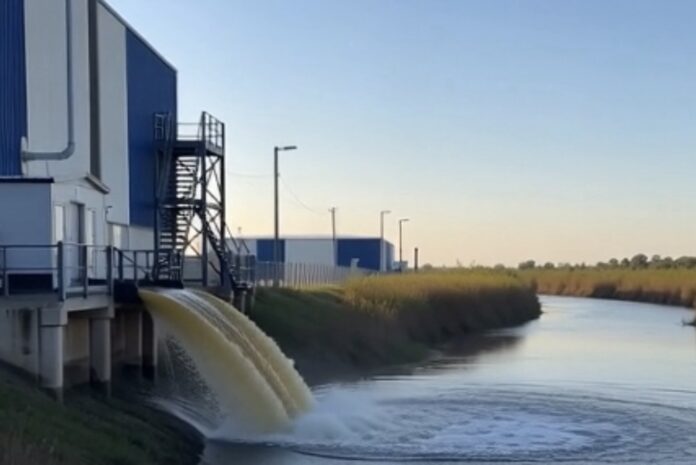
The Florida Department of Environmental Protection (FDEP) has issued a draft permit that would allow Blue Origin to discharge almost half a million gallons of industrial wastewater each day into a stormwater system that ultimately drains into the Indian River Lagoon, one of the most environmentally fragile waterways in Florida.
- Advertisement -
The draft permit, filed under NPDES Permit FL0A00007 002 IW7A, covers Blue Origin’s Orbital Launch Site Manufacturing Complex on Merritt Island. The company uses significant amounts of water in its industrial processes, including rocket component testing, cooling, cleaning and manufacturing operations. According to the draft permit, up to 0.49 million gallons per day of industrial wastewater would be authorized for release.
Where the Water Would Go
- Advertisement -
Under the proposed system, wastewater first enters a large onsite holding pond covering roughly 403,000 square feet. While this water undergoes treatment, the final outflow from that pond travels through the Ransom Road Ditch, a man made waterway that empties directly into the Indian River, which is part of the Indian River Lagoon estuary.
The discharge breaks down as follows:
- Advertisement -
• 0.467 million gallons per day of treated process wastewater
• 0.015 million gallons per day of non process industrial wastewater
The treated wastewater includes water used for industrial cleaning and cooling operations. The non process wastewater, though far smaller in volume, includes water exposed to facility operations prior to treatment.
County Officials Request Public Meeting
The issue surfaced publicly after Brevard County added an item to its December agenda titled “Written Request for Public Meeting regarding Draft Permit FL0A00007 002 IW7A.” The Natural Resources Management Department is recommending that commissioners request a public meeting from FDEP and submit formal written comments before the December deadline.
County officials say the volume of water, its proximity to the river, and the lagoon’s already compromised ecological condition warrant the highest level of scrutiny.
Public Reaction Growing Quickly
A petition launched on November 22 calling for FDEP to deny the permit has already gained traction. It argues that the Indian River Lagoon, which has suffered years of algae blooms, seagrass die offs and manatee starvation, cannot handle additional industrial discharge.
The petition calls for:
• A denial of the permit unless Blue Origin adopts a zero discharge system
• Independent third party water quality monitoring
• Full public transparency of discharge data
• A mandatory public meeting before any approval
Environmental groups and lagoon advocates are warning that even treated industrial wastewater still contains nutrients and chemicals that can worsen algae blooms and degrade water quality, especially in shallow estuarine systems.
Blue Origin Responds
Blue Origin says the permit is a renewal of an existing agreement and that the company has operated under similar discharge conditions for more than five years. In statements to multiple media outlets, the company says it is “committed to responsible and compliant operations” and that the draft permit reflects updated requirements consistent with state regulations.
What Happens Next
The draft permit has not yet been approved. FDEP is required to consider public comments submitted during the 30 day window after publication of the draft permit notice. The agency has the authority to hold a public meeting if requested by the public or by government agencies such as Brevard County.
If enough concern is raised, FDEP can modify the permit, impose stricter limits, add monitoring requirements or deny the permit entirely.
Residents wishing to comment must reference the permit number and include factual grounds for objection. Comments must be submitted before the deadline, which falls in mid December 2025.
Why This Matters
The Indian River Lagoon is already in a long term ecological crisis. Billions of dollars in restoration efforts are underway, and both state and local agencies continue to warn that any additional nutrient loads or chemical stressors can set back recovery efforts.
Approving a permit allowing nearly 500,000 gallons of industrial wastewater per day to enter a lagoon connected waterway is raising questions about Florida’s regulatory standards and the balance between aerospace development and environmental protection.
This story will continue to develop as public comments, county actions and potential hearings unfold. The Space Coast Rocket will provide updates as new information becomes available.
- Advertisement -