
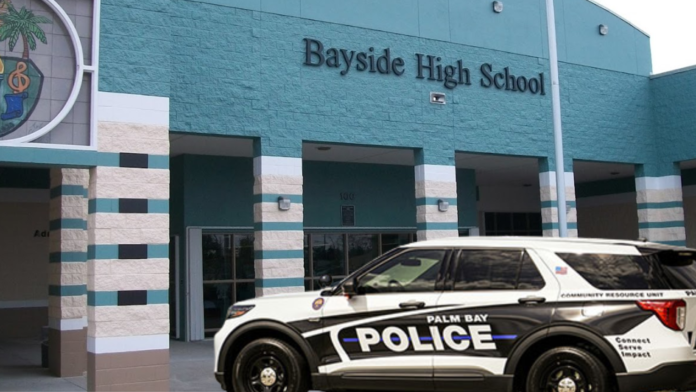
PALM BAY, Fla. — The Palm Bay City Council voted 3-2 Wednesday night to deny the proposed Memorandum of Understanding with the School Board of Brevard County that would have assigned up to fourteen Palm Bay police officers as School Resource Officers for the 2026-2027 school year, ending months of negotiations over what city officials say is a reimbursement rate covering only a fraction of the actual cost of providing each officer.

The agreement would have committed Palm Bay to providing a minimum of three SROs at the start of the school year at fourteen Palm Bay-area campuses, with the School Board reimbursing the City a flat fee of $77,000 per officer for a total not-to-exceed amount of $231,000. According to Palm Bay’s own benefit calculator records, the fully loaded cost of a single sworn officer exceeds $170,000 per year when accounting for salary, benefits, and costs.
Johnson Led Negotiation Effort
Councilman Kenny Johnson, who has spent recent weeks attempting to negotiate a higher reimbursement rate, told his colleagues he had personally contacted three of the five Brevard School Board members, including Chair Matt Susin, Katye Campbell, and John Thomas. Johnson said all three indicated the Board considered the $77,000 figure justified and was unwilling to increase it.
“It was also mentioned to me that they are not willing to budge on the amount,” Johnson said during the meeting. He noted that he and City Manager Morton attempted to negotiate directly with Superintendent Dr. Mark Rendell and Deputy Superintendent Rashad Wilson at the district’s Viera offices. The district responded with a letter outlining funding increases over the years since the Marjory Stoneman Douglas Public Safety Act was enacted in 2018, but did not move on the per-officer rate.
Johnson also relayed that school board members expressed concerns about the productivity of some current SROs assigned to Palm Bay schools, and signaled that regardless of how the council vote came out, they wanted ongoing conversations between principals, the police chief, and the superintendent about the program going forward.

“I still do feel that they should be bringing more,” Johnson said before the vote.
Public Comment Raised Concerns About Department Staffing
A speaker during public comment, told the council that the SRO program has historically been difficult to staff and that pulling officers away from patrol assignments creates real strain on department operations. He described patrol officers as stretched thin by the city’s continued growth, noted that filling a patrol officer position can take over a year, and warned that the SRO program ties up additional sergeant and liaison positions beyond the officers assigned to schools themselves. The remarks framed the vote as a difficult tradeoff between school coverage and street-level response capacity.
The Math Behind the Denial
According to Palm Bay’s FY 2026 benefit calculator, a single SRO costs the City approximately $170,868 per year. The School Board’s $77,000 reimbursement covers approximately 45% of that fully loaded cost according to the Palm Bay City Manager. Even excluding vehicle and equipment costs, which some argue are fixed regardless of officer assignment, the salary-and-benefits gap alone leaves nearly $60,000 per officer absorbed by Palm Bay taxpayers. Across the fourteen positions the MOU authorized, that gap would have approached $840,000 annually in unreimbursed city expense.
Palm Bay residents pay both county property taxes that fund the School Board and city property taxes that fund Palm Bay PD, meaning the subsidy effectively requires city taxpayers to cover a function state law assigns to the school district.
Mayor and Councilman Hammer Voted to Approve
The motion to deny was made by Deputy Mayor Jaffee and seconded by Johnson. Voting in favor of denial were Johnson, Deputy Mayor Jaffee, and Councilman Chandler Langevin. Voting against denial, and therefore in favor of accepting the agreement, were Mayor Rob Medina and Councilman Mike Hammer.
Mayor Medina expressed appreciation for Johnson’s work but suggested a different path forward. “Perhaps it’s something that we could jointly go together towards lobbying our state legislators since they’re the ones putting on the demand, the mandate,” Medina said. The mayor pointed to the structural problem that the 2018 state law required armed safe-school officers at every public school but did not fully fund the requirement, leaving school districts to negotiate cost-sharing arrangements with local law enforcement agencies.
Councilman Langevin, who voted to deny, framed the outcome as a productive result of pushing back rather than rubber-stamping the agreement. “When you just don’t be complacent and you push back, you may not get exactly what you wanted, but now we’re having a conversation,” Langevin said. He also raised concerns from his own volunteer experiences at Heritage High School and other campuses, saying he observed students freely violating administrative codes without consequence and was told resource officers were limited to criminal enforcement and could not address administrative violations.
“If they’re not having the rules enforced in school, then that’s going to carry over into society when they graduate,” Langevin said.
School District Responds
In a statement issued following the vote, Brevard Public Schools expressed disappointment with the council’s decision but indicated that the Brevard County Sheriff’s Office would be stepping in to fill the gap.
“We are disappointed by the Palm Bay City Council’s decision, but we want families to know that the safety of their children remains our absolute priority,” the district said. “We are thankful for our strong partnership with Sheriff Wayne Ivey and the Brevard County Sheriff’s Office. Sheriff Ivey has personally assured us that he will work with us to meet our obligation to the students of Palm Bay, and we have every confidence in that commitment.”
The statement concluded: “Our kids deserve to feel safe at school. We will make sure they do.”
What Happens Now
Although the rejected MOU listed fourteen schools that could be assigned to Palm Bay SROs, Brevard Public Schools clarified that only three district schools plus one charter school are actually impacted by the council’s vote. The Brevard County Sheriff’s Office already provides SRO coverage at the remaining Palm Bay-area schools, and Sheriff Wayne Ivey is now expected to extend that coverage to the affected campuses for the 2026-2027 school year.
Councilman Johnson noted during the meeting that even with deputies filling the SRO role, “It will still be Palm Bay Police Department getting the calls.” Calls for service generated inside Palm Bay schools fall within Palm Bay PD’s jurisdiction regardless of whether a deputy or a city officer is assigned as the SRO, meaning the department would still respond to incidents at the campuses without receiving the partial reimbursement that came with the SRO assignment.
The vote leaves the Brevard School Board with a statutory obligation under Section 1006.12, Florida Statutes, to ensure an armed safe-school officer at every public school campus when classes resume in August. With Sheriff Ivey’s commitment now public, Brevard County Sheriff’s deputies are expected to fill those positions.
The MOU as drafted would have taken effect July 1, 2026, and remained in force through June 30, 2027.
Criminal Defense
Bankruptcy · Evictions
WICKS LAW P.A.
Call or text for
free consult
321-733-2700
Eric Wicks, Esq.
1250 West Eau Gallie Blvd. G
Melbourne, FL 32935
Abogado Wicks habla español