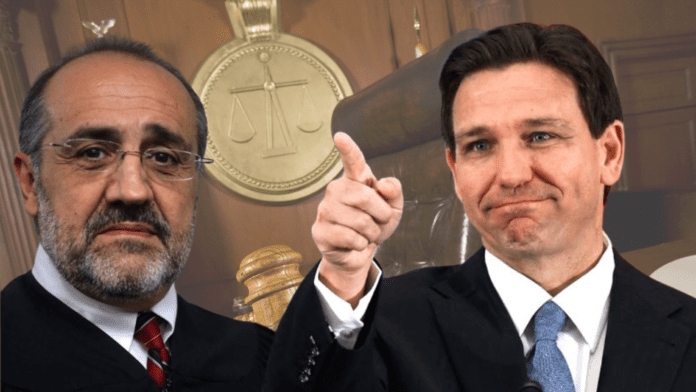
BREVARD COUNTY, Fla. — A week-long investigation by The Space Coast Rocket has uncovered documents and testimony that fundamentally change the story of how Brevard County’s Group 8 judicial election was cancelled. What initially appeared to be another case of a judge engineering a vacancy to hand his seat to Governor Ron DeSantis was as we’ve seen in other circuits, in fact, the opposite: a retiring judge’s routine paperwork was intercepted through an administrative pipeline created by the Governor’s office, recharacterized as a resignation, and “accepted” with strategic precision three days before the qualifying period opened, cancelling a democratic election that two candidates had spent nearly a year preparing for.
- Advertisement -
Judge Benjamin B. Garagozlo did not resign. He retired. He never submitted a resignation to the Governor. And he had no idea his retirement letter would be used to cancel the election for his seat. He is the victim of what appears to be a scheme by the Govenor’s office to gain an appointment.
What the Documents Show
The Space Coast Rocket has obtained the key documents in this chain of events, and they tell a story that is sharply different from the one initially presented by the Brevard County Supervisor of Elections.
- Advertisement -
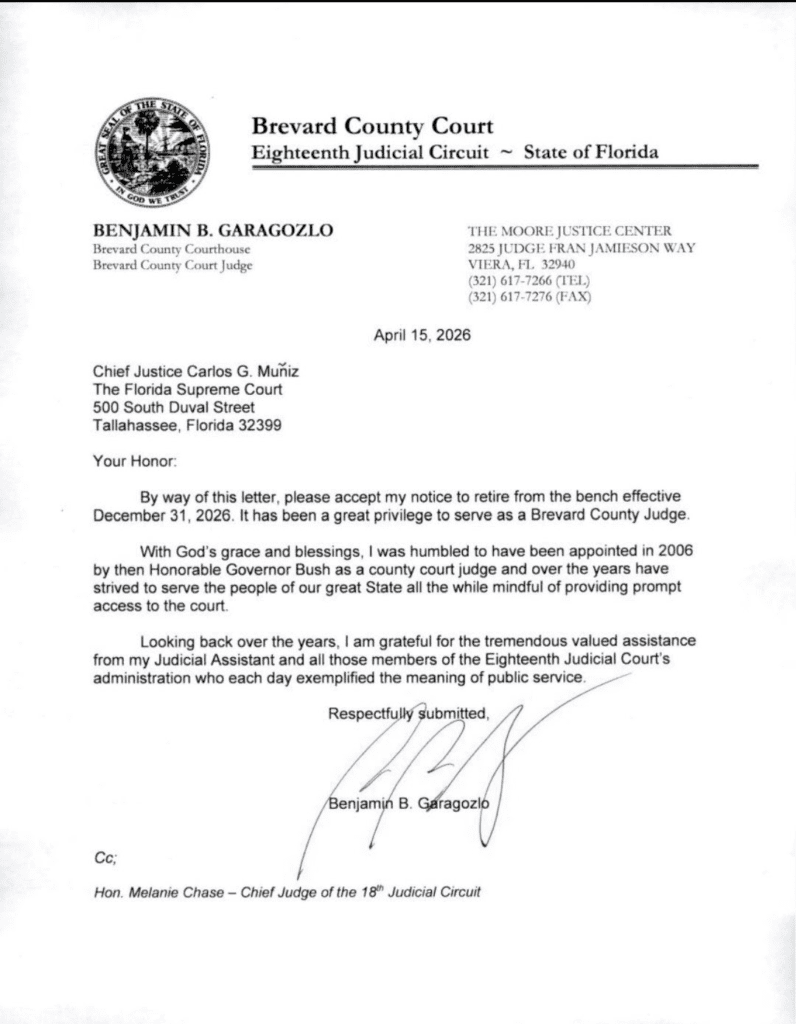
On April 15, 2026, Judge Garagozlo sent a letter to Chief Justice Carlos G. Muniz of the Florida Supreme Court. The letter, written on Brevard County Court letterhead, states: “By way of this letter, please accept my notice to retire from the bench effective December 31, 2026.” The letter was copied to Chief Judge Melanie Chase of the 18th Judicial Circuit. It was not addressed to, submitted to, or copied to Governor DeSantis or anyone in his office.
The word “resign” does not appear anywhere in the letter. The word “resignation” does not appear anywhere in the letter. The judge used the word “retire.”
- Advertisement -
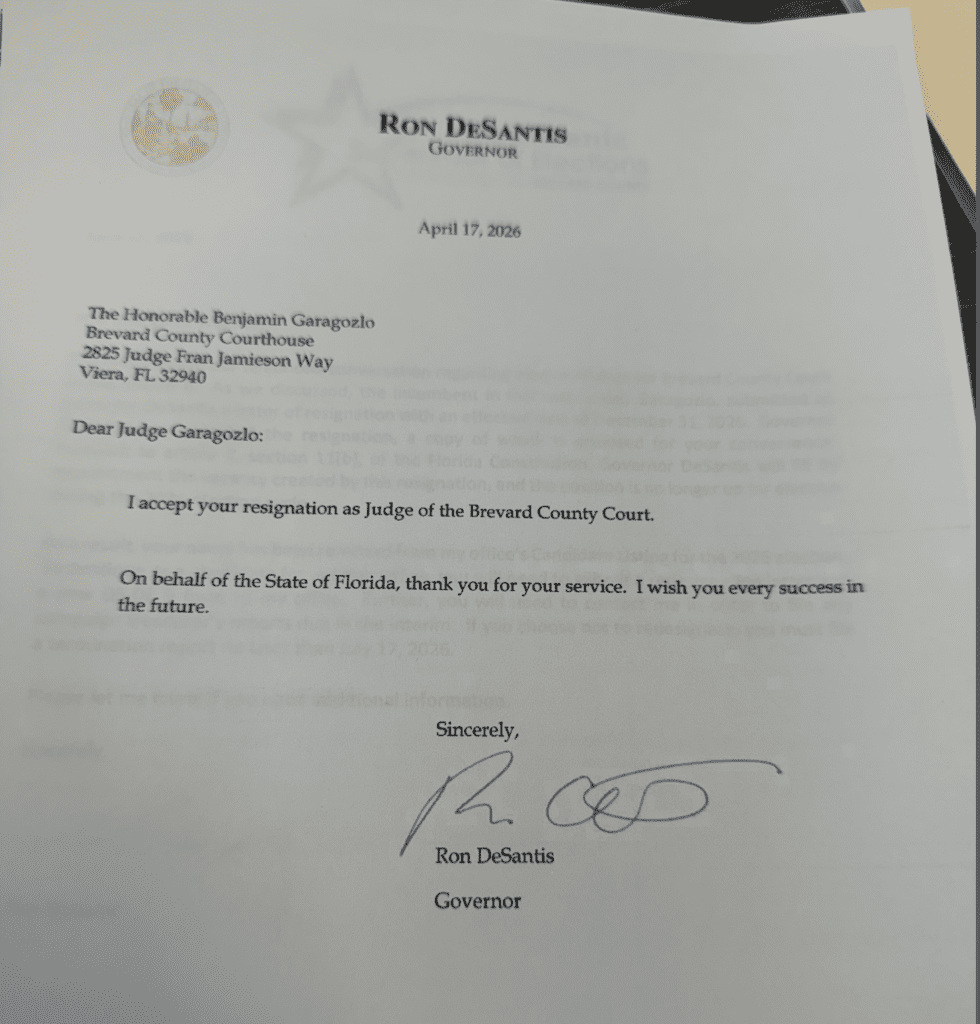
Two days later, on April 17, Governor DeSantis sent Judge Garagozlo a letter stating: “I accept your resignation as Judge of the Brevard County Court.” The Governor recharacterized the judge’s retirement as a resignation — a term the judge never used.
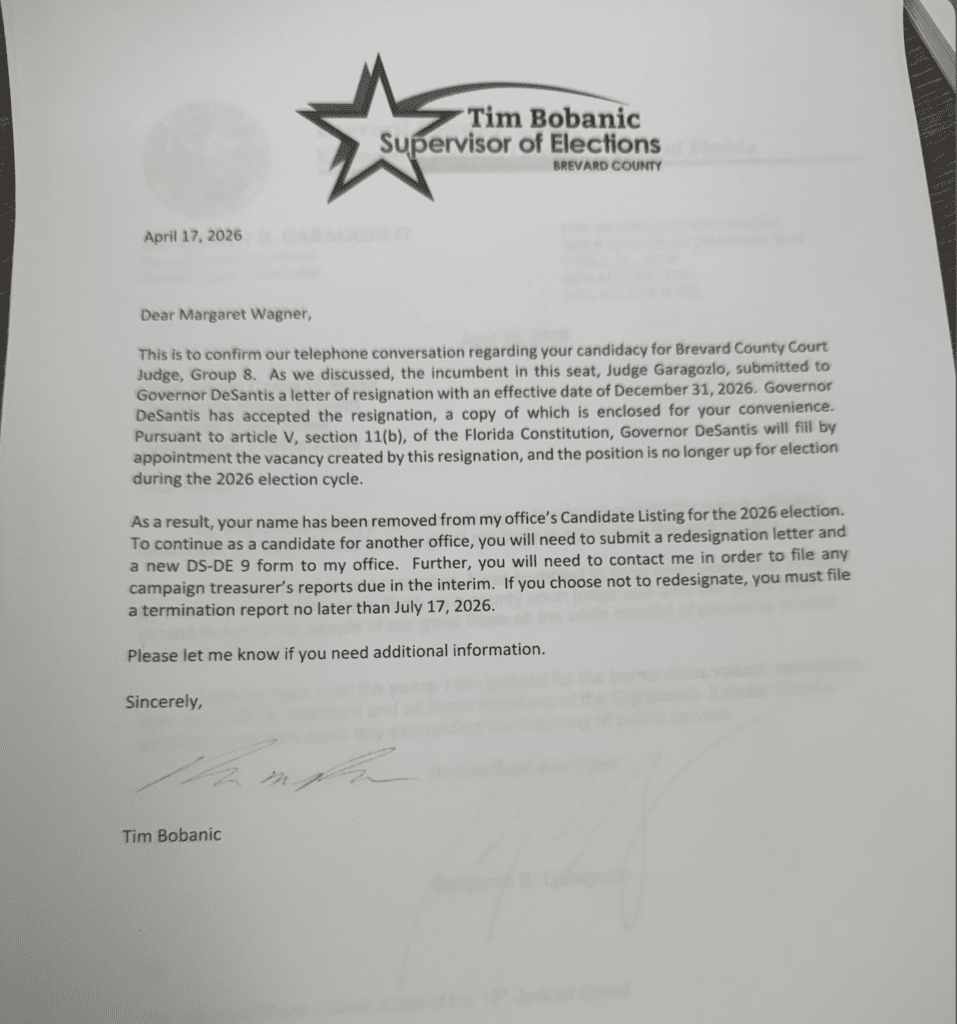
That same day, Brevard County Supervisor of Elections Tim Bobanic sent a letter to candidate Margaret “Maggie” Wagner stating that Judge Garagozlo had “submitted to Governor DeSantis a letter of resignation with an effective date of December 31, 2026.” This statement is factually incorrect on two counts: the letter was submitted to Chief Justice Muniz, not to the Governor, and it was a retirement notice, not a resignation.
Wagner and candidate Andrea Fant were notified at approximately 4:00 p.m. on Friday, April 17, that their names had been removed from the Candidate Listing and the election had been cancelled. The qualifying period for judicial races opened the following Monday at noon.
The Pipeline: How the Governor’s Office Got the Letter
The Space Coast Rocket obtained, through public records requests, the email chain that explains how Judge Garagozlo’s retirement letter ended up in the Governor’s hands.
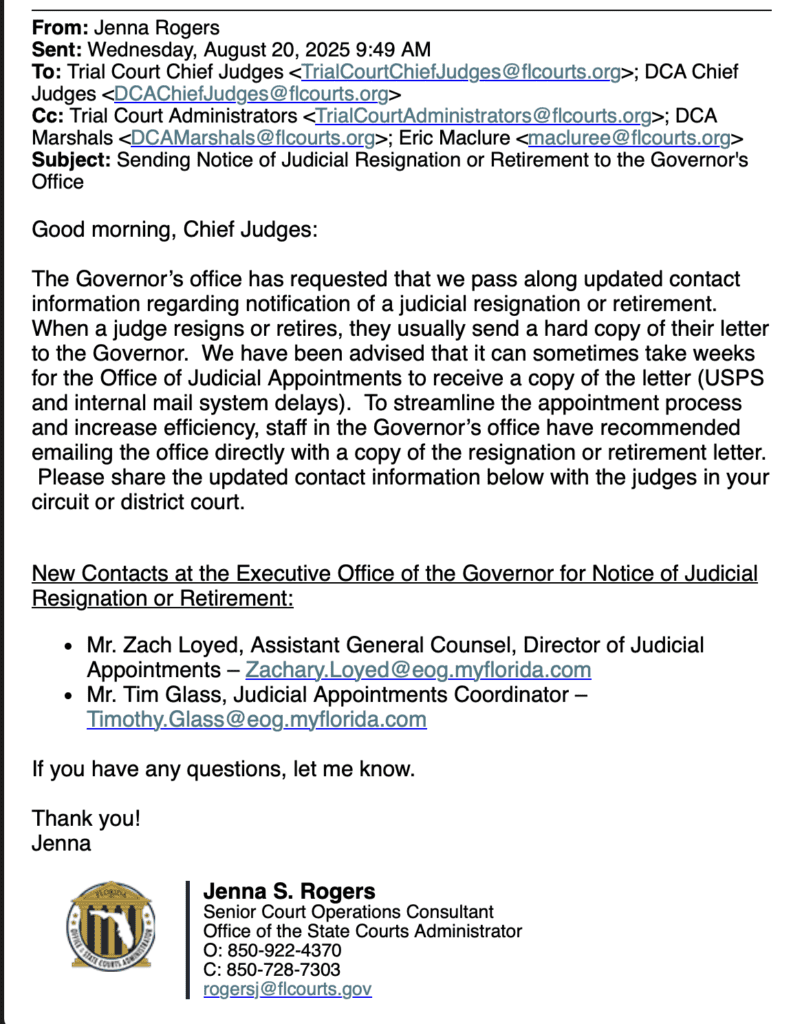
On August 20, 2025, Jenna S. Rogers, a Senior Court Operations Consultant with the Office of the State Courts Administrator, sent an email to all Trial Court Chief Judges across the state. The email stated that the Governor’s office had “requested that we pass along updated contact information regarding notification of a judicial resignation or retirement” and recommended that chief judges email copies of retirement or resignation letters directly to the Governor’s Office of Judicial Appointments.
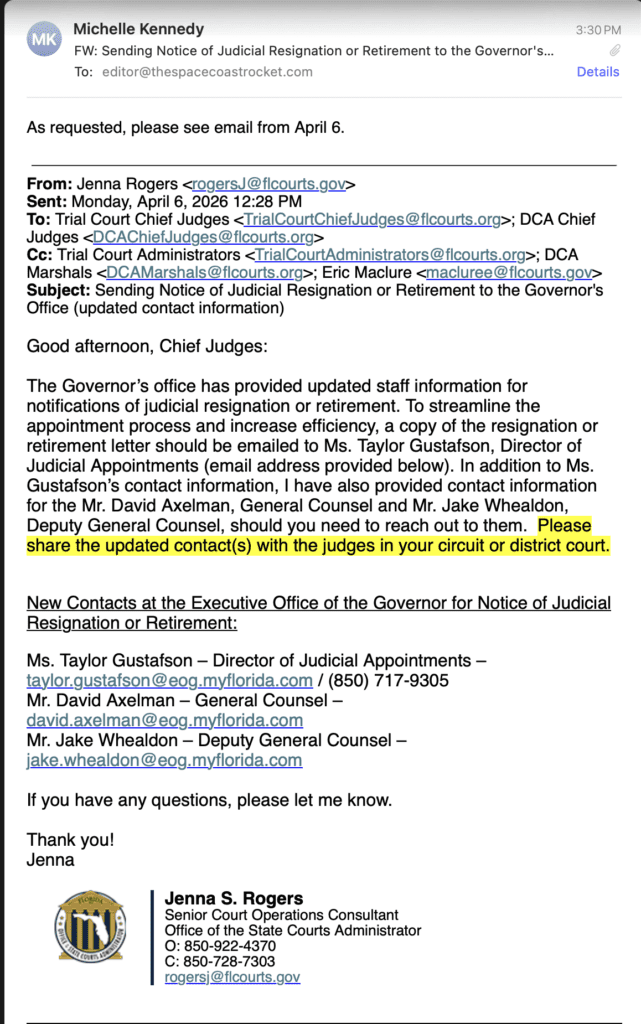
On April 6, 2026 — the same day the statutory pre-qualifying period opened for judicial races — Rogers sent a second, updated email with new contact information, directing that letters be emailed to Ms. Taylor Gustafson, the new Director of Judicial Appointments in the Governor’s office.
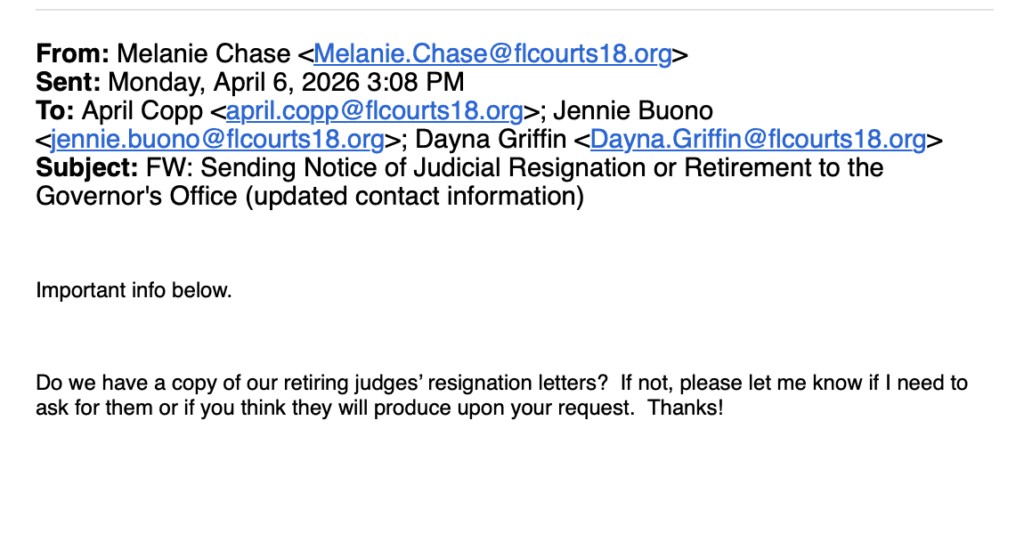
That same afternoon, at 3:08 p.m., Chief Judge Melanie Chase of the 18th Judicial Circuit forwarded the Rogers email to April L. Copp, Chief of Personnel Services for the circuit, and other administrative staff. Chase wrote: “Important info below. Do we have a copy of our retiring judges’ resignation letters? If not, please let me know if I need to ask for them or if you think they will produce upon your request. Thanks!”
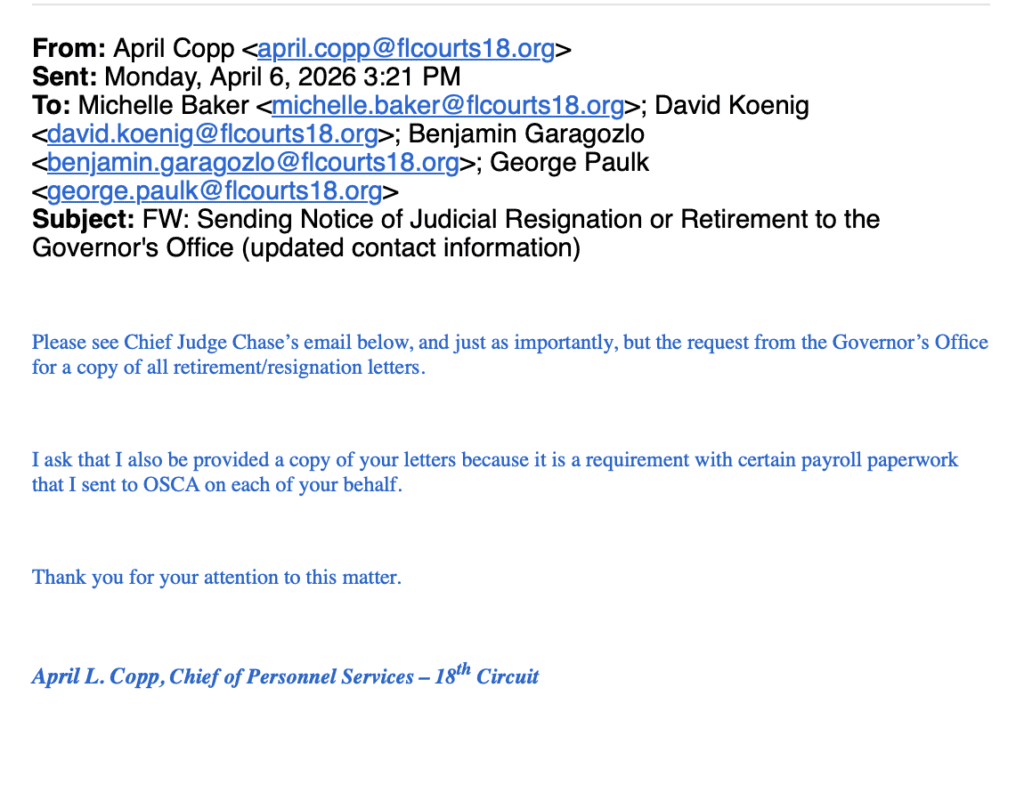
Thirteen minutes later, at 3:21 p.m., Copp forwarded the directive directly to the retiring judges themselves, including Judge Garagozlo by name. Copp’s email stated: “Please see Chief Judge Chase’s email below, and just as importantly, but the request from the Governor’s Office for a copy of all retirement/resignation letters.”
Nine days later, on April 15, Judge Garagozlo submitted his retirement letter to Chief Justice Muniz. The letter was then transmitted to the Governor’s office as part of routine retirement paperwork. Two days after that, the Governor “accepted” it as a resignation.
‘He Was Shocked’
In a conversation with The Space Coast Rocket, Michelle Kennedy, a spokesperson for the 18th Judicial Circuit Court’s administration, provided critical context that corroborates the documentary evidence.
Kennedy stated that Judge Garagozlo “was told to get his letter in and it was going to be sent in with his retirement packet.” She said the circuit’s HR personnel, wanting to ensure the retiring judges “had their ducks in a row for retirement,” bundled the retirement letter with payroll paperwork and sent it to the Office of the State Courts Administrator and the Governor’s office in response to the Rogers directive.
“He had no idea that this would initiate an appointment process,” Kennedy said. “We’ve never heard of that happening locally.”
Kennedy confirmed that Judge Garagozlo learned of the Governor’s action late in the evening on April 17, when another judge called him. “He was very shocked,” she said.
Kennedy, who has served the 18th Judicial Circuit for 26 years, said she was “unaware of any other occasion when this created a vacancy” or “turned into an appointment rather than an election.”
When asked whether anyone in the Governor’s office or any political organization contacted Judge Garagozlo about the timing or form of his departure, Kennedy responded: “No.” She described the Rogers email directive as “probably a catalyst” for the HR staff to package and transmit the letter but said it “was not a directive from the Governor’s office” to Judge Garagozlo himself.
Kennedy was emphatic on one point: “He did not change. He is not resigning. He wants that clear. He is retiring.”
Not What It Looked Like
When we first reported this story, the available facts suggested that Judge Garagozlo may have deliberately engineered a vacancy to hand his seat to the Governor. That framing was based on the information available at the time, primarily the Supervisor of Elections’ announcement, which described the letter as a “resignation” submitted to the Governor. That very action has been and is currently being used in another County to accomplish just that. We also had submitted several questions directly to Judge Garagozlo seeking explanation or comment for his action, which have still not been directly addressed by him. However, as stated above, Ms. Kennedy was able to provide some information on the substance of those questions.
The documents and testimony obtained since then tell a different story.
Judge Garagozlo, despite what the Governor’s office and the Supervisor of Elections Office stated, did not submit a resignation. He submitted a retirement notice. He did not direct his letter to the Governor. He directed it to the Chief Justice. He did not intend to cancel an election. He intended to do routine retirement paperwork. He selected December 31 as his effective date because retiring even one day into January would have delayed his retirement benefits by an entire month — a common practice among retiring judges, as Kennedy explained.
The effective date of December 31, 2026 is five calendar days before his term ends on January 5, 2027. In practical terms, given the New Year’s Day holiday, it represents a gap of just one business day.
This is not a case of a judge manipulating the system. This is a case of an administrative process that accidentally (or intentionally by another party) funneled a retirement letter to the Governor’s office, and a Governor who appears chose to exploit that accident to seize an appointment rather than allow voters to choose. The timing of the correspondences is what makes this scenario plausible. The April 6th email sent from the Governor’s office seeking the retirement and resignation letters what sent on the same day pre-qualifying for the elections started. The letter of Governor DeSantis “accepting” the “resignation” was on the evening of the last day of pre-qualifying. Had that letter come on the following Monday when qualifying began, the election would still be taking place. Those are all extraordinary coincidences.
The Legal Fight
The legal question at the center of this situation has never been resolved by the Florida Supreme Court. Our research has found that in every prior case involving the cancellation of a judicial election in favor of a gubernatorial appointment, the judge submitted a resignation directly to the Governor. The Governor then “accepted” the resignation, creating what the courts have called a “constitutional vacancy” that must be filled by appointment if it occurs before the qualifying period opens.
But that framework has always assumed the judge intended to resign and directed the resignation to the Governor. Neither of those things happened here.
In Trotti v. Detzner, 147 So. 3d 1031 (Fla. 1st DCA 2014), the First District Court of Appeal held that a judicial vacancy occurs when a resignation is “received and accepted by the Governor.” But that case involved a judge who deliberately submitted a resignation letter to the Governor. Every case in this line of precedent involves the same fact pattern.
Justice Barbara Pariente of the Florida Supreme Court flagged the constitutional problem with this framework in her concurrence in Pincket v. Detzner, SC16-768 (Fla. 2016). She wrote: “If this case were before us on the merits to decide the constitutional question and we were thus not constrained by the narrow scope of mandamus relief, I would adopt the reasoning of Judge Padovano’s dissent.” Judge Padovano had warned that the majority’s approach “creates a high potential for abuse.”
Justice Fred Lewis went further, describing the practice as one that “allow[s] judges to make a mockery of our Florida Constitution with impunity.”
But in those cases, the judges were willing participants. Here, the judge is the unwitting victim of the very process those justices condemned.
The Space Coast Rocket has learned that a legal challenge is being prepared. The central arguments are expected to include that the Governor cannot “accept” a resignation that was never tendered to him; that a retirement notice is not a resignation under Article X, Section 3 of the Florida Constitution; and that the Governor’s actions violate the constitutional command in Article V, Section 10(b) that the election of county court judges “shall be preserved.”
What is crucial to the success of the challenge is Judge Garagozlo himself. The Florida Supreme Court has opined in the past that they will not speculate to a judge’s intent. Although we’ve learned his true intent, he must state it as a matter of fact through a sworn affadavit, or an amended letter of retirement submitted directly to the Governor definitively stating he had not intention of retiring or creating a vacancy for what amounts to a day before the end of his term.
It’s Happening Across the State
The Brevard situation is not occurring in isolation. In Leon County, Circuit Judge Angela Dempsey submitted her resignation directly to the Governor’s office on April 14, 2026, effective December 28, just days before the end of her term and just days before qualifying opened. Her resignation came shortly after campaign finance reports showed her challenger, first-time candidate Talley Kaleko, had raised nearly $120,000 in less than three weeks, vastly outraising Dempsey. The Leon County Democratic Party accused Dempsey and DeSantis of coordinating the resignation to prevent the election of a more liberal judge, and a Tallahassee attorney wrote in the Tallahassee Democrat that “anyone with two brain cells to rub together can easily surmise that Dempsey and DeSantis coordinated her resignation to prevent the election.” Unlike the Brevard situation, where Judge Garagozlo submitted a retirement letter to the Chief Justice and was shocked to learn it had been used to cancel the election, the Leon County case appears to follow the deliberate playbook that dissenting Florida Supreme Court justices have condemned for years: an incumbent judge facing a difficult election submits a strategically timed resignation to the Governor, cancelling the race and handing the seat to the Governor for appointment. Both cases, however, share the same result: voters in Florida are being stripped of their constitutional right to elect their judges.
Two Candidates, One Year, Zero Votes
Margaret Wagner and Andrea Fant spent about a year campaigning for the Group 8 seat. Both submitted pre-qualifying paperwork during the statutory pre-qualifying period that began April 6. Both invested time, resources, and personal commitment to a democratic process that the Florida Constitution says must be preserved.
They were told on a Friday afternoon that none of it mattered.
Fant has since filed for and qualified for a circuit court race that recently opened. Wagner’s next steps are not yet known publicly.
What Happens Next
The qualifying period for the 2026 judicial election cycle opened at noon on Monday, April 20, and closes at noon on Friday, April 24. Any legal challenge would need to be filed on an emergency basis to preserve the candidates’ and voters’ rights.
If the Governor’s action stands, the Judicial Nominating Commission for the 18th Circuit will convene to recommend candidates for the Governor’s appointment. The voters of Brevard County will have no say in who sits on their county court bench for the next six years.
If the action is successfully challenged, the election would proceed and voters would choose their next county court judge, as the Florida Constitution provides.
The Space Coast Rocket will continue to follow this story as it develops.
Robert W. Burns III is the Editor and Publisher of The Space Coast Rocket. He can be reached at editor@thespacecoastrocket.com or 407-810-3200.