

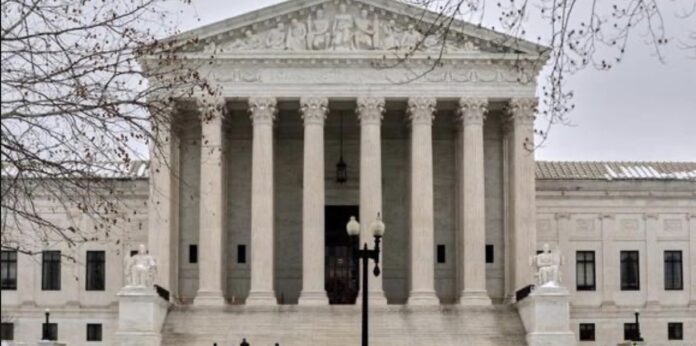
WASHINGTON — The United States Supreme Court has temporarily blocked a California law that restricted schools from notifying parents if their child identifies as transgender or changes pronouns at school, a move that could carry significant implications for education policy debates nationwide, including in Florida.

In granting an emergency appeal filed by religious parents represented by a conservative legal organization, the high court reinstated a lower court order preventing California from enforcing its law while the case proceeds through the courts. The challenged law had barred school districts from adopting policies requiring parental notification when a student changes gender identity markers at school.
The Supreme Court’s decision does not create new law nationwide. However, it signals how the current majority views conflicts between student privacy rights and parental rights in education.
What the Decision Does
The ruling blocks, for now, California’s prohibition on mandatory parental notification policies. Religious parents had argued that schools were effectively concealing significant information about their minor children, including social gender transitions, without parental consent.

California officials defended the law by arguing that students have privacy rights related to gender identity, particularly if disclosure could expose them to harm at home.
The Supreme Court sided with the parents at this stage of the litigation, allowing school districts to require parental notification while the case continues.
What It Means for Florida
For Florida, the immediate impact is limited because the state already emphasizes parental notification and parental rights in education.
Florida has enacted multiple laws in recent years expanding parental access to school records and reinforcing what lawmakers describe as “parental rights in education.” School districts in Florida generally are not permitted to withhold significant information about a minor child from parents absent specific safety exceptions.
The decision strengthens the constitutional arguments Florida officials have used to defend those policies.
If a Florida school district were to attempt to withhold information about a student’s gender identity from parents, the Supreme Court’s posture in the California case suggests that parental rights claims could receive a favorable hearing at the federal level.
Broader Legal Context
The ruling comes amid a series of Supreme Court decisions involving religious liberty and parental rights in education. In recent terms, the Court has sided with religious plaintiffs in multiple school-related disputes and has shown openness to states regulating gender identity policies involving minors.
Florida has also been at the forefront of national debates over gender identity in schools, transgender participation in girls’ sports, and restrictions on gender-affirming medical care for minors. Those policies are currently being litigated in various federal courts.
Legal observers note that while this California case remains unresolved, the emergency order offers insight into how the Court may ultimately rule if it takes the case on the merits.
A Continuing National Divide
The divide between states like California and Florida reflects broader political and constitutional disagreements over who has primary authority in decisions involving minors at school.
Supporters of parental notification laws argue that parents have a fundamental constitutional right to direct the upbringing and care of their children.
Opponents argue that mandatory disclosure policies can endanger vulnerable students and undermine privacy protections.
For now, Florida’s existing legal framework remains intact, and the Supreme Court’s action appears to reinforce, rather than challenge, the state’s current policy direction.
The California case will continue in lower courts, and a full Supreme Court ruling on the merits could further shape the national legal landscape in the months ahead.
Criminal Defense
Bankruptcy · Evictions
WICKS LAW P.A.
Call or text for
free consult
321-733-2700
Eric Wicks, Esq.
1250 West Eau Gallie Blvd. G
Melbourne, FL 32935
Abogado Wicks habla español