


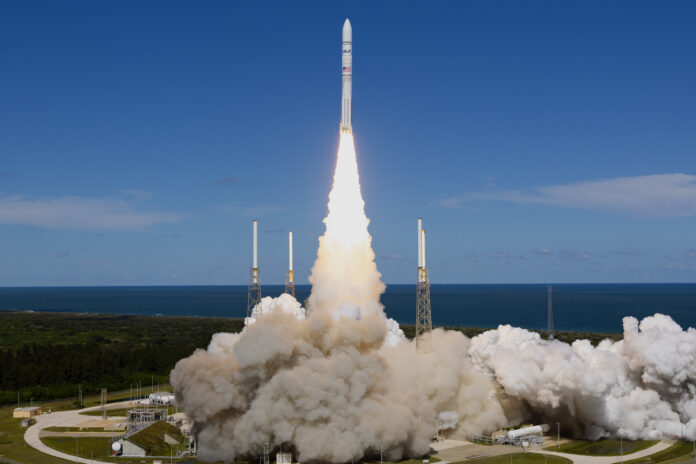
United Launch Alliance’s Vulcan rocket suffered an anomaly about 10 minutes after lifting off Sunday from Cape Canaveral, ending a critical return-to-flight mission and destroying 40 Amazon Leo broadband satellites.
CAPE CANAVERAL, Fla. – United Launch Alliance’s Vulcan rocket failed to reach orbit Sunday after an in-flight anomaly during the Amazon Leo 1 mission, the company’s first outright mission loss since ULA was formed in 2006.

The 215-foot rocket lifted off from Space Launch Complex 41 at Cape Canaveral Space Force Station at 12:40 p.m. on Nov. 15. ULA later confirmed that the vehicle “suffered an anomaly 10 minutes into the flight and failed to deliver the Amazon mission to orbit.”
All 40 Amazon Leo broadband satellites aboard the rocket were lost. ULA said it did not yet have specific data identifying what went wrong and promised to work with Amazon and other organizations to determine the cause, take corrective action and return Vulcan to flight.
What happened during the flight
Sunday’s launch came at the end of a 29-minute window after controllers stopped the countdown at T-minus 20 seconds to address an unspecified technical issue. The team resolved the problem and cleared the rocket for liftoff.
The six Northrop Grumman GEM 63XL solid rocket boosters appeared to perform normally and separated about a minute and a half into the flight. The two Blue Origin-built BE-4 engines on Vulcan’s first stage then continued the climb over the Atlantic.

The mission began departing from ULA’s published timeline later in ascent. The first stage appeared to burn longer than planned, stage separation appeared to occur late, and the webcast’s telemetry-driven animation showed the Centaur V upper stage making unusual orientation changes after its engines ignited, according to Spaceflight Now’s launch coverage.
ULA ended its live broadcast before confirming completion of the Centaur’s first burn. Those visible signs may help define the investigation, but they are not a root-cause finding. ULA has not publicly identified the failed system or said whether Sunday’s countdown hold was related to the anomaly.
A record payload on a new Vulcan configuration
The Amazon Leo 1 mission was the first flight of Vulcan’s VC6L configuration, which used six side-mounted boosters and a 70-foot payload fairing. It also debuted a shorter, low Earth orbit-optimized version of the Centaur V upper stage.
The rocket carried more than 50,000 pounds of satellites, which would have been a new payload record for ULA. The 40 spacecraft made up the largest single batch Amazon had attempted to launch for its low Earth orbit broadband network.
Sunday’s flight was also the first of 38 Vulcan missions booked by Amazon. The company has invested in a dedicated Vertical Integration Facility and launch platform at the Cape so ULA can prepare two Vulcan missions at the same time and increase its launch cadence.
Amazon said launch risk is especially high on an inaugural mission and called ULA a trusted partner. The company said it believes ULA will learn from the loss and deliver on its long-term Vulcan plans.
Vulcan’s first flight in nine months
The mission was Vulcan’s fifth flight and its first since February. That earlier mission delivered its U.S. Space Force payloads to orbit despite an anomaly involving a solid rocket booster nozzle.
ULA, Northrop Grumman and government partners spent months investigating that problem. Before Sunday’s launch, ULA said the team had changed the nozzle design and manufacturing process, completed component testing and fired a full-scale motor in Utah.
The six boosters on Sunday’s vehicle appeared to operate as expected, and ULA has not indicated that the new failure is connected to the earlier nozzle problem.
The loss broke a two-decade record for ULA, a Boeing and Lockheed Martin joint venture formed in 2006. Its Atlas V and Delta IV rockets completed their missions without an outright launch failure during that period.
What happens next
ULA has not set a date for Vulcan’s next flight. The company said its investigation will use a formal process to identify the cause and required corrective actions, with customers given visibility into the work.
Before Sunday’s loss, Amazon expected its second Vulcan mission to follow within weeks. That schedule is now on hold while ULA determines what failed and demonstrates that the problem has been corrected.
Amazon’s broader deployment will continue on other rockets. Its next mission is targeted for no earlier than Nov. 23 aboard an Ariane 6 from French Guiana, according to the company’s official mission tracker.
For the Space Coast, the immediate effect is a pause in the high-cadence Vulcan operation that ULA and Amazon have built around SLC-41. The larger impact will depend on how quickly investigators isolate the failure and how extensive the required changes are.
Featured image: United Launch Alliance’s Vulcan rocket lifts off from Space Launch Complex 41 at Cape Canaveral Space Force Station on Nov. 15, 2026. Photo credit: United Launch Alliance.
Criminal Defense
Bankruptcy · Evictions
WICKS LAW P.A.
Call or text for
free consult
321-733-2700
Eric Wicks, Esq.
1250 West Eau Gallie Blvd. G
Melbourne, FL 32935
Abogado Wicks habla español