

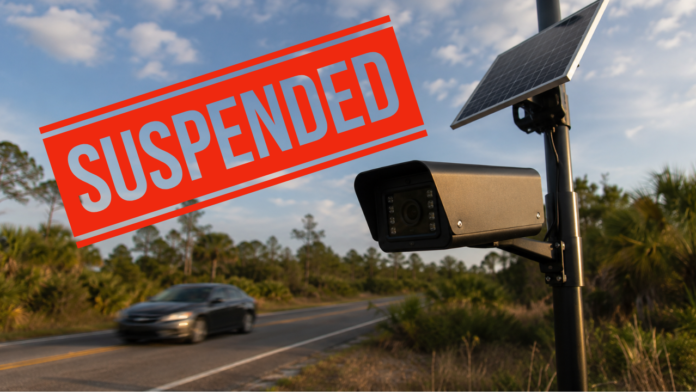
SUMTER COUNTY, Fla. – A Sumter County sheriff’s detective has been fired and arrested on accusations she used the agency’s license plate reader network and two other restricted law enforcement databases to keep tabs on her husband’s ex-wife, prompting the sheriff to shut down his county’s Flock camera program while auditors go through every search his agency has run.

The case is the scenario privacy advocates have spent years warning about, and it happened roughly 90 minutes from Brevard County.
The audit that started it
Sumter County Sheriff Pat Breeden said an internal audit conducted on July 23 flagged irregular activity tied to Detective Brandy Almany, who had worked for the agency since 2019. Investigators say the searches had nothing to do with any criminal case.
According to the sheriff’s office, Almany accessed the Florida Driver and Vehicle Information Database (DAVID), the Comprehensive Case Information System (CCIS) and the agency’s Flock Automated License Plate Recognition system to gather information on an ex-wife of her husband.
Investigators allege she did not simply run the searches. They say she attached unrelated sheriff’s office case numbers to them and generated official electronic records making the lookups appear to be part of legitimate investigations, according to a sheriff’s office release detailed by Villages-News.

Almany was interviewed and immediately suspended from duty. The case was presented to the State Attorney’s Office for the 5th Judicial Circuit, which approved an arrest warrant.
The charges
Almany was charged with one count of official misconduct and three counts of offenses against computer users, the latter counts alleging she exceeded her authorized access to law enforcement systems to obtain confidential information unconnected to any legitimate criminal justice purpose.
She was booked into the Sumter County Detention Center on a $12,500 bond and was notified following her arrest that she would be terminated.
The sheriff’s office has said additional charges are possible depending on what the expanded database audits turn up.
“Today, I had to arrest one of my own for misuse of multiple law enforcement databases,” Breeden said in a statement, adding that he had promised accountability and transparency and expressing what he called extreme disappointment in the detective’s choices.
Then he turned the cameras off
The part that separates this case from the usual bad-deputy story came next. Breeden suspended his agency’s use of Flock entirely and ordered a complete internal audit of all databases, saying that while he still considers the systems a valuable law enforcement tool, the circumstances left him no other option.
That is a step almost no Florida sheriff has taken. Agencies facing misuse allegations have generally fired the employee, filed charges and kept the cameras running.
Volusia County Sheriff Mike Chitwood’s office laid out that more common position in a statement to FOX 35 Orlando, saying clear policy on appropriate use, backed by termination and prosecution when it is violated, is the way to handle concerns about abuse.
The sheriff’s office has not said how many cameras the Sumter suspension affects.
Residents split on the shutdown
Reaction in Sumter County has been mixed. Resident Bill Glynn told News 6 he considers the cameras terrific, arguing they have solved far more crimes than they have caused and that the program needs cleanup rather than cancellation. Another resident, Erik Field, told the station he had felt uneasy about the cameras appearing around his community and welcomed the decision.
Both reactions have evidence behind them. Flock’s network has produced leads in homicides, abductions and stolen vehicle recoveries across Florida, including cases where a plate hit tracked a suspect across multiple counties. It has also, in this instance, allegedly let one employee follow a private citizen around a county without ever leaving her desk.
What this means for Brevard County
Brevard is not a spectator here.
The Electronic Frontier Foundation’s Atlas of Surveillance lists the Brevard County Sheriff’s Office as operating 15 Flock automated license plate readers as of September 2025, and municipal police agencies across the county maintain their own camera contracts and data-sharing arrangements. Statewide, community mapping efforts had documented more than 6,000 license plate reader cameras in Florida as of March 2026.
Every one of those cameras operates on the same assumption: that the people holding login credentials will use them only for legitimate police work, and that somebody is checking.
Which is the uncomfortable part of the Sumter case. It did not surface because of a public records request, a defense attorney, a journalist or a citizen complaint. It surfaced because someone inside the agency ran an audit and looked at the results.
That raises a straightforward set of questions for every agency in Brevard County that touches DAVID, CCIS or a Flock terminal. When was the last audit of database access? Who conducted it? Is it routine or was it prompted by a complaint? Are searches audited against case numbers to confirm the case actually exists and actually relates? And has any Brevard employee been disciplined for improper database access in the past five years?
The Space Coast Rocket is submitting public records requests on those questions to local law enforcement agencies and will report what comes back.
The larger fight
License plate readers sit at an awkward intersection in Florida politics. They are popular with sheriffs and with residents worried about property crime. They are also drawing bipartisan skepticism, with elected officials in several Central Florida counties raising Big Brother objections and civil liberties groups pressing on data retention, out-of-state access and the absence of independent oversight.
Breeden’s decision hands both sides ammunition. Supporters can point to a system that caught its own abuse and a sheriff who announced it publicly instead of quietly processing a resignation. Critics can point out that the abuse happened at all, that it allegedly ran through falsified case records, and that nobody outside the agency would ever have known.
The question for Brevard is not whether the cameras work. It is who is watching the people watching.
Criminal Defense
Bankruptcy · Evictions
WICKS LAW P.A.
Call or text for
free consult
321-733-2700
Eric Wicks, Esq.
1250 West Eau Gallie Blvd. G
Melbourne, FL 32935
Abogado Wicks habla español