- Advertisement -
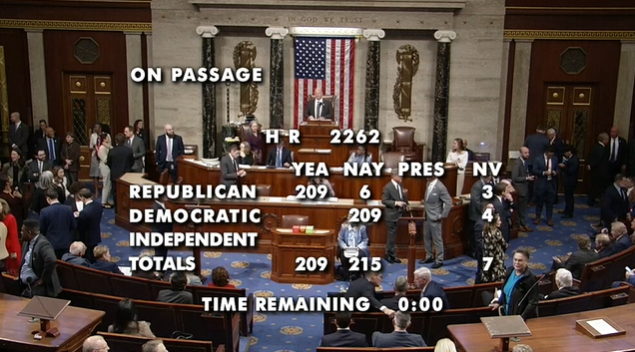
WASHINGTON — A Republican-backed proposal to change federal wage-and-hour rules so certain after-hours job training would not count as paid work time failed on the House floor Tuesday after six Republicans broke with their party and joined Democrats.
- Advertisement -
The measure, H.R. 2262, the “Flexibility for Workers Education Act,” was defeated 215-209 on final passage, according to the official roll call vote.
All voting Democrats opposed the bill, and they were joined by Reps. Rob Bresnahan of Pennsylvania, Brian Fitzpatrick of Pennsylvania, Nick LaLota of New York, Riley Moore of West Virginia, Chris Smith of New Jersey, and Jeff Van Drew of New Jersey. The bill’s defeat was notable in a closely divided House, where party leaders typically keep must-pass votes from reaching the floor unless they have the numbers.
What H.R. 2262 would have changed
H.R. 2262 sought to amend the Fair Labor Standards Act (FLSA) by excluding certain “voluntary” training from the definition of compensable work time if the training took place outside an employee’s regular working hours. In practice, that could allow employers to offer job-related training sessions after hours without paying employees for attendance and without counting that time toward minimum wage and overtime calculations.
Supporters argued the bill would reduce red tape and make it easier for employers to provide optional upskilling opportunities outside normal shifts. Critics countered that the proposal risked creating a pathway for employers to re-label required workplace instruction as “voluntary” or “education,” resulting in more uncompensated time for hourly workers.
- Advertisement -
How current federal guidance treats training time
Under long-standing Department of Labor guidance, training, meetings, and similar activities generally must be counted as paid working time unless specific conditions are met. The Labor Department’s Fact Sheet #22 on hours worked outlines a four-part test that, in general, requires training to be outside normal hours, truly voluntary, not directly related to an employee’s job, and conducted without any other work being performed at the same time.
Analysts following H.R. 2262 said the bill would broaden when training can be excluded from paid time, because it was aimed at job-related training offered by an employer as long as it met the bill’s “voluntary” and non-retaliation conditions and involved no productive work.
Florida delegation votes
Florida’s congressional votes largely tracked party lines. Rep. Mike Haridopolos, a Republican whose district includes Florida’s Space Coast, voted in favor of the bill, as did most Republicans. Florida Democrats opposed it along with the rest of their caucus.
Other votes pulled after the defeat
After H.R. 2262 failed, Republican leadership pulled two other workforce-related bills from consideration, according to accounts of floor activity and lawmakers’ statements. Those bills included the Empowering Employer Child and Elder Care Solutions Act (H.R. 2270) and the Tipped Employee Protection Act (H.R. 2312), both of which had been slated for consideration under the week’s rule for floor debate.
With H.R. 2262 defeated and additional bills pulled, the vote served as another example of how a small bloc of defections can derail leadership priorities in a narrowly divided House.
- Advertisement -