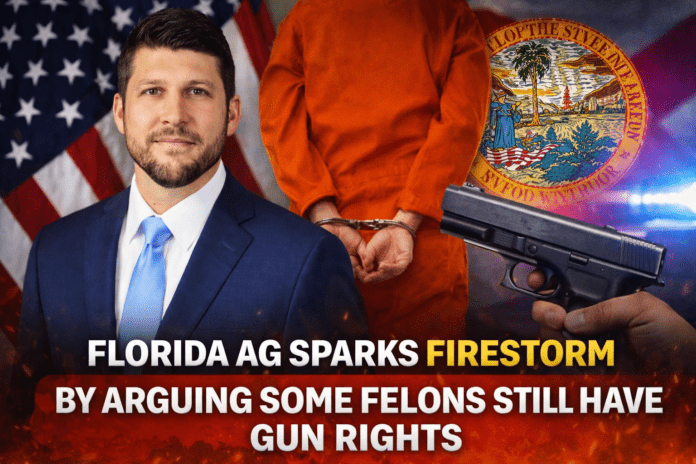
An unusual split inside Florida’s criminal justice system is now playing out in court, with Attorney General James Uthmeier arguing that some nonviolent felons cannot be categorically stripped of gun rights, while the state’s elected prosecutors warn that such a move would create confusion and weaken a long-standing public safety law.
- Advertisement -
Florida Attorney General James Uthmeier has taken the unusual step of arguing that the state cannot constitutionally disarm every person with a felony record, only those whose history shows they are dangerous. The issue is now before Florida’s First District Court of Appeal in Morgan v. State of Florida, a case involving Christopher Morgan, whose only prior conviction was a 2007 Pennsylvania felony for carrying a firearm without a license. After a 2022 traffic stop in Tallahassee, Morgan told law enforcement he had a gun in his center console and was later charged under Florida’s felon-in-possession law.
That law, section 790.23, broadly makes it unlawful for a person convicted of a felony, including certain out-of-state felonies punishable by more than one year, to possess a firearm in Florida. The statute contains exceptions for people whose civil rights and firearm authority have been restored, or whose qualifying record has been expunged.
- Advertisement -
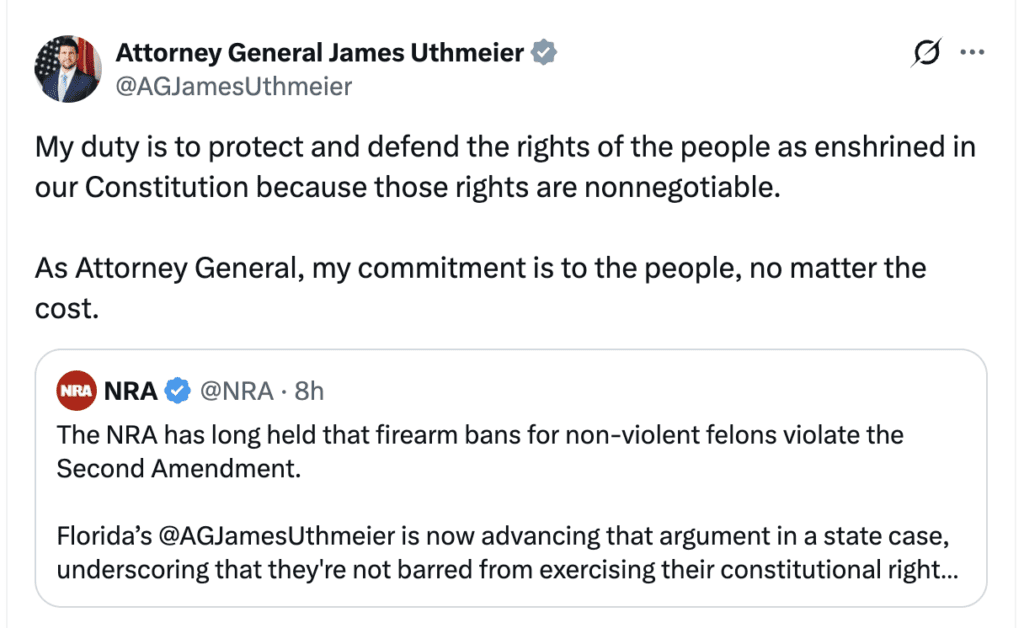
In a February filing, the Attorney General’s office told the appellate court it had changed its position and now believed Morgan’s conviction violated the Second Amendment. A later supplemental brief, described in the NRA-ILA article provided for this story, argued that Morgan remains among “the people” protected by the Second Amendment and that history supports disarming dangerous people, not every nonviolent felon as a class. According to that filing summary, the state’s new theory is that disarmament is justified for people whose prior offense or record shows a tendency toward violence or breach of the peace, involvement in potentially dangerous activity, or traits indicating their gun possession would threaten public safety.
Supporters of Uthmeier’s position say that argument follows the Supreme Court’s modern Second Amendment framework. In Bruen, the Court said when the Second Amendment’s plain text covers conduct, the government must justify restrictions by showing they fit the nation’s historical tradition of firearm regulation. Gun-rights advocates also point to the Third Circuit’s en banc decision in Range v. Attorney General, where the court held a man convicted of a nonviolent false-statement offense still fell within “the people” protected by the Second Amendment and could not be disarmed on the record before it. Uthmeier’s office is making a similar argument here, saying Morgan’s old Pennsylvania conviction, standing alone, does not prove dangerousness.
- Advertisement -
But the other side has substantial legal ammunition too. In District of Columbia v. Heller, the U.S. Supreme Court said nothing in its opinion should cast doubt on “longstanding prohibitions” on gun possession by felons and the mentally ill, calling such measures “presumptively lawful.” In United States v. Rahimi, the Court again pointed to those same prohibitions while upholding a separate federal gun ban aimed at people found by a court to pose a credible threat to others. Those decisions are central to the argument that categorical felon bans remain constitutional even after Bruen.
That opposition sharpened Friday when the Florida Prosecuting Attorneys Association filed a brief against Uthmeier’s position. According to News From The States, the prosecutors told the court that bans on firearm possession by convicted felons are consistent with the nation’s historical tradition and warned that recognizing a special category of “non-dangerous felons” would create uncertainty, confusion, and inconsistent enforcement. The group also argued that, from a constitutional perspective, all felons are dangerous felons, directly rejecting Uthmeier’s attempt to divide past offenders into dangerous and non-dangerous camps.
The dispute also matters beyond Florida because federal law independently bars people convicted of crimes punishable by more than one year from possessing firearms. And in the Eleventh Circuit, which covers Florida, judges have continued to uphold the federal felon-in-possession ban, saying Bruen and Rahimi did not overrule earlier precedent relying on Heller’s statement that felon bans are presumptively lawful. In other words, even if Morgan were to win under Florida law, the broader national question would still remain unsettled.
Florida does already provide a route for some felons to seek restoration of firearm rights through clemency, but reporting on the Morgan case says that process generally does not begin until at least eight years after completion of sentence. That existing pathway is one reason this case could become so significant. If the First District Court of Appeal accepts Uthmeier’s view, Florida courts may be forced to sort prior convictions into “dangerous” and “non-dangerous” categories on a case-by-case basis. If the court rejects it, the traditional rule remains in place and the constitutional fight will continue to build toward a higher court. Either way, the case has already opened a rare and public rift between Florida’s attorney general and the state’s elected prosecutors over how far the Second Amendment reaches.