Debbie Mayfield sponsors bill tied to $5 million request to rename Palm Beach airport for President Trump as Trump-linked company files trademarks for the name
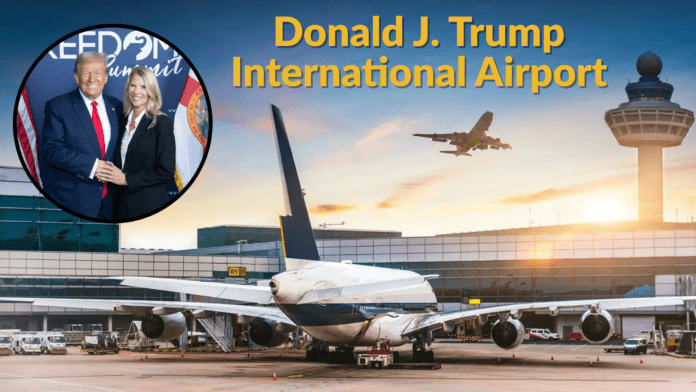
WEST PALM BEACH A Florida Senate proposal sponsored by Sen. Debbie Mayfield would rename Palm Beach International Airport with President Donald J. Trump’s name, while a Trump-linked private company has moved to secure federal trademark rights for the same airport branding.
- Advertisement -
The legislation, Senate Bill 706, is part of a broader measure that would shift naming authority for Florida’s major commercial service airports to the state. The current Senate bill text includes a specific rename of Palm Beach International Airport and makes that change contingent on federal approval and a commercial-use agreement with the rights holder.
What SB 706 would do
SB 706 would designate names for seven major commercial service airports statewide and, as written, require Palm Beach International Airport to be renamed “Donald J. Trump International Airport.” The bill states the Palm Beach rename is subject to Federal Aviation Administration approval and the execution of an agreement with the rights holder authorizing Palm Beach County’s commercial use of the name.
- Advertisement -
Committee language has also circulated that uses the longer title “President Donald J. Trump International Airport” and ties implementation to the county’s receipt of a $5.5 million appropriation for the rename-related costs.
The $5 million request and what it is for
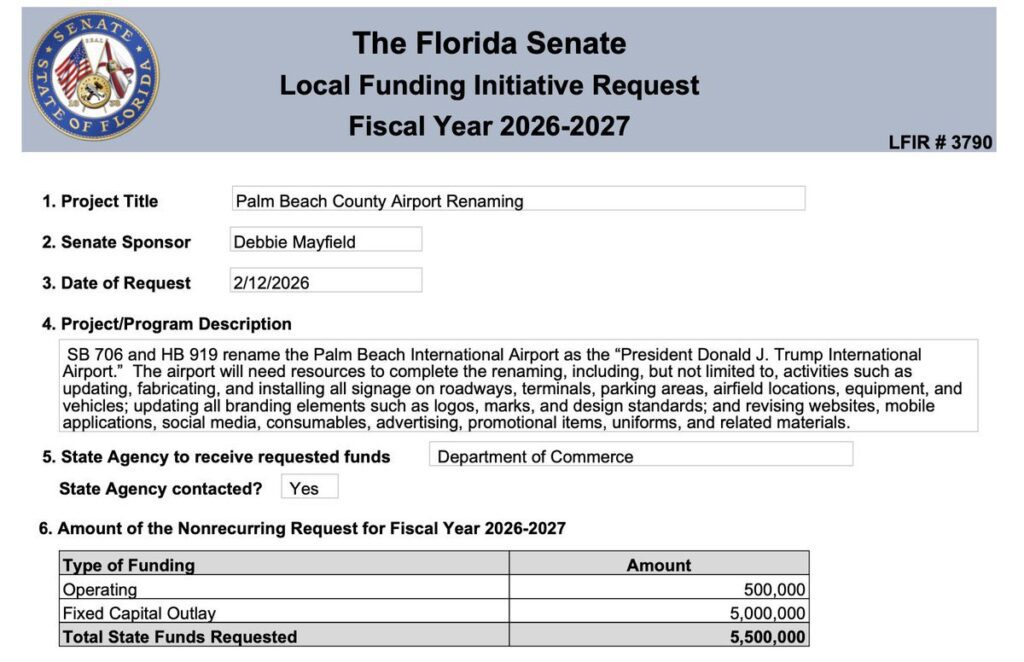
Separate from the bill itself, Palm Beach County’s airport renaming plan is spelled out in a Florida Senate Local Funding Initiative Request (LFIR 3790) dated February 12, 2026, listing Mayfield as the Senate sponsor.
- Advertisement -
The request totals $5.5 million and includes a $5,000,000 fixed capital line item tied to major signage replacement and a separate amount for consultant and contracted services related to rebranding and technology updates. The document describes broad changes, including signage across roadways and terminals, updated branding elements like logos and design standards, and updates to digital and operational systems (websites, mobile apps, social media, messaging systems, and other materials).
The trademark filings and why they matter
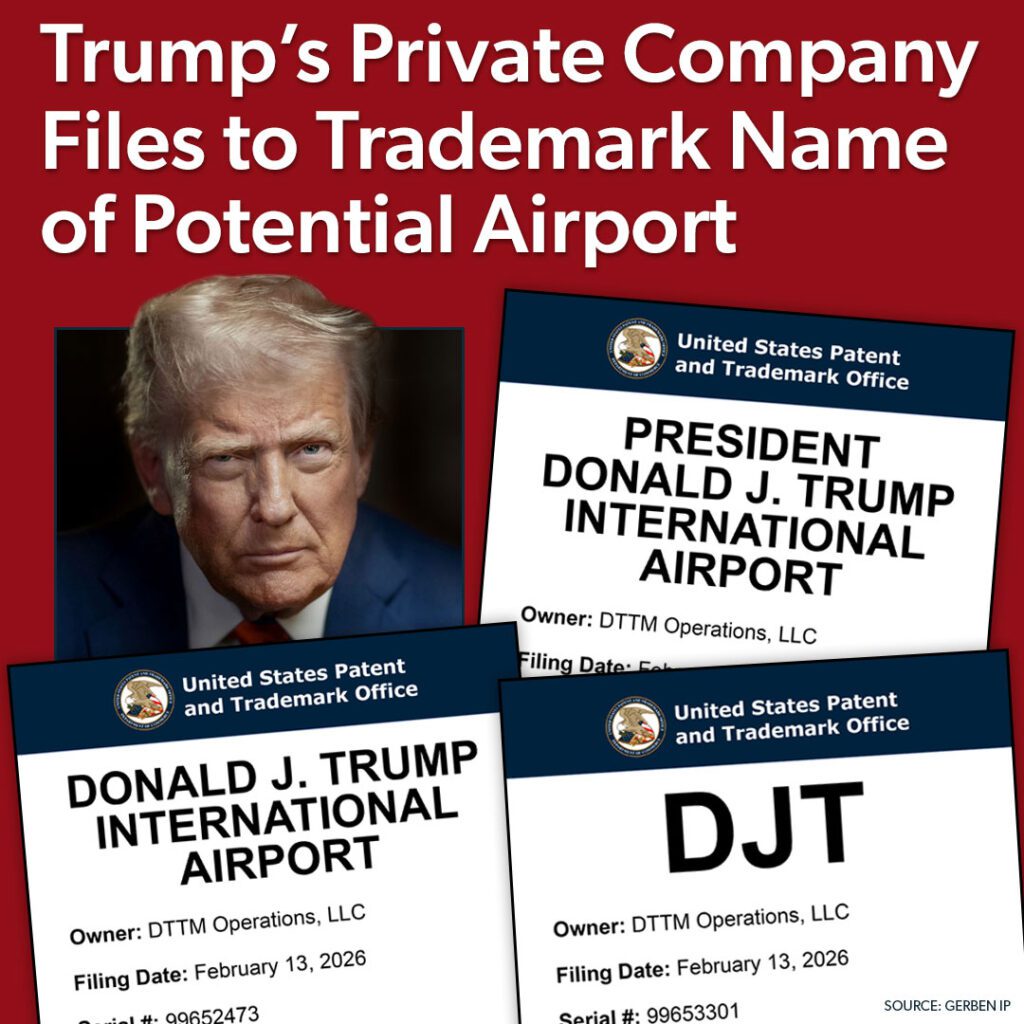
As the renaming effort moved forward in Tallahassee, DTTM Operations LLC, a Trump-linked entity that manages Trump-related trademarks, filed federal trademark applications on February 13 and 14 seeking protection for names tied to airport services, including:
“President Donald J. Trump International Airport”
“Donald J. Trump International Airport”
“DJT”
Trademark attorney Josh Gerben, who reported the filings, described the move as highly unusual because airports are typically named and trademarked by the government entity that owns or operates them, not by a private company tied to the person being honored.
The Associated Press reported the Trump Organization said the filings were triggered by the Florida bill and were intended to prevent misuse of the Trump name, adding that the president and his family would not receive royalties or licensing fees from the proposed Palm Beach renaming. The AP also noted the organization did not immediately address whether it would charge royalties for other airports or for merchandise categories included in the filings.
How a private trademark holder could profit, even if the county pays nothing
Even where a government’s own use of a name is free, trademark ownership can still create potential commercial leverage. Trademark rights can allow the owner to control certain uses of the name in commerce, including licensing and enforcement against unauthorized sellers.
In practical terms, if an airport actually adopts a high-profile name, it can become a consumer-facing brand that shows up on signage, wayfinding, advertising, and souvenirs. Gerben noted the filings extend beyond airport services into classic merchandise categories, which can support licensing programs for branded items such as travel goods and apparel. :contentReference[oaicite:8]{index=8}
SB 706 committee language attempts to address part of that by requiring an agreement that grants Palm Beach County a perpetual right to use the airport name at no cost for airport branding and related purposes. Still, trademark ownership can matter most for third parties, including private vendors, outside marketers, and other commercial users who may want to sell “official” merchandise or use the name in promotions.
Concerns raised in the Legislature
The proposal has also drawn attention because it is not only about Palm Beach. News Service of Florida coverage published by NBC 6 reported that some lawmakers raised concerns about the bill’s broader effect of shifting airport naming authority to Tallahassee, with debate about how easily future legislatures could attempt to rename other major airports. Mayfield, according to the report, said any attempt to rename other airports through the legislative process would likely face resistance from lawmakers representing those regions.
What happens next
For the renaming to occur, the legislation must clear the remaining steps in the Florida Legislature and receive the governor’s signature. The bill also contemplates FAA approval and a commercial-use agreement with the rights holder for the new name.
On the funding side, Palm Beach County’s LFIR outlines the scope and scale of the rebrand effort and lists an estimated completion target into 2027, reflecting the breadth of signage, branding, and systems changes that would follow a rename.
Editor’s note for readers: This story involves both a public renaming proposal and private trademark filings. The bill language, the funding request, and the trademark filings each carry different legal and financial implications, and the final impact will depend on what version of the legislation becomes law and what agreements are executed afterward.