


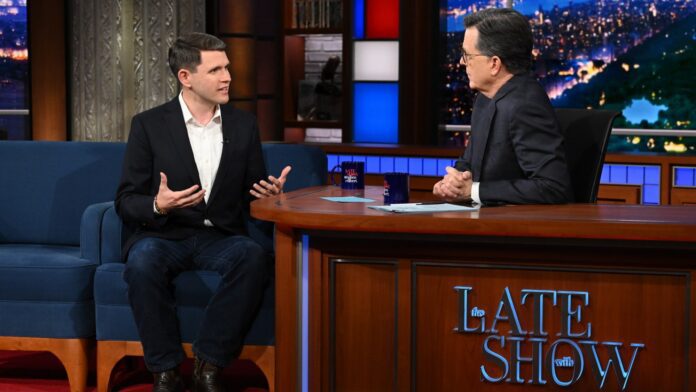
CBS PULLS COLBERT INTERVIEW FROM BROADCAST AFTER FCC CONCERNS
What does this mean for free speech and the future of political coverage?

Letter to the Editor By J. Carter Flynn
Columnist covering media, government, and public policy.
A recorded interview with a U.S. Senate candidate never made it to CBS air. Not because the guest backed out, and not because the host changed his mind, but because the network worried federal regulators might come calling.
The segment aired online instead.
If that sounds like a technical programming decision, it is. It is also something bigger. It raises questions about how speech gets narrowed in modern America. Not always by a direct ban, but by fear of enforcement.

Last week, Stephen Colbert told viewers that CBS chose not to broadcast his recorded interview with Texas Senate candidate James Talarico due to concerns related to the Federal Communications Commission and the equal opportunities rule. Viewers can watch the portion where Colbert addresses the issue here:
https://www.youtube.com/watch?v=oh7DPSP65JA
The full interview with Talarico, which did not air on CBS broadcast television, was later released online and can be viewed here:
https://www.youtube.com/watch?v=oiTJ7Pz_59A
The legal issue at the center of the controversy is known as the “equal opportunities” rule, often referred to as the equal time rule. Under federal law, if a licensed broadcast station allows a legally qualified candidate for public office to use its airwaves, it must provide comparable opportunities to opposing candidates who request it.
The rule was created decades ago to prevent broadcasters from favoring one candidate over another during an election cycle. It applies specifically to broadcast television and radio stations that operate under federal licenses. It does not apply in the same way to cable networks or digital platforms such as YouTube.
There are exceptions written into the law. Bona fide news interviews, news documentaries, and coverage of news events are generally exempt. For years, late-night programs have operated under the understanding that their interviews could fall within those exemptions.
What appears to be shifting is not necessarily the wording of the law, but how carefully networks are choosing to interpret risk.
According to Colbert’s public comments, CBS lawyers advised against airing the segment on broadcast television due to concerns that doing so could trigger equal time requests or regulatory scrutiny. Rather than test the boundaries, the network opted to release the interview online.
The FCC regulates broadcast licenses. It does not regulate YouTube.
That difference is now shaping what viewers see on traditional television versus what they find online.
Critics of this approach argue that it reflects what constitutional scholars call a “chilling effect.” A chilling effect does not require a government official to issue a direct ban. It occurs when the possibility of regulatory consequences leads media organizations to limit content preemptively.
Supporters of strict enforcement of the equal opportunities rule argue that the law exists to protect fairness. If one candidate is given airtime on a licensed broadcast station, others should have an equal opportunity to appear. From that perspective, networks exercising caution is simply compliance with long-standing law.
The tension between those positions is where the debate now sits.
This is not the first time equal time concerns have influenced programming decisions. Historically, networks have adjusted candidate appearances on entertainment programs to avoid regulatory complications. Congress even temporarily suspended aspects of the rule in 1960 to allow the Kennedy-Nixon debates to proceed without triggering equal time requirements for every declared candidate.
What makes the current situation notable is the visibility of it. A major network talk show host publicly stated that an interview was withheld from broadcast due to regulatory concerns. That acknowledgment pulls what is usually a quiet legal calculation into public view.
For many viewers, the immediate impact may seem small. The interview is available online. Anyone interested can still watch it.
But not everyone consumes news digitally. Millions of Americans still rely primarily on traditional broadcast television for political coverage. If networks increasingly shift candidate interviews off regulated airwaves and onto digital platforms to avoid risk, the information landscape may become uneven.
Some audiences will see more. Others may see less.
As the country moves deeper into another election cycle, decisions like this one will likely continue. Whether they are viewed as prudent legal compliance or as the early signs of regulatory pressure shaping editorial choices depends largely on perspective.
The broader question is this:
If fear of regulatory consequences is enough to move political interviews off broadcast television and into digital spaces, what does that mean for voters who depend on traditional media for access to candidates and ideas?
Criminal Defense
Bankruptcy · Evictions
WICKS LAW P.A.
Call or text for
free consult
321-733-2700
Eric Wicks, Esq.
1250 West Eau Gallie Blvd. G
Melbourne, FL 32935
Abogado Wicks habla español