


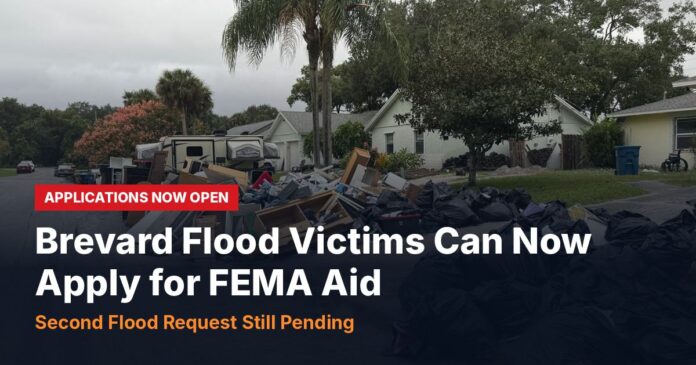
BREVARD COUNTY, Fla. – Brevard County residents whose homes were damaged in this month’s flooding can now apply for federal disaster aid. The official FEMA summary of the Major Disaster Declaration that President Trump approved Tuesday includes Brevard for Individual Assistance, the program that pays homeowners and renters directly.

UPDATE, Wednesday, Nov. 25: The declaration is now live on DisasterAssistance.gov, and applications are open. When the site asks you to select a disaster, choose “Severe Storms and Flooding (4956).” Step-by-step details are in the How to apply section below.
The declaration, numbered FEMA-4956-DR, covers “Severe Storms and Flooding” with an incident period of “October 31, 2026, and continuing.” It responds to the request Gov. Ron DeSantis filed on Nov. 9. It does not cover the separate expedited request the state filed Tuesday after the second round of flooding.
How the news broke
U.S. Sen. Rick Scott was first to announce the approval, a little after 7 p.m. Tuesday. He wrote on social media that President Trump had called to tell him the request was granted. Scott’s post did not say which counties were covered or which types of aid were approved. At the time, the declaration was not listed on FEMA’s website.
About an hour later, U.S. Rep. Mike Haridopolos (R-Florida) sent a press release titled “Congressman Mike Haridopolos Helps Secure Presidential Disaster Declaration for Brevard County Following Severe Flooding.” The release said the declaration lets eligible residents and local governments apply for federal disaster assistance. It included statements from Palm Bay Mayor Rob Medina, West Melbourne Mayor Andrea Young, Brevard County Commission Chairman Rob Feltner and Sheriff Wayne Ivey.

Haridopolos later posted the summary page from the declaration, which is reproduced in full below.
Who is covered
Individual Assistance (aid to individuals and households) was approved for six counties: Brevard, Indian River, Martin, Okeechobee, Palm Beach and St. Lucie.
Public Assistance (aid to local governments) was approved for Brevard, Hardee, Indian River, Martin, Okeechobee and Palm Beach counties. For now, it covers only debris removal and emergency protective measures, known as Categories A and B, including direct federal assistance. Permanent repairs to roads, bridges and public buildings are not included yet.
Hazard Mitigation Grant Program funding is listed as “Under Review.”
The governor’s Nov. 9 request listed nine counties: Brevard, DeSoto, Hardee, Highlands, Indian River, Martin, Okeechobee, Palm Beach and St. Lucie. DeSoto and Highlands do not appear anywhere in the approved declaration. Hardee was approved for Public Assistance only, and St. Lucie was approved for Individual Assistance only.
The summary says “additional designations may be made at a later date if requested by the State and warranted by the results of further damage assessments.”
The second flood request is still pending
Brevard was hit again last week, with parts of the county receiving 28 inches of rain or more. On Tuesday afternoon, the Florida Division of Emergency Management said the State Emergency Response Team had submitted an expedited request for a second Major Disaster Declaration covering Brevard, Broward, Flagler, Indian River, Orange, Putnam, Seminole and Volusia counties.
That request has not been approved. The approved declaration’s incident period is listed as “October 31, 2026, and continuing,” but the summary does not say whether damage from last week’s flooding falls under FEMA-4956-DR.
As of Tuesday, Brevard County Communications Director Don Walker said residents had filed 952 damage self-reports. Walker said “thousands of homes” were likely affected, but the full count won’t be known until FEMA tallies assistance.
A long wait
The approval came 15 days after the governor’s request. Earlier Tuesday, West Melbourne Mayor Andrea Young went on Facebook Live to ask the president to sign the declaration. On Nov. 12, U.S. Rep. Brian Mast announced that 29 members of Florida’s congressional delegation, including Scott and U.S. Sen. Ashley Moody, had signed a letter he led urging the president to approve it.
For comparison, the state’s request after Hurricane Isaias was filed Oct. 16 and approved Oct. 27 as FEMA-4955-DR.
The Space Coast Rocket previously reported on what Brevard residents needed to know about the governor’s request while the county waited on a federal decision.
How to apply
Residents in the six Individual Assistance counties can apply at DisasterAssistance.gov, through the FEMA app, or by calling 1-800-621-3362. As of Wednesday morning, the flood declaration appears on the site’s list of Florida disasters.
Pick the right disaster. When the site shows the list of Florida disasters, select “Severe Storms and Flooding (4956),” listed as Oct. 31, 2026, to present. Do not select Hurricane Isaias (4955), which is a separate disaster. FEMA says anyone with losses from more than one recent disaster must file a separate application for each one.
You will need a Login.gov account. According to the site, the application has three steps: you tell FEMA about your needs, you create a Login.gov account if you don’t already have one, and you return to DisasterAssistance.gov to finish and submit. FEMA says you don’t need every detail right away. Once your account is set up, you can save your progress and finish later.
What FEMA can help with
According to DisasterAssistance.gov, Individual Assistance can help with costs your insurance does not cover. That can include a small amount of money for emergency needs and for cleaning and sanitizing your home, plus limited funds for uninsured property damage, such as short-term lodging, home repairs and personal property losses. In limited cases, FEMA can also help with disaster-related child care, medical, lodging, moving and funeral expenses.
The application asks you to check every need that applies. FEMA says that if even part of an option fits your situation, you should check it. The choices include:
- Property damage: home damage, vehicle damage and personal property damage
- Emergency needs: food, clothing, shelter, gas, medication or medical equipment; access to your home; and loss of utilities
- Other expenses: funeral or reburial costs, lodging, medical or dental costs, new or extra child care costs, and home safety items
If you skip an option and later find you have that need, FEMA says you can call or visit a Disaster Recovery Center to update your application.
$770 Serious Needs Assistance
FEMA notes on the application that its assistance is limited. Households may qualify for Serious Needs Assistance only if their home was damaged, their home cannot be reached, or they have had an extended utility outage. Eligible households receive a one-time payment of $770.
If you have insurance
You do not have to file your insurance claim before applying with FEMA. However, FEMA cannot pay for losses that insurance already covers, and the site says FEMA will not provide money for those losses until it reviews your insurance settlement or denial. FEMA urges anyone with insurance that may cover some or all of their losses to file a claim as soon as possible.
If you are underinsured, meaning your insurance does not cover all of your needs, FEMA may still be able to help. FEMA does not pay deductibles directly, but the site says a FEMA award may cover some or all of a deductible.
Lost jobs and business losses
FEMA’s Individual Assistance does not cover lost jobs or business losses, but the site points residents to other programs:
- Unemployment: If you lost your job because of the flooding, you may qualify for unemployment benefits through the state. The U.S. Department of Labor’s CareerOneStop Unemployment Benefits Finder can point you to Florida’s program.
- Businesses: Business owners with losses, including property damage and lost revenue, may qualify for help from the U.S. Small Business Administration through the MySBA Loan Portal.
What to have ready
- Your address at the time of the flooding and a current phone number
- Insurance information, if you have it
- Photos of the damage and receipts for repairs, cleanup or lodging
- Bank account information for direct deposit
Full text of the FEMA declaration summary
DECLARED NOVEMBER 24, 2026
SUMMARY
STATE: Florida
NUMBER: FEMA-4956-DR
INCIDENT: Severe Storms and Flooding
INCIDENT PERIOD: October 31, 2026, and continuing
DATE REQUESTED BY GOVERNOR: November 9, 2026
FEDERAL COORDINATING OFFICER: Brett H. Howard, National FCO Program
DESIGNATIONS AND TYPES OF ASSISTANCE:
INDIVIDUAL ASSISTANCE (Assistance to individuals and households): Brevard, Indian River, Martin, Okeechobee, Palm Beach, and St. Lucie Counties.
PUBLIC ASSISTANCE (Assistance for emergency work and the repair or replacement of disaster-damaged facilities): Brevard, Hardee, Indian River, Martin, Okeechobee, and Palm Beach Counties for debris removal and emergency protective measures (Categories A and B), including direct federal assistance.
HAZARD MITIGATION GRANT PROGRAM (Assistance for actions taken to prevent or reduce long term risk to life and property from natural hazards): Under Review.
OTHER: Additional designations may be made at a later date if requested by the State and warranted by the results of further damage assessments.
This story will be updated.
Criminal Defense
Bankruptcy · Evictions
WICKS LAW P.A.
Call or text for
free consult
321-733-2700
Eric Wicks, Esq.
1250 West Eau Gallie Blvd. G
Melbourne, FL 32935
Abogado Wicks habla español